Brother Louie

TV Show: Louie | Place: FX | Watched: Netflix | Staring: Louis C.K.

I know this blog normally contains my poor attempts at discussing comicbooks, but I thought for the sake of writing away frustration that I would share a few thoughts on LOUIE.

LOUIE is an odd ball of a sitcom. A tale of a lonely, middle-aged father trying so hard to find a love connection in his post-divorce life. That may seem like enough, but Louie also have to put up with thoughts of image, religion, sex, and social standards. It may not seem like something you’d want to view with your free time as it’s always best to stray away from the unhappy, but it’s excellent television.

Don’t get me wrong, the show is absolutely hilarious. C.K.’s vulgar, questioning, and possibly offensive style influences the show to no end. If anything, LOUIE may be more of a realization of C.K.’s comedy than the actual bit he presents on stage. I just don’t feel that sums up the show, though. As mentioned, the subject matter isn’t exactly bright and shiny, and LOUIE never forgets this.

The audience sees splices of C.K.’s standup through each half-hour, but the meat of the show are the vignettes written and directed by C.K. These vignettes only seem to visualize C.K. stories when you first see them. The beginning of the season seems to ease you into what the show is really after, so up front the vignettes are short while the stand-up fills the majority of time. At this stage, everything is wonderful and the show still latches onto you while entertaining to the nth degree. Mid-season the vignettes take over, though. The show gets to business portraying more of C.K. himself. Granted, it’s a fictionalized version, but I feel it’s pretty obvious that C.K. lives this kind of lifestyle, minus a bit of exaggeration. The greatest thing is he’s not afraid to show it. LOUIE will go bleak at times. Episodes about God, scenes discussing child abuse, or explanations of the word “faggot” go past the territory of just making fun. The show actually begins to really question. Why do we live with such things?

There’s another element I find highly relatable. This is the story of a middle-aged man, but Louie’s luck with dating or just being social in general really clicks with me. The guy is lonely and lacks the motivation to find people. That’s me, and in someways the show scared the fuck out of me while also providing comfort. “I’m not alone” seemed like the appropriate phrase while watching this on a Friday night in my dark bedroom.

Seriously, for those who have seen the show. Season finale. The club scene. I’ve fucking been there.

The show has such a  strong and unique composition and vision, and the rotating cast never ceases to impress. It’s one of the rare TV shows airing on a basic cable channel that can still provide a challenge to its audience. I respect it. It’s Harvey Pekar molded into a Seinfeld cookie cutter, yet in someways it cannot be labeled.

Netflix Instant. Now, people.

Leave a comment

Filed under Uncategorized

Why Target One?

Originally written for PopMatters.com, but I’ll throw the unedited, direct version up here anyway.

The DC announcements, for now, are over, and we the readers understand the plan set for September when DC relaunches its publishing line and sets forth 52 new comic book series.

But I still want to talk about it. It’s big and, while already over discussed to death, this event will dictate much discussion by fans and critics alike for sometime to come. Most likely, years from now, the historians (you know, the comic book ones) will look back at this summer and the next 6 months to ponder what it meant in the grand scheme. Was this the moment to predict the end, or was this beginning of a new golden age? Or, was it just like any other renumbering we, the readers, see so often in the modern super-hero market?

True, there are these questions, but I’ll save those for the future writers and pundits. For now, another questions taps about my mind.

What’s the creative direction and tone?

With the brunt of the announcement, before all of the specific details, I immediately put forth an opinion on Twitter  that a relaunch is all good and fun, but for it to really make a mark, talent behind the books is necessary. I still stand by such an opinion.

Why? Comics sell and generate favor by their talent.

That should seem like common sense, right? That a good comic book sells well as a bad one sells poorly, and the focus of most readers is the artists and writers producing the work? Well, things rarely make sense in comics, and such belief has not always been the case. Instead, for most of its existence, the super-hero market has been dominated by fanfare and expectations of “what happens next,”which, in result, have created an environment ignorant of creative talents and the actual, real people involved.

But that’s kind of changing, now. Publishers are printing the creative talents’ names on the covers of super-hero periodicals, and the font size seems to be increasing each month. Readers now list their favorite artists and writers and name off their most notable works. The unofficial movement, positivity, and sometimes unneeded care of “Team Comics” chants and hollers for creator rights as well as exposure.

Comic readers are leaving the character/plot-driven mindset behind. They’ve entered the age of the creator being real. The internet has given their reading a new intent as Twitter and podcasts present live coverage of the behind-the-panel process. We watch writers, like Marvel Comics’ self-dubbed “Architects,” as if they are the stories and characters.

Understanding this, it would seem important that a new line of books be headed up by strong talent. And by strong talent, I mean writers and artists who both “wow” through quality but also possess a dedicated audience while holding a presence in the industry.

In an ocean of 52 comic book series, it’s very doubtful that even half are something worthwhile. But 15, maybe 20? That should be doable, and I feel DC may actually have a line up to do that.

Here’s a list for the sake of a list:

Justice League Geoff Johns & Jim Lee
Wonder Woman Brian Azzarello & Cliff Chiang
Aquaman Geoff Johns & Ivan Reis
The Flash Francis Manapul & Brian Buccallato
Green Lantern
Geoff Johns & Doug Mahnke
Batman Scott Snyder & Greg Capullo
Batman: The Dark Knight David Finch & Jay Fabok
Batwoman J.H. Williams III, Haden Blackman & Amy Reeder
Batgirl Gail Simone, Ardian Syaf & Vicente Cifuentes
Catwoman Judd Winick & Guillem March
Batwing Judd Winick & Ben Oliver
Swamp Thing Scott Snyder, Yanick Paquette & Francesco Francavilla
Animal Man Jeff Lemire, Travel Foreman & Dan Green
Frankenstein, Agent of SHADE Jeff Lemire & Alberto Ponticelli
Hawk & Dove Sterling Gates & Rob Liefeld
All-Star Western Jimmy Palmiotti, Justin Gray & Moritat
Grifter Nathan Edmundson, Cafu, & Bit
Action Comics  Grant Morrison & Rags Morales

Personally, not all of these announced titles float my boat, but I think this is a case where everyone could potentially receive a piece of the pleasure pie.

Example: the snobs and critics get their J.H. Williams’ book while the fans can happily read Batman by David Finch.

Both groups, both audiences of comics, have the selected few they follow in this now creator driven market, and I think DC has made it clear to have a nice, rounded group of creators to hopefully speak to and draw attention from all sorts of comic book readers.

Sell comics to all we can. Let’s not target one audience. That’s the plan.

And speaking of speaking to the multiple audiences, DC is in this move to hopefully restore sales and inspire new life-long comic book readers. Well, what better market to target with all of this mainstream press than the lapsed reader of 1996.

If you know comics, you know the 1990s were a big time. Spawn #1 sold a million some copies, and Todd Macfarlane probably bought a space shuttle with that money. Point is: comics were spread wide across the populace in the 90s, and it was a time for the industry to make a lot of money.

It seems like DC has the major players to possibly drum up that excitement again. They have just the right arrows to target those readers who left comics with the collapse of the later 1990s.

Jim Lee, Rob Liefeld, Scott Lobdell, and Bob Harras.

Two of the biggest artists of the 90s (plus, they are kind of iconic for the time), the guy who wrote X-men in the 90s (X-men was BOOMING in the 90s), and once Editor-in-Chief of Marvel Comics (in what decade? The 1990s when the X-men were BOOMING).

Three guys, arguably four, who were single-handedly responsible for the 1990s super-hero aesthetic. Now they are all in one place generating a comic book event whose scale could probably only be contained by an era such as the 1990s.

Coincidence? I think not.

As Bob Harras found his way to DC last year and Jim Lee became the new co-Publisher, they probably set out to make  a portion of their line 1990s inspired. It’s what these guys know and do.

That look and that vibe sold comics, and it was a time when the industry possessed a rapid energy. Now they are channeling and pumping that energy into this new, drastic course change in hopes to once again capture that 1990s Boom.

The issue is, it’s 2011 and I’m not sure I’m in the mood for another round of Jim Lee knock-offs or 17 Batman titles. I always find it better to progress rather than re-capture the past, but hey, DC is after the varied audience and this may bring back some of the 1990s faithful.

Plus, Morrison is writing Superman in Action Comics, so DC is certainly after something forward thinking.

Finally, for the best discussion yet on the DC Relaunch, all should listen to Episode 44 of the Wait, What podcast. Hosts Jeff Lester and Graeme McMillian bring in comics retailer Brian Hibbs, and they bring up very, very good points about what this could mean.

Leave a comment

Filed under Uncategorized

Writing is Personal. This-This is just Data Spill.

How’s it going?

This post basically says I’m alive and kicking. The blog (the one you’re reading) has been pretty lackluster as of later. Very little postage, and the posts made recently have been pretty weak – did you read that Scarlet write up?

I just want to say: don’t give up. I will still write. On this page.

Recent events and thoughts have just made me consider where my focus and energy is at. Specifically, my energy as a writer. Most could care less about my energy, but I do care, , and yeah, I’m figuring my focus out. I believe it’s just a matter of what I want from writing, and I’m starting to fall closer to the desire of personal pursuits.

You know, just being me. Like the final lyrics of  ‘Golden’ as Tyler, The Creator realizes who he is and Doctor TC fades out.

Could I be more vague?

Anyway, to make this post some sort of something, I will link a review I wrote for The Daily Athenaeum. The DA is West Virginia University’s student newspaper, and the review would be on Uncanny X-force, specifically the “Deathlok Nation” arc. Check it out. I liked it (the review, that is).

Also, I read The Mighty Thor #2 and no longer carry any interest for Matt Fraction’s Thor. Why? It’s simply more of the long, drawn out cape comics I am really starting to loose patience and interest for. But, why don’t I just copy and paste my mini Twitter rant on the subject? I thought I may have possibly tweeted something interesting for once.

I did like the first Fraction Thor story. The one Pasqual Ferry drew the fuck out of. Many weren’t cool with it, but I thought the story carried a cool epic poem aesthetic, and it seemed to have everything that makes a Thor story. I don’t know, I was into it. Anyway, here’s the Twitter stuff. Until next time.

– No longer hold any interest in Fraction’s Thor. Mighty Thor #2 is a mess of drawn of story with no sense of purpose.
– What is the direction or point of this? Odin’s preparing for something. Who gives a fuck?
– The comic looks fantastic. I love the team of Morales and Martin on about any artist and w/ Coipel they are doing something special.
– Maybe I keep buying it for that, but I don’t know. I could use the time and money on something else.
– I do believe the choice of long and drawn out is made by Fraction. He knows what cape comics are. He knows what the audience wants.
– So, he gives it to them. Nothing wrong w/ that. I just don’t feel his Marvel stuff, not all of it, is for me.
– But Casanova? Fuck yeah. I’ll be there, and I’m pretty sure he hasn’t lost that skill. The new Cas story in Gula #4 sold me on that.
– With him, I think it’s just a choice of how he is going to write. I would love to see the Casanova style brought to hero comics, but …
– … if Fraction doesn’t want to do that, well, he doesn’t want to that. I have no say in the matter.

– All of my tweets were speculation, of course. My opinion. I mean, this is Twitter after all. Want real shit? Read a book.

Leave a comment

Filed under Uncategorized

The Internet Blew Up

And I was off to the side, trying my best to be snarky on Twitter. In case you’re wondering, I feel I failed miserably. But, oh well. The Marvel Bullpen of modern day made up for my suckage.

So, DC, eh? This is a big deal. The Internet storm may appear just like any ol’ comics Internet storm, but this is no simple costume change or cancellation. This is a LINE WIDE costume change and cancellation. Heh. Sarcasm aside, it is big as DC is going ALL THE WAY with this. No pussy footing nor any hesitation. DC altered itself over night.

What I find most interesting though is the backlash from many people on twitter. Granted, comic fans are always the most prone to complain, and the lose or altercation of continuity is always controversial among the nerd contingent…but most people online, reading comics have wanted this, right? Especially the digital angle of this?

My friend Joey Aulisio (Chemical Box, Matinee Idles) made this point to me, and I immediately felt he was right. This is what most have wanted. I know I’ve requested a line wide reboot or a drastic change to hero comics aloud at least once or twice. Yet, the Internet cries and cries or acts as if this isn’t good enough.

Not good enough?

What else could DC possibly do? Give the books away for free?

The day-and-date digital aspect is the bold move, though. Continuity and costumes aside, super-hero comics will still be super-hero comics. The digital direction will really bring the change, whether it is for better or worse. Brick-and-mortar comic stores will see some effect, and I highly, highly doubt Marvel ignores such a move. Not saying to expect a Marvel announcement next week or anything. This is more of a “wait and see” action. Either DC strengths the digital market in a big way, or DC proves that the world really doesn’t want digital comics. Either way, this may be the telling tale of the oh so talked about digital comic book.

And, possibly, the down fall of the physical direct market.

But, yeah, I’m sure you’ve heard enough “doom” talk at this point.

Personally, I actually want digital comics to fail to some degree. Not a total failure, just not enough success to make it the mainstay. I’ve said it before, and I’ll type it now; the industry needs an even mixture of both print and digital. Balance always seems to be the key to life, and I am willing to bet balance in this situation will work just the same.

Let’s see what happens.

As for the DCU, I need talent on these books. 52 new titles is A LOT of comics, and only 10 strong books will not cut it. If DC really wants to make this work and keep this excitement post the initial announcement and hype, they need quality and artists who will make people talk issue-to-issue. So far, from what has been announced, I feel there may actually have a shot at this. First off, even though I have been low on Geoff Johns before, I have to say the Justice League team is good. If DC wants to capture the spirit of Marvel’s Avengers franchise, which I feel they do, this is very smart of them to put the company’s top two on a book like Justice League.

Brian Azzarello and Cliff Chiang on Wonder Woman? There’s the energy that character desperately needs. Azzarello has wrote off mainline DC projects before, but I don’t know, I feel if he is working with an artist of Chaing’s caliber, the result could be different this time around. We know it will at least look good.

Manapul writing and drawing Flash. Again, energy. Whether Manapul can write or not, I almost don’t care. That dude can draw. But it is a writer/artists project, and I like that DC is continuing this experiment even though Finch’s Batman went no where and Daniel’s Batman wasn’t all that. Comics still needs writer/artists, and Manapul may have the special juice to do it well.

Johns/Reis Aquaman will make people read. Hell, I may even give it a shot.

DC Universe Presents sounds interesting, and Bernard Chang is drawing some of it.

Those five projects announced, and we haven’t even heard of the Morrison or Snyder projects yet. Plus, DC does tell of more new talent doing work.

And, I bet the J.H. Williams Batwoman shows up at some point. Would explain the long delay on the series.

My question, though, is where is Chris Roberson in all of this? The man came in on a terrible Superman run and somewhat saved it for people. Plus, the dude writes a Vertigo book for Mike Allred. Hello?

Even if this fails, I feel we always have to respect DC to some degree for this. They took the risk, and honestly they went from second stringer to suddenly taking all of the industries attention for the rest of the year. DC is pushing the game right now. Especially, again, with this digital thing.

And, hey, Flashpoint went from the event few cared about to probably the series everyone watches. Smart business move  by them. Flashpoint now sells more. Fuck, I’ll probably buy it because, well, I know I come off as cynical a lot, but honestly I am excited about this. I like the DCU very much. To me, the DCU is super-hero comics, and I like the idea that DC may finally publish a few good, exciting super-hero comics.

My eyes are glued.

Leave a comment

Filed under Uncategorized

Some Things Just Don’t Change

Brian Michael Bendis means many things to many people, but for the longest time Bendis, to me,  meant company bullshit and the error of super-hero comics. I’m not necessarily sure why. I think it was a matter of his position and the frustration I felt toward Marvel. You see, they raised prices at the time of my highest “hate,” and, well, I was one of those “3.99 protesters.” I know, I know. Something I should probably keep hidden nor does it really have anything to do with Bendis,but whatever. I was there, and I’m past it now that I actually read my comics…Anyway, Bendis…not my favorite dude in the heyday of late 2009/early 2010. His books were 3.99, his Avengers did plenty of talking, and Siege was on the horizon.

“Fuck this guy,” I thought. “My days of Ultimate Spider-man respect are gone.”

Taking Marvel Readers for the usual spin, Siege came and went, but while so, news broke.

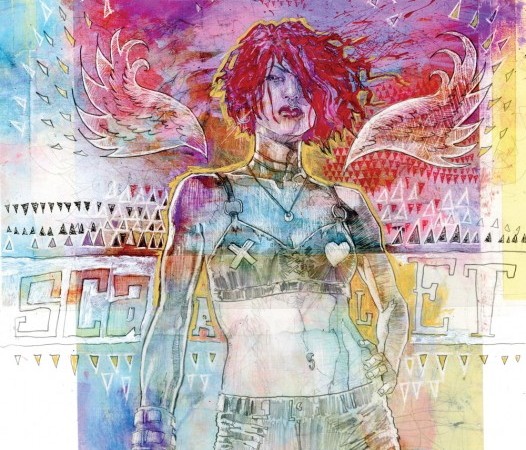
“In July, writer Brian Michael Bendis and artist Alex Maleev examine those questions and more when “Scarlet,” their new ongoing, bi-monthly creator owned series from Marvel Comics’ Icon imprint, begins. We spoke with Bendis about the project…”
Comic Book Resources

July, Bendis back to his roots, and I gave it a shot. Boy, I’m glad I did so.

Scarlet’s still some sense of the traditional Bendis. Characters talk while stories span more than a few issues. There’s even that sense of slow down mid-arc while the last chapter inspires thoughts of, “what happens next.” Bendis writes this book through and through. No doubt about it. On a larger playing field though, this book resembles something like a rejection slip or a mighty middle finger aimed at all the nay sayers and labels. Yes, in some sense, this is Bendis’ Recovery. Here’s the album where the artist, while not totally reinvented, comes out and exclaims, “I’ve still got it.” That “it,” in this case, would be Bendis’ ability to bring something a little different and exciting to the comics market.  Scarlet proclaims Bendis’ right to still be in this game.

Part of the Scarlet’s statement simply comes from the creator-owned aspect. We have this odd perception in the comics scene that when a creator goes creator-owned it means some sense of “rebellion.” Kirkman, I think, is owed much thanks for this perception. The original Image guys inspired this idea nearly twenty years ago, but I think for this current era Kirkman steals the show. That manifesto went a long way, and it still lingers in the air now. He, whether he wished it not, made creator-owned this quasi-bad boy act where the artist can tell the company man to fuck off and seemingly be ok.

Not saying Bendis is telling Marvel to fuck off – that would honestly make no sense -, but the bare aesthetic of a creator-owned comic encourages thoughts of breaking the mold. Scarlet being Bendis’ first major creator-owned work since Powers, the book that got attention, says something about the writer’s place as of now. After ten years of being Marvel’s go-to boy with an on-and-off creator-owned book floating in the background, Scarlet makes us all suddenly question. Is Bendis just the “Avengers guy?”

That answer would be no. Our attentions are so caught up in who this guy is today that we forget Brian Michael Bendis wrote and drew as an indie comics creator. Before Ultimate Spider-man, the world knew Bendis as Fire and Goldfish. And Bendis still talks about these books, more than a decade later. Listen to any Bendis Tapes on John Siuntres’ Word Balloon Podcast, and I bet Bendis will name drop a few of those early books. Why? I think they are still strongly attached to him. This isn’t a guy who found a Marvel gig and said, “Ok, now I start.” This is a guy who loved doing his early stuff, and he never tries to cover it up. Bendis still pushes copies of Jinx and Torso; he wants the world to know what he’s capable of. Scarlet, and really this entire wave of new creator-owned material from Bendis, is another step in that direction. A certain amount of it disproves the majority perception, but another piece of the pie is a return to form. Bendis’ core, I think, is creator-owned, and Scarlet exists as a call back to that.

But it’s not all in the book’s appearance and identity; the story itself holds meaning. This book kicks off with a female protagonist who, right out of the gate, strangles a man and tells us why. The bare action isn’t the point, though. The “how” is.

Scarlet breaks the fourth wall. The technique should clue us in. The author wants to talk. Let’s look at this line: “I’m sorry to be right in your face like this. I know you were looking for a little diversionary fun. I know you were subconsciously hoping you could just watch without any of it actually involving you” (Issue 1, Pg. 4).  Hmmm. Involving “you.” This goes back to my idea typed above. While Scarlet in the story is on a mission to instigate revolution and wants “your” help, Bendis is clearly speaking for his own cause here. The thought of looking for some “diversionary fun” without involvement so sums up a majority of comics readers and specifically the readers invested in Bendis’ Marvel work. Stuff like Avengers and the event books are so spelled out, and people read them as diversion. I mean, that kind of is the point of entertainment, but comics readers, as most on the internet should know, take the concept of thinking and multiply the aspect of pain tenfold. Remember Final Crisis? Yeah, people bitched. Why? They wanted the story’s “hows” and “whys” spelled out.

Bendis’ work kind of contributes to this. His style of storytelling, the decompression we’ve all come to love, is the norm in today’s mainstream comics. It’s become Marvel’s house style of writing, and it’s possibly conditioned readers to be, well, lazy. Decompression lets everything see time on the panel. Thought needs no part of the reading process when the writing is such because the writer can literally tell you everything.

But Bendis wants “you” involved in this one. He wants “you” to think and contribute. He, again, wants us to see him differently.

This opening houses another important aspect, though. Maybe more important than the line about contribution. It’s how it’s written. When we think of Bendis, we think of dialogue and long scenes of transacting characters. It’s the Bendis trademark. Scarlet breaking the wall reminds readers of that and reminds in a fresh way. The opening scene jolts us. It’s Bendis writing dialogue but not in a fashion we expect. Characters sit no where near a table, but rather one pissed off woman looks directly at us. Sure, she delivers a few lines of meta statement, but her plain action almost says more. She’s just talking, but she’s taking the Bendisism in a different direction.

Bendis, because of his sometimes overuse of dialogue, has lost some of his shine. Rather than it now being his gift, dialogue has almost become his curse, and it’s not something readers look forward to but rather dread. This opening feels like Bendis taking control again, though. The switch in approach makes the dialogue feel special again. The moment sounds a lot like the opening seconds on Eminem’s “Cold Wind Blows.” The exclamations of “I’m back” and “Some things just don’t change” seem appropriate in this moment. It’s Bendis doing his finest Bendis and showing that he is still the guy for dialogue. No one does it better.

The story continues as Scarlet opens up her operation and rubs the dirt further across her hands. Cops die and pressures increase, but the series unfolds in other ways. I want to point out the statement made by this comicbook, but I also feel it shouldn’t be limited to that. Scarlet has more to offer as a story. Namely, the use of a female lead. For a tale about rising up and speaking out against oppression, following a woman around seems like the only right idea. The male voice could make a point here, and maybe convey some similar feelings, but making the character female brings much more by simple nature of context. Plus, Bendis has history with the lady lead, and Scarlet makes a lot of sense in his larger body of work. Jessica Jones meet Scarlet.

But, yes. The context. This is the woman taking back her world and executing revenge on the men who made her suffer. Sounds about right. Where on the surface Bendis shapes Scarlet to represent the common, downtrodden, middle class person, Scarlet herself takes on another shape. She’s a symbol. A symbol for what we are told and a symbol for the woman as an entity. Here’s a woman who feels the need to speak and speak loud in a culture where men seem to make the rules. Plus, she’s tearing down the rules and citing them as wrong. It’s almost like this woman scorned is the release of hundreds of years of built up aggression. The denial of school, jobs, voting, and sexuality are all being voiced against right here, through Scarlet. Maybe Bendis wants that, maybe he doesn’t. I see it, though, and I think it’s impossible not to because the fiery red of Scarlet’s hair and the show of midriff only catch the eyes.

So, to wrap up, I blame this book for my resurgence of Bendis reading. While not necessarily something game changing or even solid, Scarlet shows me that Brian Bendis can still make a point and make a comic with a layer or two. I lost faith in this dude for a while, but it feels like Bendis is hitting a new creative stride. He still needs to speak and deserves to do so. He still makes interesting comics. I’m happy about that.

1 Comment

Filed under Uncategorized

One Day We’ll Win

Alt. Comics. I know little about them.

I know there’s a MOCCA arts festival, and I know the names Robert Crumb, Chris Ware, Harvey Pekar, Daniel Clowes, and Jeffrey Brown.

That’s it. And I’ve never actually read anything by any of those names. Except Clowes. I read Wilson.

I am fascinated by the scene, though. The personality, the technique, and the “art” keep grabbing at my eyes. But hero comics won’t let me go, so I hold back the full dive into alternative. One day, I figure. For now, I stay where my heart’s at.

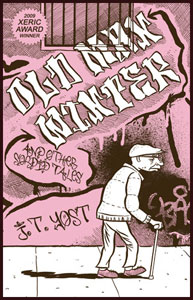
There does exist one alternative artist I feel confident in “knowing.” His mini comics found home with me by way of a friend. They were cluttered in with an assortment of items handed off to me. For a while, they lay dormant with the rest of my ‘to read” pile, but at some point the work of J.T. Yost caught my attention. I’ve purchased all of his books since.

The end.

I’m kidding. That would suck as a blog post. So what made Yost’s work impressive? For starters, the generous amount of breasts splattered about his pages made reading quite enjoyable.

Again, kidding. I’m bad at jokes, I know. No, what made Yost impressive came down to a matter of voice. His comics utter something unique and worthwhile in terms of perspective. This may be insignificant in the world of alternative, personable comic books, but I don’t know, voice is hard to do. I’m speaking from my own experience, you know, writing these blog posts. Active voice, points, organization – that shit is cake. Sounding distinct? Whole other game. J.T. Yost, at least from my context, sounds like his own man.

His focus sticks to the everyday man and the idea of bearing witness, and his work captures that focus in a very blunt fashion. Yost has produced several mini comics and one-page stories, but his “Losers Weepers” series speaks the most about his work. The premise of Weepers is part catch, part emotion. Yost builds his story from a handful of random letters and notes he has come to possess. These letters are in no way directed at him, as most have been found on sidewalks, in parks, or on bulletin boards, but Yost looks into the words communicated and does his best to imagine the world of the person writing. From this, Yost hones in on a themes of defeat, perseverance, and stress.

Yost’s true talent resides in his ability to communicate emotion. A certain amount of it comes from the pure subject matter, but another half lies in the technique. His artwork holds an expressive style, and much of its power originates from the roundness associated with Yost’s figures and objects. While I certainly believe emotion can seep through blocky or angular line work, the roundness in Yost’s brings out a soft quality that really drives home the feeling. Everyone appears vulnerable and slightly bruised, and the backdrop, the setting, feels equally worn.  Yost can jump over to generous detail too. At times, backgrounds are completely absent, but at some point a full page splash showcases his printed world. These moments put the story into perspective, and they show you where these characters come from. They suggest an environment which is out to get you, or at least pester you.  

It’s the characters that stand out as well. As Yost uses story to walk in another’s shoes, he crafts characters to work as the men and women we see everyday. A single mom, an ex-boyfriend, and an immigrant – all archetypes in a way. Further connection comes from this element. These are figures we can easily believe in and may even know in our own lives, and Yost’s narrative gives us a little glimpse into that world. He holds little back too. It may come more from the format, but Yost gets right to the events in his story. The pacing can seem a little quick at first. Most characters seem to sometimes spontaneously act out, but after sinking into the narrative it all seems natural. As if, the rules of Yost’s story world dictate a universal bluntness. I like it. The story doesn’t waste time yet moves comfortably and gets to the point. The pacing helps shape these mini comics into short vignettes that stand out.

I don’t know. My knowledge is limited, but I dig J.T Yost’s comics. I probably own most if not all of them, and I will continue to follow his future exploits. This guy has something, and his talent as a story teller is impressive.

Now, if you’re interested, you can listen to me interview him. But. I warn you. This interview is weak. I blame me. J.T. speaks well and has much to offer, but my questions are lame and predictable. Also, as stated, I know nothing about alternative comics, and this is J.T.’s background. The interview sounds like two guys on two separate wavelengths. Listen at your own expense. Here.

You can also buy the dude’s comics. I highly recommend such action. Do it. Losers Weepers #3 is his new one.
http://birdcagebottombooks.com/

6 Comments

Filed under Uncategorized

Thoughts: S.H.I.E.L.D. #1-6 + ∞

A Marvel or DC comicbook breaking the mold, in any fashion, deserves some sort of credit. Why? It’s not easy for a mainstream book to push forward. The editorial hurdle stands tall, and it preaches a pattern of slow pace and continuity. Any light of experiment in a mainstream book, especially in these modern times, is, honestly, quite the achievement. While Jonathan Hickman’s S.H.I.E.L.D. stills functions within the Marvel house style, the book  does showcase an element or two that make its narrative unique. Namely, the characters and their function.

The cast includes Da Vinci, Issac Newton, Nostradamus, Nikola Tesla, Michelangelo, the fathers of Reed Richards and Tony Stark, and some kid (whose name I honestly forget), and after six issues I honestly feel I know none of them. At least, not as I would expect when reading a Marvel Comic. Hickman characterizes and defines his cast, but he does it in more of a archetypal way. Da Vinci stands in as the good, smart guy with a pocket full of ideals, while Newton functions as the bad, smart guy concerned with selfish development.  They go no farther than what the reader would already know; it’s pretty obvious and well-known these guys were smart. The bad and good, the ideals and selfishness are the only new bits. Even those stick to the archetypes. The combination of those specific qualities is nothing new in terms of heroes and villains.

And yeah. Mr. Richards and Mr. Stark are a lot like their sons. Not necessarily archetypes, but they work as stand-ins for characters we already know. Nostradamus speaks the future while burdened by the knowledge he carries. Tesla and Michelangelo are mysteries.

None of it goes farther, but it surprisingly works.

Hickman sacrifices character for idea in S.H.I.E.L.D. There is a cast, yes, and members of it seem to be experiencing an arc, but their “existence” doesn’t seem to mesh in a traditional sense. The characters feel hollow, almost: just shells for concepts rather than actual characters. That’s what Newton and Da Vinci are in this series. Hickman takes entire issues to examine the two to show their concept and not their actual character. Maybe that’s confusing and maybe the book cold better from a strong, developed cast, but to me the hollowness is intentional. For two reasons. One, this isn’t about characters; this is about knowledge, human potential, and more. A writer could write high ideas and character complexity, but leaving the character out helps the reader hone in on the series’ core. Plus, the appraoch gives the book an attitude – an attitude that says, “this is what we’re about.” This is the first volume or prologue after all. To Hickman and the story, it’s important we understand what this is from the beginning.

Second, the hollowness or lack of character centric plot breaks the Marvel mold and helps the book stand out in a sea of simularity. Marvel books center on characters, and S.H.I.E.L.D. does not. It’s simple, but the difference alters S.H.I.E.L.D. in a big way. Many during its monthly release, including myself, said that at some point the book’s plot would come together in a recognizable thread. Truth is it was there all along,  just not in a form we expected. The focus on ideas rather than some lead figure changes the way we read it. Comicbook readers, specifically mainstream readers, make a point or just instinctly know to attach to a character. That’s our anchor point and guide; characters are the heart beat of most stories. S.H.I.E.L.D. throws us off when we cannot find a character to grasp onto. We suddenly begin to read differently as we search for a plot thread, and S.H.I.E.L.D. gains a sense of narrative identity by doing something a little different.

I like how Hickman achieves this, and I like the result. I find it smart and stylish. The pacing of S.H.I.E.L.D., however, sticks close to Marvel’s current style. Yeah, I know, I couldn’t let it get away completely. It does, though. The narrative follows a different pattern, but its actual flow plays it pretty safe. Marvel books, excluding Rick Remender’s stuff, share a common ground of slow pace. What do I mean by that? Plots unfold and declare themselves sluggishly. Everything is little drawn out and everything has a wide screen, absorb this kind of tone. Plots and their visuals feel almost a little big for the printed page. Everything feels a little too serious, and specific moments see specific attention. Most would probably call this “decompression,” but I’m not sure what to call it. I just know this exists, and the thread runs all across books by Bendis, Brubaker, Fraction, Millar, Gillen, and probably others. S.H.I.E.L.D. falls into this slump just by its structure. 

It’s not a terrible thing by any means, but it is nothing different. On some levels, I feel Hickman does a wonderful job structuring this comicbook. I love how the first three issues unfold. We go from a classic first issue with everything in your face to two issues focusing on two sides of the same coin. Hickman gives you everything in the first half of the prologue; then, everyone meets in issue four to go nuts in the second half. But, as I just typed, it takes Hickman HALF of this first volume to setup his world. HALF. That’s a lot of time, especially when you consider this book’s “every other month” scheduling. Slow pacing: that’s the draw back of most Marvel/DC books.

S.H.I.E.L.D. does enough to break away though, and as stated at the top, the smallest action to experiment is just enough to give a mainstream book credibility. And the writing stands complimented. Dustin Weaver, what can I say? He brings this book home in a lot of ways.  There is a certain cosmology that comes when creating a book like this, and Weaver understands that. The big panels and detail he provides echo Hickman’s intended focus, and he gives Hickman’s point a visual look. 

I don’t see S.H.I.E.L.D. keeping this chosen style of narrative – the infinity issue makes it clear that Hickman wants to develop his cast as he seeds background and plants motivation- but for what it’s worth S.H.I.E.L.D. volume one feels different enough. The story certainly pulled me in, and I still feel Hickman has something to say. That’s what matters, right?

1 Comment

Filed under Thoughts

Let’s Talk Comics

I disagree a lot. My rebellious, youthful anger may contribute to that, or maybe I’m just a dick.

I should stop writing this post. Right now. In the end, these words will do harm and provide a bad representation. I bet most walk away from this post shaking their head. I bet some understand. Maybe one will applaud.

Or everyone just won’t care. (Probably this one.)

Stick till the end, though. The conclusion may differ from the heading. 
 
I care little for characters or plot.  
I care less for continuity or universes.
I read for execution.
I read for craft.
I love art, and I love storytelling.
Their application fascinates me.
Artists and writers applying them well …
… fascinates me more.

Yet, I read mainly Marvel and DC super-hero comics. I should not. My perspective probably flows more with a PictureBox crowd than a Hulk crowd. I might fit right in over there. You know, chatting about page composition and narrative structure and, of course, conversing about how flowers in one specific panel represent the backwards nature of the universe…

Yet, I read Savage Dragon every month, and I enjoy it. I enjoy super-heroes; they embody comicbooks through their basic visual appeal, and I smile at their wackiness and bright colors and punches. I just want to talk about them differently. Why? I tire from hearing everyone else’s discussion or point. Everyone else either fulfills the expected fanboy quota or offers lackluster criticism.

Well, not EVERYONE obviously, but the internet sure feels that way some days.

Everyone lets comics slip to something simpler. They ignore the makeup and construction in favor of price tags and Spider-man joining a team. No wonder the outside looks down on us. We give them reason. We tell them Spider-man and the Fantastic Four are friends, for christ’s sake. We portray these fictitious elements as truth. No wonder they look down. Our conversations doom comics to a poor reputation.

I probably should not care. At all. What stake do I hold in it? None. Comics live on with or without me. I love them though, and I cannot help but feel a burn when I read someone’s poorly conceived notion of critique. If I disagree, I yearn to jump into the conversation and shout, “no!’.

As mentioned, I love super-heroes, but I tire of how they are talked about. Continuity and plot need to occupy the backseat for a bit while craft and design grab the wheel. Let’s talk Marvel and DC like they are PictureBox. Let’s talk art or maybe lack of – however you see it, really. More exists on those pages than most let on to believe.

Of course, most stay put in their outlooks and keep comicbooks as strict surface entertainment.

The post may turn around right here. Or dampen.

I cannot argue this, really. I mean, comics do act as entertainment, and they are sold as entertainment. Why shouldn’t people be entertained and be entertained by the plot and surface material provided? That’s why they purchase it. Unlike myself, most people work traditional jobs and have families and obligations. Comics become that one moment in the day where they can relax. Why not allow them that? How can I argue that choice to read in a particular way? I cannot. They have every right.

These people who jump online, though…Obviously they put in extra time so why not read a bit closer? For all the individuals who bitch about price and “3.99,” you may feel a greater satisfaction by spending a little more time with your purchase. For those hitting up the message boards or recording a podcast, do a little homework and make your point worth a person’s time. Just a thought.

I would love more discussion on comics’ craft and execution. I believe it would take us away from the usual “comicbook guy” tropes. It would take us to another level of fanhood. The truth of the matter? DC characters and their magenta rings dominate the discussion and attention. That’s the extent of the reading experience.

What do I know, though? I’m probably a snob because my tastes and outlooks are slightly pretentious. Very few will agree with me. Most will shun me. I guess I will bite my lip, not step on toes, and keep my voice here to my blog. Best I can do.

And there lies the finish. Granted, there be plenty of exciting comics discussion online. Just not the majority. But, for the sake of linkage, here are voices that must be heard.

Sean Witzke, Chad Nevett, Tucker Stone, Tim Callahan, Jason Wood, David Brothers, Peter Rios, Matt Seneca, Derek Coward, Savage Critics.

Leave a comment

Filed under Uncategorized

No Clever Title Needed #4

Bits of info that go no farther than this.

I’m expecting to be busy this week, so this post is it for the next few days. But, hey, I updated three times last week. I’m happy with that, especially since my writing made a little bit of progress. At least I felt that way. (Just read the First Wave post and compare it to anything previous). My writing still needs work though, and I’m not afraid to admit it. Most posts I write hold a “clunk” in their flow and my word choice lacks, but I’m working on it. I’m searching for the right flow, I’m cracking the code of verb choice, and I’m finding my voice in the words. I’ll crawl my way there. I hope.

Last week was good, though. The Chemical Box, after a four month absence, finally made its return. For those on the outside, The Chemical Box is a comicbook centric podcast hosted by Joey Aulisio, Just Jean, Chris Johnson, and myself. Why absent that long? Every other time we recorded, the show went sour. Plus, I had a bad case of “radio-Alec,” and I kept taking away from the show by trying to sound pro. Lesson learned. I’m loosening the tie and using podcasting as the escape. As it should be.

Listen in, though. We should be somewhat consistant now. link.

—————————

Erik Larsen took some shit last week. He tweeted a few thoughts on web comics, and people went crazy in true internet fashion. Larsen said:

Every crappy submission can “see print” on the web–every reprint book that would sell three copies in print would work on the web. The web is the great equalizer. Every crappy thing can get tossed up there. If it all went digital nothing separates a pro from an amateur. Print is far more discriminating. There are fixed costs which can’t be ignored for long. It’s not the wild west like the Internet is. That’s why the web doesn’t excite me a whole lot. Every nitwit can put stickmen telling fart jokes up–there’s nothing special about it.

Stickmen telling fart jokes is Watchmen as far as the internet is concerned, @BizzaroHendrix.

I mean–there’s things on the internet that people are willing to read but they would never pay for–and those are the success stories.

It’s an entirely different level though, @NoCashComics– even the worst pro comics have a modicum of professional standards.

I’m not saying everything on the net is bad–no need to take offense, @tsujigo @BizzaroHendrix just that there is no filter.

I disagree and I don’t disagree, @IanBoothby — how’s that for being agreeable? There are plenty of groundbreaking things in print as well.

I don’t think it’s unfair to say that the best online work is on par with good pro comics but the worst is far worse. I don’t think there is a web only comic that’s as good as Watchmen or Dark Knight. Correct me if I’m wrong. There are certainly web comics that are good for a laugh–and better than what’s in the Sunday Funnies–but not at a Watchmen level–yet.

Point being–anybody can do a web comic. There’s nothing preventing a completely incompetent idiot from doing it, @215Ink.

No. Nothing promising falls through the cracks, @drawnunder if you can’t get your proposed book in print somewhere–your book sucks.

Now, this wonderfully organized collection of tweets originally saw “print” here, at Robot 6. The have every right to report on this. I mean, I’m “reporting” on their reporting. I just feel Larsen’s point was unfairly twisted.

“I’m not one for Internet triumphalism, but it seems awfully churlish — and odd, for an artist and publisher — to greet the Internet’s enormous boon to speech and self-expression in this way, quite aside from the question of whether he’s accurately characterizing webcomics to begin with,” the article comments.

First off, I do not feel it is “odd” for to Larsen speak his honest opinion. The guy holds a reputation, so this type of outburst should come as no surprise. I actually champion him for being so outspoken. Why? Bullshit grows old, and a lot of the “opinion” offered by comics pros never rings completely true. I understand why the tongue must be bitten at times, and I would probably follow suit if I too worked at Marvel or DC. Larsen does not work for either, though. The guy creates Savage Dragon and holds a comfortable relationship with Image Comics – who, in terms of quality, is probably the strongest publisher in the business right now. A guy should speak up when in that postion, holding that many years of experience. He will have things to say, and people will listen. The honest voice provides a nice break in the manufactured PR.

As for the point, all Larsen said was that web comics are open everyone, and they lack a professional standard because of that. That’s it. The guy told no one directly that they suck, nor did he say web comics are completely useless. They are just open. And he’s correct; web comics are open. Filters do not exist for quality nor does a professional standard. Sure, any “idiot” with a pile of cash could publish a bad print comicbook, but compared to the workload web comics require how many would go through with a print book? Then there still remains the question of Diamond and distributing your print comic to stores. Print weeds out the unnecessary just through its basic operation.

Granted, maybe Larsen could have been more direct in his statement. Someone just glancing at the twitter speech could take it farther than it needs to go. When the entire statement is blogged about though, I would expect people to actually read. People react to headlines, though. That’s the nature of journalism. People skim. I would be surprised if anyone actually read this far into THIS post.

“Now if you’ll excuse me, I’ve gotta go scour eBay for that Dart miniseries…,” the article says.

Oh, and I know it’s not cool, but I do like Savage Dragon. I would happily read that Dart miniseries.

———————————————

Matt Seneca writes about comics, and he is quite good at it. The man reviews for The Comics Journal, produces a column for Robot 6, writes for Comics Alliance, and he has a blog. Matt Seneca runs all over the internet, but his recent blog post, entitled “HarmoniComix”, is by far my favorite thing he has written. Matt knows a lot about the medium. I love when he shares his thoughts on it because his voice is so distinct, and his writing feels like a peak into another outlook I would never come up with.

Anyway. Matt wrote a mind blowing piece on color and its function in comics. To Matt, color and music are basically one as they both produce specific sounds and tones. Comics may not look the same to me anymore.

Read. Be Educated.

————————–

Enough. I have other topics and thoughts, but this one is running long. Next time is down the road.

Also, I have a new job – a web editing job. The staff of The Daily Athenaeum, WVU’s student newspaper, has for some reason accepted my offer to care for their website. I won’t question it. I’m excited about the position and the opportunity. Hopefully, I can implement some cool online content in the next year. Plus, I have the option to write, and I plan on taking full advantage. Just another avenue.

Peace.

Leave a comment

Filed under Uncategorized

Thoughts: First Wave #1-6

Too bad this failed. It had potential.

Not that I am a big supporter of the golden age or pulp heroes. Most of them uninterest me and bringing them back just feels regressive rather than cute. With Brian Azzarello’s voice though, the golden age suddenly peaks my curiousity. I am in no fashion a huge Azzarello fan as most of his work still remains unread by me, but I have experienced the epic 100 Bullets. That comic and its well focused narrative are enough to keep Azzarello’s name in my sight line. Plus, the concepts of power and agenda tossed around in 100 Bullets seem to be appropriate for a story about golden age super-heroes. They walk as gods among men, and being set in some form of the DC Universe (because, you know, of Batman) they represent the first of a new breed. As George Washington would like to think, precedence is everything, and these characters are setting it for the “superman.” Power and agenda have a lot to in that situation. At least, that’s how I see it.

Some of these ideas were brought about in First Wave. Azzarello touches upon being post-human and leaving a good example. The story just falls on its execution, and it sometimes becomes down right confusing. First Wave involves a plot where Doc Savage, The Spirit, and Batman are all brought together to stop a post-war mad scientist, and this scientist’s mad scheme seriously feels like a rip-off of  Kevin Spacey’s Lex Luthor. Not that I even mind a threat similar to something I have seen before. There is plenty of room for a writer to approach common threats  from different angles, but the Superman Returns threat, Luthor building his own island, was pretty weak to begin with. A mad man running off to his own land is in no way comparable to a mad man invading the citizen territory. The invasion factor creates  fear by taking away the idea of santuary. Mad man on his own island? Oh well, at least he is not bugging the rest of the world. Azzarello then brings nothing new to this conflict. He still directs the characters toward the super-island where they sneak around and fight henchmen. A dinosaur does appear, and it does fight The Spirit – which is kind of cool in a weird nerdy way. That’s the extent of excitement in the fight, though. Especially since Rags Morales brings absolutely nothing to this comic besides artwork I would rather not look at.

Morales likes to split the page horizontally…a lot. Now while this technique can be affective in conveying a widescreen sensibility, a horizontal split can disrupt a page’s ability to build a sense of speed. Smalls panels or large-count grids add something to a comic’s pacing. They can cause the reader to read faster as their eyes do not linger on small panels as long as wide panels. Look at this Savage Dragon example:

Small, little slivers of the page (the whole page can be seen somewhere else on the internet). This example comes from Savage Dragon #168, the conclusion to the book’s “Emerpor Dragon” arc. Erik Larsen captured much excitement from the audience with this story, and this moment acts no different as the conclusion draws close. This point in the plot shows the meeting of Dragon and Darklord, a character important to the series, and it stands as a scene of excitement and pushes the reader toward the resolution. The artwork and panel design reflects that completely. Ignoring the dialogue, you zip through this portion of the comic at a rapid pace. The panels feel like brief flashes, the sense of claustrophobia they carry increases the reader’s heartrate, and the close focus along with the bright flares of red and pink grip the eye’s focus.

Now look at the Morales example:

Long, dimly lit panels that seem to carry a lot in their gutters. For a helicopter boarding a plane, you would think the prensentation would appear exciting, but no…Morales gives us one, measly, wide panel and expects it to completely capture this action in the story. There probably is much more to landing a helicopter within a plane than one long focus shot, but no attempt is made to show it. Instead, the details lie in the panel gutters and the story gains no sense of visual appeal or energy.

The coloring on this book also acts a detriment. I understand that colorist Nei Ruffino is probably going for the “noir” look, but I think the dimness in his colors really adds to the snore factor this comic suffers from. Never did my eyes perk up. Rather, they fell into a state of drowsiness, and I honestly had a hard time finishing this comic because of how unexciting it looked.

Let’s get back to the “confusing” statement I made earlier, though. I jumped over it. Azzarello threads this plot together in a jarring manner. The cast starts out seperated but then must come together, but they come together in a car crash way. I really cannot even remember how Doc Savage meets Batman and Batman meets the Spirit. Why? I don’t even think I knew when I read it. It just seemed to happen. The Spirit is tricked by some scum bag to investigate a suspicious delivery truck, which then turns out to house Doc Savage’s father’s body. Bruce Wayne (Batman) is contacted by the mad scientist to join him, so Bruce ends up on the island. The rest show up at some point. Granted, Azzarello does spend time jumping around the cast in order to show their progression through the story, it’s not like he just literally throws the cast on the island, but the writing makes it feel that way. The subplots never feel fully form, and the main conflict actually feels undetermined until about halfway through the series.

I am also confused as to when this story takes place. Guts tells me post-WWII, around the time the actual golden age of comics took place, but other details within the artwork seem to suggest otherwise. Character designs span from clothing that looks 1940s-esque to football jerseys and outfits that resemble the modern day. It just comes off as inconsistant. Plus, it does not help give this world a visual definition. The intergration of modern day technology could help defne the world. Like a juxtapositon between 1940s apparal and jargon and modern day computers and iPods. The mix and match of clothing and character style seems to take the “golden age meets today” idea a bit far though, and it completely throws it off.

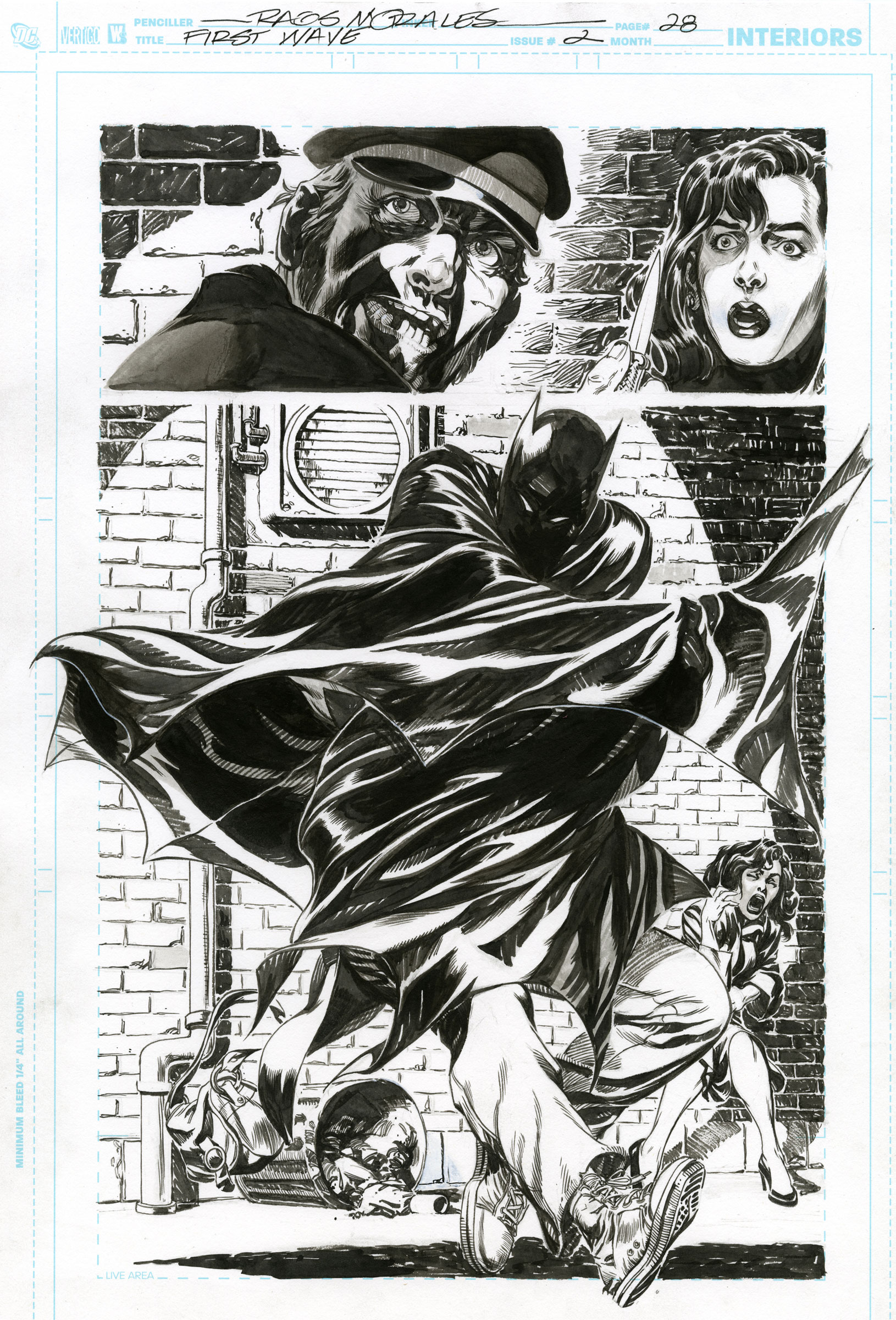
One compliment I will pay: I feel Azzarello did a really nice job capturing the voices of Doc Savage, Spirit, and Batman. Each sounds how I would expect them too. Thier dialogue stands out when they all share a panel. Also, I will give Rags Morales this one page:

I just like the way he draws Batman here, like a big, black sheet that just eats that crook. It’s a cool visual.

I have to say this was poor, though, and I feel Azzarello may have just let this happen. He is the type of writer, like Ellis, to take a corporate gig and just churn out something that is well enough yet does impress. The help of delays and impending doom for the First Wave line may have also contributed to a lack of interest on Azzarello’s part. Oh well. I am not done with the work of Brian Azzarello, and I still remain excited for his next two projects, Batman: Knights of Vengeance and Spaceman, because they involve the other half of 100 Bullets: Eduardo Risso. Those two working together should produce some quality, and speaking of Risso…maybe he should have drawn First Wave?

If he did, I would have automatically liked it a lot more.

2 Comments

Filed under Thoughts