Category Archives: Uncategorized

Savage Dragon. Read it.

As Joe Keatinge points out, Savage Dragon is the comic book you all want.

Consistent creator? Spontaneous, episodic adventure? Big sequences? Real consequences? Commentary? Experimentation? Artist connection? African American protagonist?

Check, Check, Check, Check, Check, Check, Check, and CHECK!

Shame on you for not paying attention.

Erik Larsen’s  pet project means many things to me, but it first and foremost represents an artist’s love of comic books and super hero convention. Larsen’s passion for comics hinges freely open. Just a short stint following his Twitter account and you’ll see the interest and opinion he broadcasts. Twitter is the man’s personal soap box, and by following him you become subject to his care and interest in sequential story. When there’s big news floating around or controversial developments, you can always expect at least a few tweets from Mr. Larsen. Twitter’s a recent development, though. Long before the invention of social media Larsen and a few other hot talents ditched their secure jobs to pursue an unfiltered vision of comics. Image Comics was the biggest risk of its day. If it bombed, the men attempting were surely out a job and possibly blacklisted. A lot rode on the simple desire to create without limits. As the story goes though, Image boomed and took its founders to new levels of fame, but think back to the start once more. Larsen risked it all just to create comics the way he desired. That’s big, and once he became the subject of Image’s success he could have done anything. Larsen had the freedom. His next comic book project could have been a cosmic romantic comedy staring ape squids for all I know, but at the end of the day Larsen created a super hero centric title. It was obviously the genre he wanted to work in. That chance and choice, sir, shows a strong love.

So why write about Savage Dragon? Other than holding my heart as my favorite comic book, I feel Savage Dragon lacks discussion from both casual readers and the critical community. The critics damn it as weak and laugh at its existence, while the mass readership ignores it to pursue the corporate icons. An unfair shun, if you ask me. Savage Dragon may read as quaint and simple when cast a quick glance, but really Dragon is rocking some levels. The content and context make this comic a rare and special work in today’s market, but in true hypocritical fashion moaning, sobbing comic book fans roll their eyes at its presence.

As I point out on a recent episode of The Chemical Box, there are hardly any (maybe none) ongoing comic book series working issue to issue. Marvel and DC possess long running, high numbered series – even though they renumber every month – but most of those series rely on 4 or 5 issue story arcs or chapters. These chapters usually work as smaller stories within the long narrative, and they could honestly be removed from the ongoing series and be sold as finite stories. In fact, they are. These finite chapters traditionally see some form of repackaging before they are sold in trade paper backs as individual stories. In most cases, transitioning creative teams or the need to spice up product completely destroys the concept of  long narrative.

An ongoing series like The Amazing Spider-man constantly bears witness to small stories. The years of “Brand New Day” brought forth different artists and writers every three issues, providing a constant inconsistency. These practices question a reader. Am I really reading the same story and the same character’s same narrative as I have been for 15 years? Really, no. Consider story arcs and creative swings a fucking reboot. You might as well. Comics are now written to serve the Hellboy model, but even the Hellboy model works with a solid, consistent creative vision. The ongoing narrative of Marvel and DC heroes is dead.

Savage Dragon keeps the narrative tradition of comics alive. It’s run for 18 years under the same creative vision, from a writer/artist no less, and hardly ever works its narrative through labeled story arcs. Savage Dragon is THE issue-to-issue comic. Never does it lull mid-arc but rather offer high points each and every issue. Every issue tells a complete tale while still belonging to a larger saga. Again, the ideal comic book everyone so wants.

But, yeah, I’ll just quit with the “you’re a hypocrite” act and get to it. There was a cool scene in the latest issue of Savage Dragon, issue #171 (actually #172 will be the latest as you read this as it hits comic stores the day I post this blog post – good timing, right?). I wish to write a few lines on this scene I so dug.

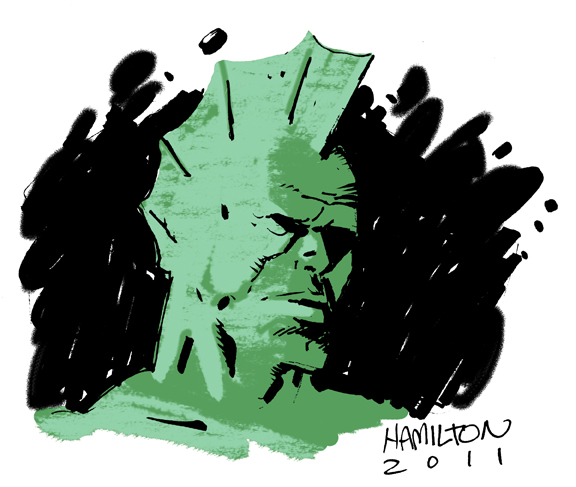
Thunder-Head a.k.a. Kevin Gorelick sits upon his dusty, worn couch as a youngster playing a video game. In storms his father a.k.a. long time Dragon villain Skullface and Larsen provides the audience with a face filled visual. A line of dialogue is bellowed. “Do your homework.”

Young Kevin proclaims that homework is unnecessary, especially in a world where his father is a “bad ass” and homework is not required to pursue bad-assery. Skullface looses his cool and lectures his son on his own terrible life. Skullface wants the best for his son, not a cheap life as a crook. Through persistence, Kevin promises his father to work hard and stay out of trouble.

Years pass.

Skullface lay deceased, and we see Kevin attending to his grave site. There’s an anger in Kevin. Through monologue, he reports of his father’s poor job as a parent yet announces the difficultly of living without his father. Kevin states that these are tough times and that there are “not a lot of opportunities for a guy that looks like” him a.k.a. guys who have a blue, skeletal face. Kevin persists to honor the promise made to his father, though. He says, “I guess you’re still looking out for me” as he walks away from his father’s grave.

Two pages later, Kevin types away at his formal office job when a young woman reports he is being “let go.” Kevin becomes upset and is escorted away by security guards. Soon we see Kevin pursuing his role as Thunder-Head. He’s communicating with the organized crime unit the Vicious Circle. Kevin breaks his promise and by the end of the issue combats with the book’s own protagonist, Malcolm Dragon.

Ok, so maybe it reads just like another, soap opera fueled origin of a super villain. You know, daddy wasn’t there (to change my underwear…) and all that jazz. Really, though, it’s not. In comics, the family aspect can spell out the coming of evil, but in this case Larsen reverses or twists the circumstance of family as motivation. Unlike the usual parent of a evil, Skullface cares. Granted, Kevin makes note in the grave scene that it was hard living with his father, but that could mean a number of things. I mean, it’s hard living with my mom, but that’s just because of her to tendency to annoy me – not poor parenting. From what we see of Kevin and Skullface’s relationship, things seem normal and well. Skulface looks out for his boy and encourages him to do well.

It’s then that the sub plot acts as expectation shifter rather than convention. Larsen, like Tarantino, poses Kevin’s story just right so that it plays with the audience. While reading, we expect Skullface to beat young Kevin when he enters the room, but instead he lectures. While reading, the flash forward instills pre-thoughts of criminal Kevin while it really depicts a white collar, office working citizen. Our guesses as to where the plot is leading land false. It’s not until Larsen takes away the respectable job that he folds to convention and portrays the orthodox, crime happy style.The play on the audience involves more than expectation tease, though. By showing this oddball circumstance of a character becoming a villain, Larsen suddenly brings an extra dimension to the usual 2-D comic book antagonist.  Most comic book baddies pertain to little motivation or explanation. They are simply bad to be bad, or because the story dictates them as so. If anything, a usual villain comes packaged with some line of vengeance or goal of world domination for a chosen idea of society. Not here. Kevin wants to be good and has every inspiration to be. The character, though, eventually loses sight and drifts away. The element of falling makes the character a bit more interesting, and Larsen’s choice of such shows his willingness to experiment with hero genre cliches.

For what Savage Dragon is – an analog version of 1960s/1970s Marvel – this move resembles perfect, “oh, of course” sense. Larsen’s book takes great pride in bending and breaking the cliches of corporate hero comics. The narrative always goes after the elements Marvel and DC will not touch, and it does what most readers won’t expect the Big 2 to do. Kevin a.k.a. Thunder-Head is only another classic Savage Dragon example.

I don’t wish to dress Savage Dragon as another super hero comment book, though. I find no problem in stories that simply choose to comment on the comics medium or super heroes, but for the sake of addressing those who do find error in such thing I’d like to point out that Larsen’s use of Kevin is a very real world, social comment. Most crime in our world does not derive from a soul of pure evil or sadistic drive. Most crime is survival based. Hurricane Katrina stands as the perfect example. Looting of retail shops made all the headlines as the flood waters climbed and climbed, but no where among any of those looters were thoughts of evil. The looters looted to survive. Whether food topped the list of stolen items or television sets, the looting became a necessary mean. Food nourishes while TVs provide black market cash. Either way, people need both results to make it.

As Kevin comments, times are tough. The character losing his job and turning to robbery represents many in America right now. People are making rash moves to make ends meat. Even Kevin’s extra incentive to join the way of crime speaks toward a survival instinct. The Vicious Circle mention their new mission as being one to bring Kevin’s father back from the dead, and as you recall Kevin announces how hard it is to live without his father. In some way, Skullface’s absence harms Kevin or inhibits his survival. Bringing back his father could only make it better for Kevin. At least, that’s the thought.

So, yeah. I just typed all of that, 1800 fucking words, to discuss one subplot in one issue of Savage Dragon. It may read as quaint, which I argue is apart of the book’s aesthetic charm, but goddamn, there’s something about Erik Larsen’s 1990s-born Image Comic. Read an issue sometime, and don’t even tell me the comic you ideally want doesn’t exist. You obviously ain’t looking.

3 Comments

Filed under Uncategorized

the chemical box – episode 009 – it’s a box social!

A new Chemical Box Podcast, hosted by Joey Aulisio, Chris Johnson, Just Jean, and myself, is available. Here are the details…

the whole gang returns for this week’s episode where they discuss such topics as the crankcast, the flaws of the modern workforce, new idw artist editions (john romita, will eisner, wally wood), joe madureira’s upcoming run on the avenging spider-man, cable reborn, brian k. vaughan & fiona staples new series saga, becky cloonan drawing a macgyver comic, marvel’s season one, the dc relaunch & women’s rights in comics, jason aaron & marc silvestri on the incredible hulk, more fear itself vs. flashpoint talk, jonathan hickman’s upcoming creator owned work, legendary comics, and much more.

music by frank ocean
You can listen by clicking here, or you can download the show, in iTunes, here.

Leave a comment

Filed under Uncategorized

A Gold, Holo-Foil Heart – McFarlane’s Spider-man #1

1st all-new collector’s item issue! The legend of the arachknight! Arachknight? Yes, I am looking back to the year 1990 because before Spawn and the boom of Image Comics Todd McFarlane debuted his  chops as a comic book writer on a certain Marvel Comics character.

The book infamously known as Spider-man #1 holds a certain place in American comic book lore. Some remember it for its ridiculous amount of collector bribing, variant editions while others recognize it simply as a poor, confused example of the medium. All of that aside though, Spider-man #1 channeled a zeitgeist excitement felt by the industry at that period. The book fell right in line with Liefeld’s New Mutant’s and Lee’s X-Men. It was a comic book on the edge, presenting unorthodox artwork and design. Spider-man looked new and different, panels knew no bounds, and the impossible seemed possible once again in a super-hero comic. Nearly everyone had to own a copy and every company needed a copycat, McFarlane-esque artist.

Deep down, though, past the 2.5 million copies sold, the holo-foil, scratch-and-sniff covers, and the rock star attitude lay an artist looking for a break. McFarlane at this time was still relatively new to the comics industry. He was coming off his two year run on The Amazing Spider-man with writer David Michelinie and nothing else really to his name. Granted, it was an impactful run from both a plot standpoint as well as an aesthetic mark, but still, a two year run is nothing in an industry where Jack Kirby penciled numerous titles per month. There was much to prove for this young artist. Thus, after a few short talks with editor Jim Salicrup, McFarlane’s own title appeared in the web-slinger’s line of funny books. A twenty-some page pamphlet where he could stretch his legs and push his ability.


Now, let me just say, Spider-man #1 does, in some regards, deserve the criticism it receives. It’s a comic book so short of plot it’s laughable. The story, if one could call it that, depicts Spider-man web-slinging through the streets of New York along with a scene of Peter Parker and Mary Jane Watson flirting in cute couple fashion. At some point, the villain The Lizard is brought in to rough up random street thugs.These events, under the hands of craftsman, could work as a fine first issue, but the problem is the drive and tie of these events. There really isn’t any. These events feel like randomly disbursed thoughts throughout a comic book, and they’re overwritten with corny caption boxes of narration – a technique that only results in great or terrible quality with no inbetween. No theme is present, no greater purpose exists, and the dialogue would make a twelve year-old version of yourself laugh.

It’s a pretty awful script, but McFarlane manages to take away some of the bad.

“I don’t profess to be a writer, but I do think I can tell a story. What this means is that most of the issues will rely heavily on the artistic side. It will also allow me to draw who I want when I want, so I can get wound up artistically and be even more enthusiastic while I am doing the work.”

Continue on.

“My writing will expand and get better as the months go by, but I will strive to present Spider-man in a fashion not seen before, and thus be able to justify the question of why a fifth Spider-man book.”

–          Todd McFarlane, Text page in Spider-man #1

Could he be anymore clear? If I had just read Spider-man #1, the comic, by itself, I would have put it down with very little to say, but after reading the afterward text page, I suddenly found a lot in this comic. This is a book that doesn’t pretend to be anything bigger than it is. It’s not Dark Knight Returns, and McFarlane knows and admits this! Instead, it’s Spider-man #1, and McFarlane clearly states his intention is to make Spider-man look cool and basically nothing else.

I’m pretty sure he accomplishes this.

The contents of the issue, even now, are visually striking. McFarlane’s vision of Spider-man, even to this day, stands unique with edge. His powerful splash pages send elbows to your face and panel layouts never slow down to anything resembling a nine-panel grid.  It is a cool looking comic book, and at the time the artwork was a game changer in the market of hero books.

Not that it stops there, though. If anything, that praise is the usual praise for an artist like McFarlane or really any of the Image guys. No, McFarlane accomplishes something else with his artwork. Rather than characterizing his cast by usual means of situational development or dialogue, McFarlane takes the John Woo approach and depicts his characters through their body language and physical action. Take a look at any Todd McFarlane Spider-man drawing and admire the way he positions the character in a very acrobatic, gawky way. Without a beat of speech, you should understand who McFarlane’s Spider-man is; a masked hero who swings through the New York concrete jungle, hangs upside down, and performs daring flips and acrobatic feats to catch criminals.

The awkward twists in the body posture even depict Peter Parker’s wise guy persona. The liberal crouching and skin tight costume provide a sense that Spider-man is unlike the usual super-hero. That instead, he is some sort of punk rock warrior. A man not following the traditional super-hero protocol, but rather cracking jokes on the crime scene, running from the law, and receiving the hate of New York City.

The weird, almost disturbing poses even speak to a primitiveness of the character. Traditionally, comic artists focus on the human aspect when they draw Spider-man; a young guy in tights trying to make a difference.  When Spider-man clings to a wall in a McFarlane comic, something animalistic seeps from the hero. The spider element becomes a bit more vital. The character becomes inherently a little darker. The popping veins and big, bug eyes communicate an idea of torture. A reader understands Spider-man’s guilt, determination, and origin point.

The artwork says a lot, surprisingly, and when it’s combined with the comic’s own idea of self-awareness, I think it actually makes Spider-man a rather interesting comic instead of a bad one. If anything, this book is much more personal than the gimmick it’s made out to be. McFarlane did as he pleased with this comic, and the book provided the young artist an opportunity to express his creative needs. It’s the comic McFarlane always wanted to do. An a-list character at an a-game publisher and he was the sole creative force behind it. McFarlane’s Spider-man really is McFarlane’s Spider-man. In some ways, I find it possible to believe that this comic may have started the creator-owned conversation for Todd. McFarlane experienced a taste of control by doing this book, and I believe that as the years past that sense of control only grew harder and harder to give up. The man yearned to own what he drew and draw what he owned, but Marvel Comics could not harbor such desires as they had, and still do, a business run. Still,  I now like to think that Spider-man, in some way, was owned by McFarlane. His artwork defined the character for a period of time, and for a period a time the character was all his in a title he wrote and drew.

In some form, Spider-man #1 was the first Image Comic: bold, unorthodox, creator-controlled.

Leave a comment

Filed under Uncategorized

MellowHype – Brain/Loaded – BlackenedWhite

Odd Future, the LA based rap group, have been that “thing” this summer. That point of discussion we all seem somehow involved with. That pop culture blip defining our memories of this time period. That event we all have an opinion of. Odd Future is everywhere right now. They’ve hit that must talk, controversial, internet fueled, talent-obsessed fame that any up and coming artist dreams about. The popularity of the group is alive and well, and their words matter like no one else. Summer 2011 is their time.

I’m of the mindset though that this attention and favor for Odd Future will exceed the Summer of 2011, but I’m not sure it’s a common thought amidst the populace.  With the debut of Tyler, the Creator’s Yonkers, I perceived the common reception of it to be something of a new musical fad. I sat within a college radio station as indie rock kids turned up their computer speakers, and right there – right fucking there –  I got the feeling that people were seeing this as the new “thing.” But not a new thing in terms of longevity. Just a new thing for the month. Just another exploitation show with a nifty beat. You know, it would just be this violent splash of weird to wake people up, but within months the weird surface would grow old and then fade away like any superficial, catchy sound we hear in music.

I felt people would just overlook this music.

And that has been the case. While Tyler, the Creator has been a massive success, and the other members of Odd Future prep their own project debuts, I feel most people may view OF as some sort of freak show or lucky break that will die away. Most seem to simply view their music as loud and vulgar as they miss the point and doubt there’s room to dig deeper.  Tyler’s proven you can dig deeper, though. Goblin, his second album, dropped months ago , and I still find myself sucked into his lyrics. The weird and outrageous are still a part of the aesthetic, but unlike most popular music there’s more below the surface of triceratops threesomes and rape jokes.  The man’s going after the big, personal issues under a partially transgressive aesthetic. Even then, I don’t think that one sentence really covers it.

I’ve also enjoyed the guest appearances of other OF members on Tyler’s albums, but the physics and situation of Odd Future and Tyler seem similar to those of any other music group who tries to section itself into solo acts. One guy usually takes the whole cake. You can blame the usual group failing; that a band is defined by the lead singer with the goofy haircut or the guitarist with the alcohol problem. He with the image holds the band’s image; therefore, he holds the band’s potential and “talent.” It’s like that scene in Sid and Nancy as Gary Oldman’s Sid Vicious barters his role in the band because Nancy isn’t allowed on tour. Nancy says, “The Sex Pistols aren’t shit without Sid,” and she is partially correct. Vicious held tight the band’s identity.

For Odd Future, Tyler seems to be standing in that oh so infamous position. The dude is the breakout star and carries all of the attention as well as defines the idea of Odd Future by way of his language, style, and approach. I feel the chance of people accepting and expressing excitement for other non-Tyler, OF projects slim, and I even doubted myself  to dig into other Odd Future projects. Why? Tyler’s work is just too cool and engrossing; I doubt anyone follows that up so soon.

they said a piece of my ambition’s ambitious

Last Tuesday, MellowHype dropped their album BlackenedWhite, and I found myself with a new anthem to blare. MellowHype is a duo group consisting of Odd Future’s Hodgy Beats and Left Brain; BlackenedWhite was previously available via the OF website, but this new release presents a remastered version while also shining some new attention on MellowHype in the post time of Tyler’s massive success.

Yeah, you better believe Odd Future’s here for the long haul.

This album sounds like a true anthem, to me. While Tyler’s music grabbed everyone by the throat, Bastard and Goblin were more about a young man exorcising demons through rhythm and rhyme. Both albums have pieces that inspire thoughts of, “Odd Future’s coming for you,” but I have to say that BlackenedWhite hits upon this idea in clearer, more determined fashion. I’d say most of this album is very, very good. Every song sports a combination of beats that alone are worth praising, and Hodgy, in the company of his companion Left Brain, brings the music to another sphere through his lyrics. I really like Tyler, but after listening to BlackenedWhite I honestly feel Hodgy may be OF’s secret weapon. The dude’s poetic and takes the transgressive element Tyler inspired to the next level. He mixes the weird and absurd into metaphors complicated enough to keep you busy for the day, and his flow holds such distinction.

The best of BlackenedWhite are the tracks Brain and Loaded, though. Over top sick Daft Punk/Tron inspired sound, Hodgy along with guests Domo Genesis and Mike G lay it down that Odd Future is here and the best.

You can quote me on my sentence nigga, catalog this
Odd Future wolves, ain’t some acid artists
A bunch of massive artists, hang up, I had to call this
We mosh through streets like a pack of walrus
So when we come around them niggas had to ball fists

In the middle of Brain‘s opening verse, Hodgy addresses the more than common doubt set upon Odd Future. He clears the mindset that OF is just some lucky success. They’re not “acid artists,” which I take to be musicians who poison or eat away at pop culture, but rather “massive artists” with big plans. They’re also loud and not ashamed to be so, and they’re not afraid to fight to do as they please.

Then Brain spills into its hook:

Man, when it came to school, I got bad grades
Now, when it came to the law, I didn’t know how to behave
My nigga, my, my nigga but with music, music, music
I’m on the honor roll, honor roll, honor roll
With music, music, music
I’m on the honor roll, honor roll, we on a roll

Hodgy may suck at school and have trouble finding place in society, but the dude knows music. He has the brain for it, and his brain is set on music.

Phone book flow, this some shit you’ll never rip off
Shitting on you niggas, I’m a level past piss off
Risk all to get all, I’m all in

Aiming for success and won’t fall for nothing less than that
Wolf Gang shit, got all my niggas repping that
If we ain’t it yet, somebody show me where the best is at

Domo Genesis provides these lyrics to continue the thought flow Hodgy has established. What Odd Future does is on another level. He dares you to try and rip it off, and encourages someone to find something better than them. I also dig the line “risk all to get all, I’m all in.” The guys of Odd Future dropped out of school to pursue music, and this line echoes that and the point that Odd Future, as a group, isn’t clowning around. They want this big time.

Loaded deals heavily in drug references to create the image of MellowHype selling “drugs” or more literally selling awesome shit a.k.a. their music. It’s a song that falls under the usual hip-hop portrayal of confidence, but the song works well in the context of the Odd Future story. MellowHype, or more general Odd Future, are the dudes to go to when you want the good stuff.

Mike G, in the song’s final verse, lays out these lines:

They ain’t learn? Hatin’ niggas won’t make your chain bigger
You’re comedy to me and crowds flee when your shit’s on
You get fake applause like a TV sitcom 

Hate all you want, but in the end it will do nothing for you except make you look stupid.  These lyrics work on two levels. While they speak for Mike G himself, these lines work well for Odd Future in general. The group has had much hate thrown at them.  The vulgar content has attracted the attention of concerned critics as well as the everyday hater for just being so big. It’s just a nice, final say. Shut up. You look stupid. We’re doing our thing.

man it’s Golden

So how do I wrap this? I’ll just basically say that to anyone who considered Odd Future a one trick pony, that Tyler, the Creator was the only bit worth paying attention to, you’re wrong. I’m wrong. BlackenedWhite proves there’s more variety and thought in the Odd Future catalog than one would initially believe. It’s an album that speaks for the group’s musical talents by way of its sound and sub textual content. It’s simply another good, solid album from the Odd Future line, and that simple fact – that OF can produce a follow up worthy of Tyler’s quality – sells the point that Odd Future has it in them.

I’m thinking it’s time we become used to Odd Future. I think they’ll be here for awhile.

Leave a comment

Filed under Uncategorized

king of the comeback pt. 2

So, yeah. My blog presence has lacked over the past few months, but I’m here to tell you that that is all going to change.

To begin, I found myself frustrated with writing. Things I desired to complete weren’t being completed, and the articles being completed were just poor. I felt the frustration you usually feel when you know a specific word in your mind but cannot, for some mysterious reason, speak it. Writing was becoming torturous to a degree. That may sound harsh or over dramatic, but honestly, I think I was being driven crazy by it.

So, I walked away to take an extended break. I figured I should enjoy my break from school rather than force myself in front of a keyboard. This would explain my initial absence.

Time passed, and I suddenly felt the urge to find a writing project. But not this blog. I don’t know, it just didn’t come off as what I wanted to do. Not at the time. So I jumped into newspaper writing with West Virginia University’s student newspaper, The Daily Athenaeum. With an Arts and Entertainment section, I assumed I could still write about comics or, to a larger degree, pop culture.  Stupid me didn’t comprehend the local aspect of the newspaper, and the comics writing I wanted to do, or the comics culture news stories I wanted to tell, would not work.

So, I went looking again. I needed to find an outlet with readers, and I needed to write about comics for that outlet. I knew! Popmatters.com

Popmatters is a packed pop culture site containing the types of critical pieces I desire to read, and they have a comics section I knew I could write for. I originally applied for the website last summer, but, understandably, I was rejected. A year later, I found myself with a writer’s position for PM’s comics blog. I. Was. Thrilled. Finally, I could write about comics, the way I wanted, on a playing field with an extended audience.

The excitement for writing began to boil and ideas came to. I felt this was it.

Now this no longer seems to be the case. I could spill the beans on the situation and be all post-empire, as it seems to be the “it” behavior these days, but I’m not sure I should. Part of me says, “go for it,” but the other half says, “just be polite and professional.” Honestly, if you want the idea, just skim back to a previous post on this very blog. You’ll get (part of) the point.

Popmatters provided me with one thing, though. The energy and ideas. The thrill of an actual writing gig kicked my head into gear, and I still need a way to utilize this new found energy. So, I’m revamping this blog to “publish” and to continue my writing development.

For those whom don’t remember, I once hosted a solo podcast. Teenage Wasteland. The show existed for two solid years, and it’s presence was very consistent with it’s weekly schedule. For two years I had a solid creative outlet. Granted, a podcast does not top the chart of creativity, but still, the show made me create in some way, and the weekly goal forced my mind into a constant idea mode. I felt good for those two years. A creative release was being met.

Then the show went to shit as the weekly schedule fell apart, and my creative release met a certain frustration. Teenage Wasteland ended. Since then, I’ve been struggling to find my new consistent creative outlet/project. For the first month or so of its existence, this blog was kind of it, but then again, I met frustration, and yeah, the story I told above happened. More time spent not creating or releasing anything.

That needs to end. I’m the creative type; I feel the constant need to produce. I’m getting back on the horse. Expect more Alec Berry on the web. For now, I will not search for the big audience. I’m better off here where I can control things.  I’m better off right here where I can train in secret for the eventual “attack.” This blog, for the foreseeable future, will update every Wednesday. That’s one of my new goals. Another is the comeback of The Chemical Box podcast I do with Joey Aulisio.

A podcast and a blog. Two things I’ve spent the past 2 and a half years focused on, coming out at once, consistently.  I feel creative once again. No one can hold me back.

So, to kick of this comeback tour, Joey and I give you episode 007 of the Chemical Box. We discuss Joe Casey’s Butcher Baker, Bendis’ Powers, and Flashpoint. Listen here. Or iTunes.

Stop back here on Wednesday as well for a new blog post will debut. MellowHype – Brain/Loaded – BlackenedWhite

Leave a comment

Filed under Uncategorized

Brother Louie

TV Show: Louie | Place: FX | Watched: Netflix | Staring: Louis C.K.

I know this blog normally contains my poor attempts at discussing comicbooks, but I thought for the sake of writing away frustration that I would share a few thoughts on LOUIE.

LOUIE is an odd ball of a sitcom. A tale of a lonely, middle-aged father trying so hard to find a love connection in his post-divorce life. That may seem like enough, but Louie also have to put up with thoughts of image, religion, sex, and social standards. It may not seem like something you’d want to view with your free time as it’s always best to stray away from the unhappy, but it’s excellent television.

Don’t get me wrong, the show is absolutely hilarious. C.K.’s vulgar, questioning, and possibly offensive style influences the show to no end. If anything, LOUIE may be more of a realization of C.K.’s comedy than the actual bit he presents on stage. I just don’t feel that sums up the show, though. As mentioned, the subject matter isn’t exactly bright and shiny, and LOUIE never forgets this.

The audience sees splices of C.K.’s standup through each half-hour, but the meat of the show are the vignettes written and directed by C.K. These vignettes only seem to visualize C.K. stories when you first see them. The beginning of the season seems to ease you into what the show is really after, so up front the vignettes are short while the stand-up fills the majority of time. At this stage, everything is wonderful and the show still latches onto you while entertaining to the nth degree. Mid-season the vignettes take over, though. The show gets to business portraying more of C.K. himself. Granted, it’s a fictionalized version, but I feel it’s pretty obvious that C.K. lives this kind of lifestyle, minus a bit of exaggeration. The greatest thing is he’s not afraid to show it. LOUIE will go bleak at times. Episodes about God, scenes discussing child abuse, or explanations of the word “faggot” go past the territory of just making fun. The show actually begins to really question. Why do we live with such things?

There’s another element I find highly relatable. This is the story of a middle-aged man, but Louie’s luck with dating or just being social in general really clicks with me. The guy is lonely and lacks the motivation to find people. That’s me, and in someways the show scared the fuck out of me while also providing comfort. “I’m not alone” seemed like the appropriate phrase while watching this on a Friday night in my dark bedroom.

Seriously, for those who have seen the show. Season finale. The club scene. I’ve fucking been there.

The show has such a  strong and unique composition and vision, and the rotating cast never ceases to impress. It’s one of the rare TV shows airing on a basic cable channel that can still provide a challenge to its audience. I respect it. It’s Harvey Pekar molded into a Seinfeld cookie cutter, yet in someways it cannot be labeled.

Netflix Instant. Now, people.

Leave a comment

Filed under Uncategorized

Why Target One?

Originally written for PopMatters.com, but I’ll throw the unedited, direct version up here anyway.

The DC announcements, for now, are over, and we the readers understand the plan set for September when DC relaunches its publishing line and sets forth 52 new comic book series.

But I still want to talk about it. It’s big and, while already over discussed to death, this event will dictate much discussion by fans and critics alike for sometime to come. Most likely, years from now, the historians (you know, the comic book ones) will look back at this summer and the next 6 months to ponder what it meant in the grand scheme. Was this the moment to predict the end, or was this beginning of a new golden age? Or, was it just like any other renumbering we, the readers, see so often in the modern super-hero market?

True, there are these questions, but I’ll save those for the future writers and pundits. For now, another questions taps about my mind.

What’s the creative direction and tone?

With the brunt of the announcement, before all of the specific details, I immediately put forth an opinion on Twitter  that a relaunch is all good and fun, but for it to really make a mark, talent behind the books is necessary. I still stand by such an opinion.

Why? Comics sell and generate favor by their talent.

That should seem like common sense, right? That a good comic book sells well as a bad one sells poorly, and the focus of most readers is the artists and writers producing the work? Well, things rarely make sense in comics, and such belief has not always been the case. Instead, for most of its existence, the super-hero market has been dominated by fanfare and expectations of “what happens next,”which, in result, have created an environment ignorant of creative talents and the actual, real people involved.

But that’s kind of changing, now. Publishers are printing the creative talents’ names on the covers of super-hero periodicals, and the font size seems to be increasing each month. Readers now list their favorite artists and writers and name off their most notable works. The unofficial movement, positivity, and sometimes unneeded care of “Team Comics” chants and hollers for creator rights as well as exposure.

Comic readers are leaving the character/plot-driven mindset behind. They’ve entered the age of the creator being real. The internet has given their reading a new intent as Twitter and podcasts present live coverage of the behind-the-panel process. We watch writers, like Marvel Comics’ self-dubbed “Architects,” as if they are the stories and characters.

Understanding this, it would seem important that a new line of books be headed up by strong talent. And by strong talent, I mean writers and artists who both “wow” through quality but also possess a dedicated audience while holding a presence in the industry.

In an ocean of 52 comic book series, it’s very doubtful that even half are something worthwhile. But 15, maybe 20? That should be doable, and I feel DC may actually have a line up to do that.

Here’s a list for the sake of a list:

Justice League Geoff Johns & Jim Lee
Wonder Woman Brian Azzarello & Cliff Chiang
Aquaman Geoff Johns & Ivan Reis
The Flash Francis Manapul & Brian Buccallato
Green Lantern
Geoff Johns & Doug Mahnke
Batman Scott Snyder & Greg Capullo
Batman: The Dark Knight David Finch & Jay Fabok
Batwoman J.H. Williams III, Haden Blackman & Amy Reeder
Batgirl Gail Simone, Ardian Syaf & Vicente Cifuentes
Catwoman Judd Winick & Guillem March
Batwing Judd Winick & Ben Oliver
Swamp Thing Scott Snyder, Yanick Paquette & Francesco Francavilla
Animal Man Jeff Lemire, Travel Foreman & Dan Green
Frankenstein, Agent of SHADE Jeff Lemire & Alberto Ponticelli
Hawk & Dove Sterling Gates & Rob Liefeld
All-Star Western Jimmy Palmiotti, Justin Gray & Moritat
Grifter Nathan Edmundson, Cafu, & Bit
Action Comics  Grant Morrison & Rags Morales

Personally, not all of these announced titles float my boat, but I think this is a case where everyone could potentially receive a piece of the pleasure pie.

Example: the snobs and critics get their J.H. Williams’ book while the fans can happily read Batman by David Finch.

Both groups, both audiences of comics, have the selected few they follow in this now creator driven market, and I think DC has made it clear to have a nice, rounded group of creators to hopefully speak to and draw attention from all sorts of comic book readers.

Sell comics to all we can. Let’s not target one audience. That’s the plan.

And speaking of speaking to the multiple audiences, DC is in this move to hopefully restore sales and inspire new life-long comic book readers. Well, what better market to target with all of this mainstream press than the lapsed reader of 1996.

If you know comics, you know the 1990s were a big time. Spawn #1 sold a million some copies, and Todd Macfarlane probably bought a space shuttle with that money. Point is: comics were spread wide across the populace in the 90s, and it was a time for the industry to make a lot of money.

It seems like DC has the major players to possibly drum up that excitement again. They have just the right arrows to target those readers who left comics with the collapse of the later 1990s.

Jim Lee, Rob Liefeld, Scott Lobdell, and Bob Harras.

Two of the biggest artists of the 90s (plus, they are kind of iconic for the time), the guy who wrote X-men in the 90s (X-men was BOOMING in the 90s), and once Editor-in-Chief of Marvel Comics (in what decade? The 1990s when the X-men were BOOMING).

Three guys, arguably four, who were single-handedly responsible for the 1990s super-hero aesthetic. Now they are all in one place generating a comic book event whose scale could probably only be contained by an era such as the 1990s.

Coincidence? I think not.

As Bob Harras found his way to DC last year and Jim Lee became the new co-Publisher, they probably set out to make  a portion of their line 1990s inspired. It’s what these guys know and do.

That look and that vibe sold comics, and it was a time when the industry possessed a rapid energy. Now they are channeling and pumping that energy into this new, drastic course change in hopes to once again capture that 1990s Boom.

The issue is, it’s 2011 and I’m not sure I’m in the mood for another round of Jim Lee knock-offs or 17 Batman titles. I always find it better to progress rather than re-capture the past, but hey, DC is after the varied audience and this may bring back some of the 1990s faithful.

Plus, Morrison is writing Superman in Action Comics, so DC is certainly after something forward thinking.

Finally, for the best discussion yet on the DC Relaunch, all should listen to Episode 44 of the Wait, What podcast. Hosts Jeff Lester and Graeme McMillian bring in comics retailer Brian Hibbs, and they bring up very, very good points about what this could mean.

Leave a comment

Filed under Uncategorized

Writing is Personal. This-This is just Data Spill.

How’s it going?

This post basically says I’m alive and kicking. The blog (the one you’re reading) has been pretty lackluster as of later. Very little postage, and the posts made recently have been pretty weak – did you read that Scarlet write up?

I just want to say: don’t give up. I will still write. On this page.

Recent events and thoughts have just made me consider where my focus and energy is at. Specifically, my energy as a writer. Most could care less about my energy, but I do care, , and yeah, I’m figuring my focus out. I believe it’s just a matter of what I want from writing, and I’m starting to fall closer to the desire of personal pursuits.

You know, just being me. Like the final lyrics of  ‘Golden’ as Tyler, The Creator realizes who he is and Doctor TC fades out.

Could I be more vague?

Anyway, to make this post some sort of something, I will link a review I wrote for The Daily Athenaeum. The DA is West Virginia University’s student newspaper, and the review would be on Uncanny X-force, specifically the “Deathlok Nation” arc. Check it out. I liked it (the review, that is).

Also, I read The Mighty Thor #2 and no longer carry any interest for Matt Fraction’s Thor. Why? It’s simply more of the long, drawn out cape comics I am really starting to loose patience and interest for. But, why don’t I just copy and paste my mini Twitter rant on the subject? I thought I may have possibly tweeted something interesting for once.

I did like the first Fraction Thor story. The one Pasqual Ferry drew the fuck out of. Many weren’t cool with it, but I thought the story carried a cool epic poem aesthetic, and it seemed to have everything that makes a Thor story. I don’t know, I was into it. Anyway, here’s the Twitter stuff. Until next time.

– No longer hold any interest in Fraction’s Thor. Mighty Thor #2 is a mess of drawn of story with no sense of purpose.
– What is the direction or point of this? Odin’s preparing for something. Who gives a fuck?
– The comic looks fantastic. I love the team of Morales and Martin on about any artist and w/ Coipel they are doing something special.
– Maybe I keep buying it for that, but I don’t know. I could use the time and money on something else.
– I do believe the choice of long and drawn out is made by Fraction. He knows what cape comics are. He knows what the audience wants.
– So, he gives it to them. Nothing wrong w/ that. I just don’t feel his Marvel stuff, not all of it, is for me.
– But Casanova? Fuck yeah. I’ll be there, and I’m pretty sure he hasn’t lost that skill. The new Cas story in Gula #4 sold me on that.
– With him, I think it’s just a choice of how he is going to write. I would love to see the Casanova style brought to hero comics, but …
– … if Fraction doesn’t want to do that, well, he doesn’t want to that. I have no say in the matter.

– All of my tweets were speculation, of course. My opinion. I mean, this is Twitter after all. Want real shit? Read a book.

Leave a comment

Filed under Uncategorized

The Internet Blew Up

And I was off to the side, trying my best to be snarky on Twitter. In case you’re wondering, I feel I failed miserably. But, oh well. The Marvel Bullpen of modern day made up for my suckage.

So, DC, eh? This is a big deal. The Internet storm may appear just like any ol’ comics Internet storm, but this is no simple costume change or cancellation. This is a LINE WIDE costume change and cancellation. Heh. Sarcasm aside, it is big as DC is going ALL THE WAY with this. No pussy footing nor any hesitation. DC altered itself over night.

What I find most interesting though is the backlash from many people on twitter. Granted, comic fans are always the most prone to complain, and the lose or altercation of continuity is always controversial among the nerd contingent…but most people online, reading comics have wanted this, right? Especially the digital angle of this?

My friend Joey Aulisio (Chemical Box, Matinee Idles) made this point to me, and I immediately felt he was right. This is what most have wanted. I know I’ve requested a line wide reboot or a drastic change to hero comics aloud at least once or twice. Yet, the Internet cries and cries or acts as if this isn’t good enough.

Not good enough?

What else could DC possibly do? Give the books away for free?

The day-and-date digital aspect is the bold move, though. Continuity and costumes aside, super-hero comics will still be super-hero comics. The digital direction will really bring the change, whether it is for better or worse. Brick-and-mortar comic stores will see some effect, and I highly, highly doubt Marvel ignores such a move. Not saying to expect a Marvel announcement next week or anything. This is more of a “wait and see” action. Either DC strengths the digital market in a big way, or DC proves that the world really doesn’t want digital comics. Either way, this may be the telling tale of the oh so talked about digital comic book.

And, possibly, the down fall of the physical direct market.

But, yeah, I’m sure you’ve heard enough “doom” talk at this point.

Personally, I actually want digital comics to fail to some degree. Not a total failure, just not enough success to make it the mainstay. I’ve said it before, and I’ll type it now; the industry needs an even mixture of both print and digital. Balance always seems to be the key to life, and I am willing to bet balance in this situation will work just the same.

Let’s see what happens.

As for the DCU, I need talent on these books. 52 new titles is A LOT of comics, and only 10 strong books will not cut it. If DC really wants to make this work and keep this excitement post the initial announcement and hype, they need quality and artists who will make people talk issue-to-issue. So far, from what has been announced, I feel there may actually have a shot at this. First off, even though I have been low on Geoff Johns before, I have to say the Justice League team is good. If DC wants to capture the spirit of Marvel’s Avengers franchise, which I feel they do, this is very smart of them to put the company’s top two on a book like Justice League.

Brian Azzarello and Cliff Chiang on Wonder Woman? There’s the energy that character desperately needs. Azzarello has wrote off mainline DC projects before, but I don’t know, I feel if he is working with an artist of Chaing’s caliber, the result could be different this time around. We know it will at least look good.

Manapul writing and drawing Flash. Again, energy. Whether Manapul can write or not, I almost don’t care. That dude can draw. But it is a writer/artists project, and I like that DC is continuing this experiment even though Finch’s Batman went no where and Daniel’s Batman wasn’t all that. Comics still needs writer/artists, and Manapul may have the special juice to do it well.

Johns/Reis Aquaman will make people read. Hell, I may even give it a shot.

DC Universe Presents sounds interesting, and Bernard Chang is drawing some of it.

Those five projects announced, and we haven’t even heard of the Morrison or Snyder projects yet. Plus, DC does tell of more new talent doing work.

And, I bet the J.H. Williams Batwoman shows up at some point. Would explain the long delay on the series.

My question, though, is where is Chris Roberson in all of this? The man came in on a terrible Superman run and somewhat saved it for people. Plus, the dude writes a Vertigo book for Mike Allred. Hello?

Even if this fails, I feel we always have to respect DC to some degree for this. They took the risk, and honestly they went from second stringer to suddenly taking all of the industries attention for the rest of the year. DC is pushing the game right now. Especially, again, with this digital thing.

And, hey, Flashpoint went from the event few cared about to probably the series everyone watches. Smart business move  by them. Flashpoint now sells more. Fuck, I’ll probably buy it because, well, I know I come off as cynical a lot, but honestly I am excited about this. I like the DCU very much. To me, the DCU is super-hero comics, and I like the idea that DC may finally publish a few good, exciting super-hero comics.

My eyes are glued.

Leave a comment

Filed under Uncategorized

Some Things Just Don’t Change

Brian Michael Bendis means many things to many people, but for the longest time Bendis, to me,  meant company bullshit and the error of super-hero comics. I’m not necessarily sure why. I think it was a matter of his position and the frustration I felt toward Marvel. You see, they raised prices at the time of my highest “hate,” and, well, I was one of those “3.99 protesters.” I know, I know. Something I should probably keep hidden nor does it really have anything to do with Bendis,but whatever. I was there, and I’m past it now that I actually read my comics…Anyway, Bendis…not my favorite dude in the heyday of late 2009/early 2010. His books were 3.99, his Avengers did plenty of talking, and Siege was on the horizon.

“Fuck this guy,” I thought. “My days of Ultimate Spider-man respect are gone.”

Taking Marvel Readers for the usual spin, Siege came and went, but while so, news broke.

“In July, writer Brian Michael Bendis and artist Alex Maleev examine those questions and more when “Scarlet,” their new ongoing, bi-monthly creator owned series from Marvel Comics’ Icon imprint, begins. We spoke with Bendis about the project…”
Comic Book Resources

July, Bendis back to his roots, and I gave it a shot. Boy, I’m glad I did so.

Scarlet’s still some sense of the traditional Bendis. Characters talk while stories span more than a few issues. There’s even that sense of slow down mid-arc while the last chapter inspires thoughts of, “what happens next.” Bendis writes this book through and through. No doubt about it. On a larger playing field though, this book resembles something like a rejection slip or a mighty middle finger aimed at all the nay sayers and labels. Yes, in some sense, this is Bendis’ Recovery. Here’s the album where the artist, while not totally reinvented, comes out and exclaims, “I’ve still got it.” That “it,” in this case, would be Bendis’ ability to bring something a little different and exciting to the comics market.  Scarlet proclaims Bendis’ right to still be in this game.

Part of the Scarlet’s statement simply comes from the creator-owned aspect. We have this odd perception in the comics scene that when a creator goes creator-owned it means some sense of “rebellion.” Kirkman, I think, is owed much thanks for this perception. The original Image guys inspired this idea nearly twenty years ago, but I think for this current era Kirkman steals the show. That manifesto went a long way, and it still lingers in the air now. He, whether he wished it not, made creator-owned this quasi-bad boy act where the artist can tell the company man to fuck off and seemingly be ok.

Not saying Bendis is telling Marvel to fuck off – that would honestly make no sense -, but the bare aesthetic of a creator-owned comic encourages thoughts of breaking the mold. Scarlet being Bendis’ first major creator-owned work since Powers, the book that got attention, says something about the writer’s place as of now. After ten years of being Marvel’s go-to boy with an on-and-off creator-owned book floating in the background, Scarlet makes us all suddenly question. Is Bendis just the “Avengers guy?”

That answer would be no. Our attentions are so caught up in who this guy is today that we forget Brian Michael Bendis wrote and drew as an indie comics creator. Before Ultimate Spider-man, the world knew Bendis as Fire and Goldfish. And Bendis still talks about these books, more than a decade later. Listen to any Bendis Tapes on John Siuntres’ Word Balloon Podcast, and I bet Bendis will name drop a few of those early books. Why? I think they are still strongly attached to him. This isn’t a guy who found a Marvel gig and said, “Ok, now I start.” This is a guy who loved doing his early stuff, and he never tries to cover it up. Bendis still pushes copies of Jinx and Torso; he wants the world to know what he’s capable of. Scarlet, and really this entire wave of new creator-owned material from Bendis, is another step in that direction. A certain amount of it disproves the majority perception, but another piece of the pie is a return to form. Bendis’ core, I think, is creator-owned, and Scarlet exists as a call back to that.

But it’s not all in the book’s appearance and identity; the story itself holds meaning. This book kicks off with a female protagonist who, right out of the gate, strangles a man and tells us why. The bare action isn’t the point, though. The “how” is.

Scarlet breaks the fourth wall. The technique should clue us in. The author wants to talk. Let’s look at this line: “I’m sorry to be right in your face like this. I know you were looking for a little diversionary fun. I know you were subconsciously hoping you could just watch without any of it actually involving you” (Issue 1, Pg. 4).  Hmmm. Involving “you.” This goes back to my idea typed above. While Scarlet in the story is on a mission to instigate revolution and wants “your” help, Bendis is clearly speaking for his own cause here. The thought of looking for some “diversionary fun” without involvement so sums up a majority of comics readers and specifically the readers invested in Bendis’ Marvel work. Stuff like Avengers and the event books are so spelled out, and people read them as diversion. I mean, that kind of is the point of entertainment, but comics readers, as most on the internet should know, take the concept of thinking and multiply the aspect of pain tenfold. Remember Final Crisis? Yeah, people bitched. Why? They wanted the story’s “hows” and “whys” spelled out.

Bendis’ work kind of contributes to this. His style of storytelling, the decompression we’ve all come to love, is the norm in today’s mainstream comics. It’s become Marvel’s house style of writing, and it’s possibly conditioned readers to be, well, lazy. Decompression lets everything see time on the panel. Thought needs no part of the reading process when the writing is such because the writer can literally tell you everything.

But Bendis wants “you” involved in this one. He wants “you” to think and contribute. He, again, wants us to see him differently.

This opening houses another important aspect, though. Maybe more important than the line about contribution. It’s how it’s written. When we think of Bendis, we think of dialogue and long scenes of transacting characters. It’s the Bendis trademark. Scarlet breaking the wall reminds readers of that and reminds in a fresh way. The opening scene jolts us. It’s Bendis writing dialogue but not in a fashion we expect. Characters sit no where near a table, but rather one pissed off woman looks directly at us. Sure, she delivers a few lines of meta statement, but her plain action almost says more. She’s just talking, but she’s taking the Bendisism in a different direction.

Bendis, because of his sometimes overuse of dialogue, has lost some of his shine. Rather than it now being his gift, dialogue has almost become his curse, and it’s not something readers look forward to but rather dread. This opening feels like Bendis taking control again, though. The switch in approach makes the dialogue feel special again. The moment sounds a lot like the opening seconds on Eminem’s “Cold Wind Blows.” The exclamations of “I’m back” and “Some things just don’t change” seem appropriate in this moment. It’s Bendis doing his finest Bendis and showing that he is still the guy for dialogue. No one does it better.

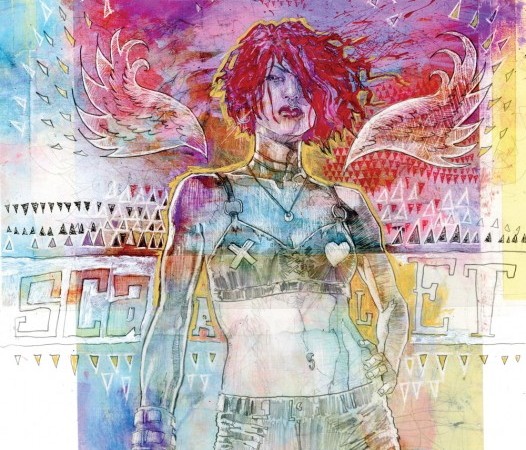
The story continues as Scarlet opens up her operation and rubs the dirt further across her hands. Cops die and pressures increase, but the series unfolds in other ways. I want to point out the statement made by this comicbook, but I also feel it shouldn’t be limited to that. Scarlet has more to offer as a story. Namely, the use of a female lead. For a tale about rising up and speaking out against oppression, following a woman around seems like the only right idea. The male voice could make a point here, and maybe convey some similar feelings, but making the character female brings much more by simple nature of context. Plus, Bendis has history with the lady lead, and Scarlet makes a lot of sense in his larger body of work. Jessica Jones meet Scarlet.

But, yes. The context. This is the woman taking back her world and executing revenge on the men who made her suffer. Sounds about right. Where on the surface Bendis shapes Scarlet to represent the common, downtrodden, middle class person, Scarlet herself takes on another shape. She’s a symbol. A symbol for what we are told and a symbol for the woman as an entity. Here’s a woman who feels the need to speak and speak loud in a culture where men seem to make the rules. Plus, she’s tearing down the rules and citing them as wrong. It’s almost like this woman scorned is the release of hundreds of years of built up aggression. The denial of school, jobs, voting, and sexuality are all being voiced against right here, through Scarlet. Maybe Bendis wants that, maybe he doesn’t. I see it, though, and I think it’s impossible not to because the fiery red of Scarlet’s hair and the show of midriff only catch the eyes.

So, to wrap up, I blame this book for my resurgence of Bendis reading. While not necessarily something game changing or even solid, Scarlet shows me that Brian Bendis can still make a point and make a comic with a layer or two. I lost faith in this dude for a while, but it feels like Bendis is hitting a new creative stride. He still needs to speak and deserves to do so. He still makes interesting comics. I’m happy about that.

1 Comment

Filed under Uncategorized