Direct Message 02: Sleeper: Part One

If you may recall, Chad Nevett and I host a little discussion series called Direct Message, in which we chat about comics. Five months ago, we kicked off DM by discussing the DC Comics relaunch, and now, some time later, we return to you to present a lengthy conversation centered around Ed Brubaker and Sean Phillips’ Sleeper, a maxiseries the duo produced for Wildstorm between 2003 and 2005.

The discussion has been split into two parts; part two is over on Chad’s blog. Without further introduction, here’s our conversation …

Alec Berry: Sleeper ran for 24 issues and spanned two volumes; the book belongs to that special, influential era of WildStorm comics that set the stage for what we know today, and in some ways I think it’s safe to say Sleeper marked the end of that era, running alongside Joe Casey’s WildC.A.T.S. 3.0.

What’s also important to note is the collaboration between writer Ed Brubaker and artist Sean Phillips. The team had worked together previously in smaller ways. Phillips inked two issues of Brubaker’s 1999 Veritgo Comics mini series Scene of the Crime, and he illustrated 2001’s Batman: Gotham Noir with Bru at the helm of the script. Sleeper, though, really meshed these guys together and transformed them into the A-team they are today. Sleeper is where the voice and the attitude found their feet.

Chad and I want to make Sleeper the focus of our second Direct Message conversation. Originally, we settled on Brubaker and Phillips’ Criminal, which I’m sure would have supplied plenty of good discussion, but after thinking on it, I changed my mind and proposed to Chad we do Sleeper. He happily agreed – although, I believe he had to move a few boxes in order to re-read it.

So, yeah, Chad, there is where I’ll stop talking to the audience and turn toward you. I’m sure we’ll touch upon Point Blank at some point in here, but I just wanted to start off with your personal history with this book. I know you love this era of Wildstorm. Were you reading Sleeper at the time, or was this something you came to later in trades?

Chad Nevett: The Wildstorm of this era, beginning mostly when Wildstorm was bought by DC and sort of relaunched itself at the start of 1999 and ending… well, pretty much with Sleeper (although The Intimates started after Sleeper Season Two and, then, there was Desolation Jones…), is probably my favourite publisher (or imprint) of all time. So many comics that I love came out during that time — and, since I turned 16 in January 1999, I was the perfect age to have all of those greats comics hit me.

I came a little late to Sleeper. With a lot of Wildstorm stuff, I read my dad’s copies since he bought almost everything they put out. He had gotten Point Blank, but didn’t get Sleeper for whatever strange reason. So, I missed out on it for a while until I got the first trade shortly after it came out (a combination of positive buzz and Sean Phillips art got me aboard) and, then, bought up the second half of the first season in singles. I think that was when issue 11 came out. Not too far behind the times, then. Right? From that point on, I bought the book as it came out and, eventually, went back and got Point Blank as well, making for an odd collection where everything is in singles except for Sleeper #1-6. And, yes, I had to move boxes to get at this. Not as many as I feared I might, though.

How about you? You’re almost ten years younger than I am, so I assume you came to this after it ended. Right?

AB: Way after. I think it might have been 2008 or whenever Wildstorm decided to recollect the series into two, thick volumes. I read it right in the heyday of my Ed Brubaker obsession, when I would have easily declared him the greatest writer ever and named my potential child after him (boy or girl!). My absolute enjoyment and attention to his work came from the fact he was the first writer who I noticed explored consistent themes and wrote in a certain fashion across works- things that were eye-opening to me at the age of 16, which I guess is still kind of sad because that wasn’t so long ago …

Seriously, though, I did little reading when I was younger. Harry Potter was as far as I went, and the rest of my time was spent running around the neighborhood. High school is what put me in the closet, so I finally turned to some form of reading, as in comics. I’m still trying to make up for what I’ve missed, and you know, read actual fucking books, watch David Lynch and listen to Depeche Mode. I’m probably a shitty “pundit” or whatever because of that, to be honest. I was pretty sheltered up until, like, my junior year of high school (strict mom).

But, yeah, Brubaker introduced me to the concept of the writer’s individual voice, and because of that, I latched onto him. One, because of the discovery, but also because I liked what his voice and style had to offer. The whole noir, espionage thing in his Captain America comics, and how it’s paired with the sly voice overs – that spoke to me. I think the aesthetic of all that was perfect for the age range I was in at the time because the whole thing was just so cool, and it felt “mature.” Sleeper sort of amped that whole thing up, and even reading it again now I’m taken away by the atmosphere and tone this comic puts forth. I’m sucked into it in a way not many other comics can do to me.

CN: This will sound harsher than I mean it to, but I never really thought of Brubaker as the sort of writer who would be so big to someone. A completely strange thing to say considering how many fantastic comics he’s written and how many of his things I buy on a regular basis. I guess he came too late for me to really fill that role, so I never think of him as the sort who could fill it for others. I’m so used to guys like Grant Morrison, Warren Ellis, and Garth Ennis being that that it doesn’t occur to me often that, yeah, there’s a whole mess of people like you that are the right age for guys like Brubaker and Bendis to be the comic book writer. Brubaker, as we’ve established, sort of entered my consciousness at the tail end of the big ‘movement’ that made its impression on my late-teenage self.

Also, I want to support people reading actual fucking books. That’s how I got to where I am today. We should make the next Direct Message be about some prose book.

Well, we’ve got the introductions over with, let’s get down to the business. I want to start with what came before Sleeper, because it annoys me that everyone focuses so much on Sleeper and completely forgets Point Blank. What the fuck, people? After all, Steven Grant wrote in a Permanent Damage column from 2004: “So what’s the best superhero story ever told? WATCHMEN? DARK KNIGHT RETURNS? This week I’m swinging toward Ed Brubaker and Colin Wilson’s POINT BLANK.” Those are some bold words from Mr. Grant and, while I wouldn’t go so far, I do think it’s a damn impressive comic. So controlled and methodical that I’m not sure Sleeper ever quite matches it on a pure craft level of storytelling. But, that’s also an advantage a five-issue mini has over a possibly open-ended story. Brubaker may have had small endings in mind should the series be cut short, but that’s not the same thing as setting out to tell a short, focused story about a man trying to solve a crime he committed and not only failing, but never actually remembering that the crime occurred!

I assume you’ve read Point Blank, right?
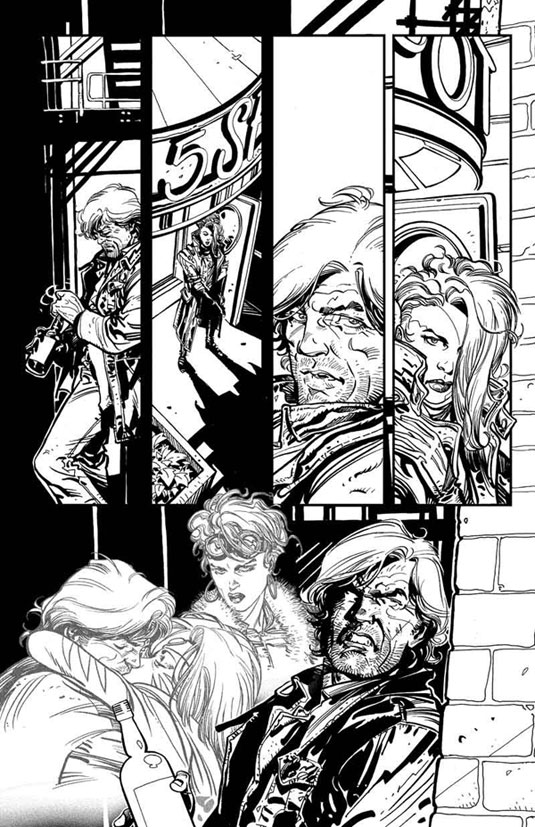
AB: I have, and I remember just how hard the ending hit when I originally read it. It’s just such a mean fucking ending. But after a reread, I will be honest, Point Blank doesn’t hold up as well for me. I still find it a good, solid comic, but it ultimately feels like the work of a young writer; one key aspect of PB supports my argument.

Like how Brubaker writes with a bit of a heavy hand. I mean, it’s a procedural, but I saw this comic kind of slipping into Scott Snyder narration box territory at times (he even uses the issue opening anecdotes). Not that narration is bad, or that words in a comic are bad. It’s just heavily used, and the story seems to hinge itself on that rather than letting the other elements tell the story.

It’s certainly key to view the situation from Cole’s perspective, and the style of writing gives you that, sure … I just would have enjoyed a bit of a balance, though. Because Cole doesn’t necessarily always have an interesting tidbit to tell me. Much of his narration keeps running through the steps, and when it’s not, Brubaker hits certain points over the head. Like how the bar Cole hangs around messes with his head. The whole thing feels so obvious when you read it back.

It’s not that I don’t enjoy procedurals. I do. Point Blank just needed more subtlety because it’s way in your face at times. That type of writing signifies a young writer to me because that type of writing is so forced and only exists to insure the point is made. A skilled scripter trusts the subtle marks he makes. Brubaker’s not doing such a thing in PB. Instead, I think he’s still in the process of learning to tell a mystery plot, and that’s why Cole constantly reviews the steps and highlights things he learned in “spy school.”

Although, PB does manage to keep the super hero stuff out of your face, and that’s what I dig the most about it. Because the whole thing takes place in the Wildstorm universe, but Brubaker and Wilson play it up like it’s Mean Streets or something. The notion of Grifter not wearing the mask really gets that across. Cole even says in the comic he’s not a big fan of masks. Point Blank entertains because its technically this grand tour of a super hero universe, yet it does such a good job of hiding the super heroes. And not by taking away the costumes or simply making them invisible – if anything Wilson and Brubaker put them up front in one, easy-to-find place with the bar set piece. No, they just convey super heroes in a very nontraditional way, so you kind of forget they are super heroes. That’s how they bury them.

I really dug the approach, and it’s something that obviously carried over to Sleeper and Incognito. But that’s kind of what the Wildstorm of this time was doing, right? I’ve read very little of it, but it seems like what’s done in Point Blank sums up the Wildstorm approach. I feel like a lot of writers and artists were working in this somewhat traditional super hero setup yet were doing all they could to go against the tradition. At least, that’s what The Authority and Casey’s WildC.A.T.S. sell to me.

CN: The ‘in your face’ nature of the comic never felt like the work of a young writer, it has always come across to me as the work of a writer letting the character dictate how the story is told. Cole Cash is not subtle. He’s sloppy in his investigation and that’s how the story is told. More than that, he’s also a nostalgic sort of guy, making the style of the captions make more sense. You mention the ‘Scott Snyder captions’ like using that anecdotal style of captions is bad when, really, Snyder is associated with that type of narration because he uses it a lot across a variety of books. That approach works with a character like Cole, because everything about the man is looking back to the past. He’s an old soldier with no war to fight who spends his time getting drunk — and, here, one of his oldest ‘friends’ is shot and he’s determined to solve the case. The past is what drives him in this story. He doesn’t like Lynch, but their past connects them.

It’s that approach that makes this such a tight, compelling read. Brubaker doesn’t just deliver a procedural about solving a crime, he tells it very specifically from the perspective of a character and everything we see is determined by that perspective. So often in comics, writers use first-person narration to offer ‘insight’ into the characters while telling a third-person story because we can see what’s happening. There isn’t a single scene in that comic that Cole doesn’t experience first-hand. It may be faint praise to talk up Brubaker for that because so many of his ‘peers’ get that wrong so often…

You’re right that it’s an odd little tour of the Wildstorm Universe in its way — and that’s part of the point. Like I said, this is a character and a story rooted in the past. It needs to go through history a little and touch on different areas, if only to make Cole feel even more distant from his comfort zone. Nothing is like what it used to be and he’s struggling hard with that. Brubaker picks up the ball on what Joe Casey was doing in volume two of Wildcats in that regard. It’s a story about the pain of memories with the twist being that Cole can’t remember the most important thing in the story.

It’s always struck me as better crafted than Sleeper because it’s a more cohesive whole. Sleeper, because of its nature, slips into a very episodic structure that Point Blank avoids. There’s a throughline in Sleeper, sure, and it’s one that reminds me of TV. Point Blank is more a movie or novella, while Sleeper is a TV show. Ultimately, for telling a large story, I find that the former lends itself to a stronger structure than the latter, if only because the needs of telling semi-self-contained chunks of story isn’t there as much. I love that Brubaker made an effort for most issues of Sleeper to tell a complete story in every issue in some way, I just think that, when looking at the whole, that detracts in a way that Point Blank’s issue-by-issue structuring and pacing doesn’t. In some ways, there is a higher level of skill and craft in writing a series that functions on self-contained chunks like that while telling a larger story. I guess it’s what you’re looking for.

AB: Yeah, I think you’re right. I think it is a matter of what you’re looking for.

What you wrote about the craft of the story supporting the type of story it is makes a lot of sense, and most likely that’s probably how the process went down. And maybe the tight-knit nature of the writing suggests the work of a skilled author, showing that he, Brubaker, can get from Point A to Point B in the most efficient way possible.

Something about that, though, bores me and supports my idea of a young writer crafting Point Blank. I feel as if Brubaker laid out an outline for this story, noting up some sheet of notebook paper, scribbling down how and when he’s supposed to hit certain scenes rather than, say, going with it, trusting his own talent. Granted, I don’t really know how he wrote it, and I’m sure most writers tend to outline their stories in some fashion, but that’s what I interpret when I read Point Blank. Some guy over-preparing a story, containing it to something. Some guy relying a bit too much on the rules of a procedural story rather than writing it how he feels it should work.

I think that’s where Sleeper excels and beats out Point Blank as my area of interest and favor because it is such a sprawling, as you said, episodic, go with the flow type of narrative. And as you said, the structure does leave more room for mistakes, and you’re right, but I also think the room and open spaces in Sleeper make it a very atmospheric, organic work rather than a list of bullet points, which is what I feel Point Blank is.

But as you pointed out, Point Blank is a five issue mini series. It really doesn’t have the room to run like Sleeper, so Brubaker probably just wrote how he needed to. So, maybe, I don’t really have an argument.

But you were starting to explain why you think Sleeper slightly fails structurally. You mentioned that the approach to telling a complete story in each issue didn’t necessary work for you, and that it ultimately detracted from the overall work. How so? (Not trying to be defensive, just interested in your thoughts). How does that approach fail, and what do you think is lost in Sleeper because of it? Just pure craft points, or do you feel it affects the voice and style of the comic in some way?

CN: I’m thinking more of the first twelve issues of Sleeper, I guess. The pacing of those twelve issues seems geared very much to the monthly reading habit. Threads are picked up from last time, but issues stand on their own, tell their own little story. Reading those issues together, there’s a very stop-and-start feel to it. Less like chapters in a novel, more like episodes of a TV show. Which isn’t bad, I’m just the sort of guy who’d more interesting in novels, I guess. Season Two wasn’t quite so bad in that respect. It improved upon that area of the craft, making things a little smoother issue to issue.

On a pure craft level, there isn’t a lot that drives me forward while reading Sleeper. Brubaker makes me care about Carver, but that’s it. It’s all character. The plot, pacing, and structure don’t push me forward at all. Brubaker does some fantastic character work and that’s what makes me keep reading. Point Blank has a story that’s much more geared towards moving forward, reading on. In many ways, Sleeper’s plot could easily have become something entirely different had Carver just accepted his role in Tao’s organization and not fought against it at all. Now, that would have been a different character, obviously — not one SO different, though. Especially once he realizes that there isn’t much difference on either side, he could have shrugged and just gone with the flow. Because that option was always there, the series was definitely executed in a very step by step fashion to provide reasons for Carver to not give up and resign himself to being one of Tao’s best men.

You basically said the same thing about Point Blank, but Sleeper seems to run off an outline a lot. Each issue is another step in pushing Carver in a certain direction. Hell, I can remember individual issues of Sleeper and Point Blank runs together as one big story.

Goddamn, it sounds like I don’t like Sleeper much, doesn’t it? I would like to take this opportunity to remind everyone that that isn’t the case — Alec just suckered me into being the ‘negative’ guy through his overwhelming praise and positivity. All sides must be represented, right?

AB: I only brought out the ever-present crank.

Nah. I think your critiques of Sleeper are fair ones, and I think it’s clear you enjoy the work. Why else would we be writing this?  And honestly, I don’t really believe Sleeper is a perfect work. I may have set this discussion up to spell out a feeling like that, but in all truth, there are issues with it in terms of plotting and direction, and they are quite obvious when you read the entire story in a sitting (or two).  Especially when you read Season 2, which is clearly where the story lost it’s tight focus to adopt a philosophy of “we gotta keep this rolling because Jim Lee likes it and wants to give us money.”

I think that in the end, yeah, there was a clear point to Season 2, but I definitely felt the stretch reading those 12 issues.  It’s really not until Carver decides to pit Lynch and Tao against each other and abandon “sides” does the narrative gain any sense of point. Until then, it’s just more of the same of what we read in Season 1. Carver working for Tao, only he’s not entirely a double agent anymore. I don’t know, it just wanders about a bit in this first few issues of Season 2.

Season 1 was such a determined thing told in a loose, relaxed fashion, and I think that’s what makes Season 2 a bit jarring because I didn’t sense a determined path from the get go. The only thing that sort of inhibits Season 1, I think, is the ending – revealing Lynch alive – because it carries on a story I felt was at a solid enough end point. But Season 1 does have such a strong drive from start to finish, and I’ll agree with you in that Brubaker and Phillips perform some excellent character work – which absolutely propels the reader forward. But I also feel the team creates such a tone, and offers such a cool aesthetic, that Sleeper gets by on more than character work alone. If anything, this is one atmospheric comic where the vibe goes from extreme paranoia, to straight noir, to pulpy vitality in such a smooth fashion, making up for some of the more technical flaws.

But enough of this court session. I no longer want to prove Sleeper’s worth. We both like this comic, Chad, so let’s talk about what works in it and why this has stood out for us.

Let’s take this conversation somewhere new.

Check Chad’s blog, right now,for Part Two.
2 Comments

Filed under Direct Message

Thoughts: Moon Knight #12

One year, and well, here we are. The finish line. Seems like not that long ago I wrote this excited expression, but as I gander at the date stamp, that was February 2011 and so much has changed since then. Moon Knight, by Bendis and Maleev, has come and gone, leaving us now to only label it with one, final opinion before we let the jaws of some long box silence these issues with its might. Because that’s how this works. One day’s hot item becomes another day’s forgotten, tarnished soul.

I guess I could run through the specifics of this final issue, but in all honesty, I’d rather not. Moon Knight #12, like issue 11 before it, only soured my overall opinion of this work. The comic simply acts like any other Marvel Comics wrap up – plot lines are jarringly tied off and hints of future stories find automatic preview. I should have expected no less from this final issue, and to run through the bullet points would only feel repetitive as well as unnecessary because, all of which really needs to be is, this issue was a disappointment.

Past the muck of the conclusion, though, I can recall enjoying this series, and I feel confident Bendis and Maleev gave a fair run at one of the few comic book characters I give a damn about. There are issues of their Moon Knight run which I feel completely capture the character while simultaneously updating him, in some sense, for this 2011-12 comic book, and the storytelling in those issues exemplify why Bendis and Maleev work so well together. The team showed this character to be a capable concept that’s not quite ruined or cursed as some may like to believe, and while not perfect, produced a fine comic book around it.

Some may have read my issue-by-issue posts and asked themselves, “why bother?”, but for me, this comic book did something I’ve been waiting to see for years. It took my favorite character and pushed him forward in some sense while also wrapping his narrative in some delightful sense of craft. At the end of the day, yeah, Moon Knight by Bendis and Maleev falls short due to the usual conflicts and constraints of mainstream publishing, but overall the book seemed to work well enough within such constraints to be something worth a read every month. For me, that was worth covering.

As for future Moon Knight stories, I don’t feel as if I need them. They’ll be more, no doubt, and I’ll probably read along, but in some sense, the end of Bendis and Maleev’s run placed the period on an ongoing desire I’ve had ever since I discovered the character. I’ve wanted a Moon Knight comic in which the character went somewhere new and was produced by top talent, and now that I’ve finally received that dream book, in some sense, I feel as if there’s no where else to go but treat this series as the character’s end and re-read what I already possess.

Does that make sense? I don’t know, but after closing issue 12 I felt oddly full. I’m no longer hungry for THAT Moon Knight series because now I feel as if I’ve finally had the meal, and for the most part, I enjoyed it.

At some point in the future, check back, as Chad Nevett and I plan to discuss this series in one, final written piece, putting a close to Moon Knight by Bendis and Maleev.

Leave a comment

Filed under Moon Knight, Thoughts

Thoughts: Moon Knight #11

I walked away from this one disappointed. No matter this issue’s place as a penultimate chapter, Bendis and Maleev feel it’s more important to make Moon Knight #11 a perfect example of what some complain about super hero comics for. The issue involves a lot of fighting with little point, and it drags out such a thing way past its due because supposedly we’ll enjoy another fight sequence in a comic book. Sure, Moon Knight, under Bendis’ pen, has kept a hand between itself and obligatory action scenes for most of it’s run, but all this newly added violence, rather than act as an appropriate crescendo to a build, stems from a character who’s role resembles a cheap cameo. As I wrote last issue, Madame Masque seemed to appear to act as bridge between this Bendis project and another, and Moon Knight #11 only confirms those previous suspicions. The inclusion of her character really hasn’t lead to anything but an off-putting aside in what was a consistent series, and man, with one issue left, what poor timing to go off on a tangent.

+ Thoughts

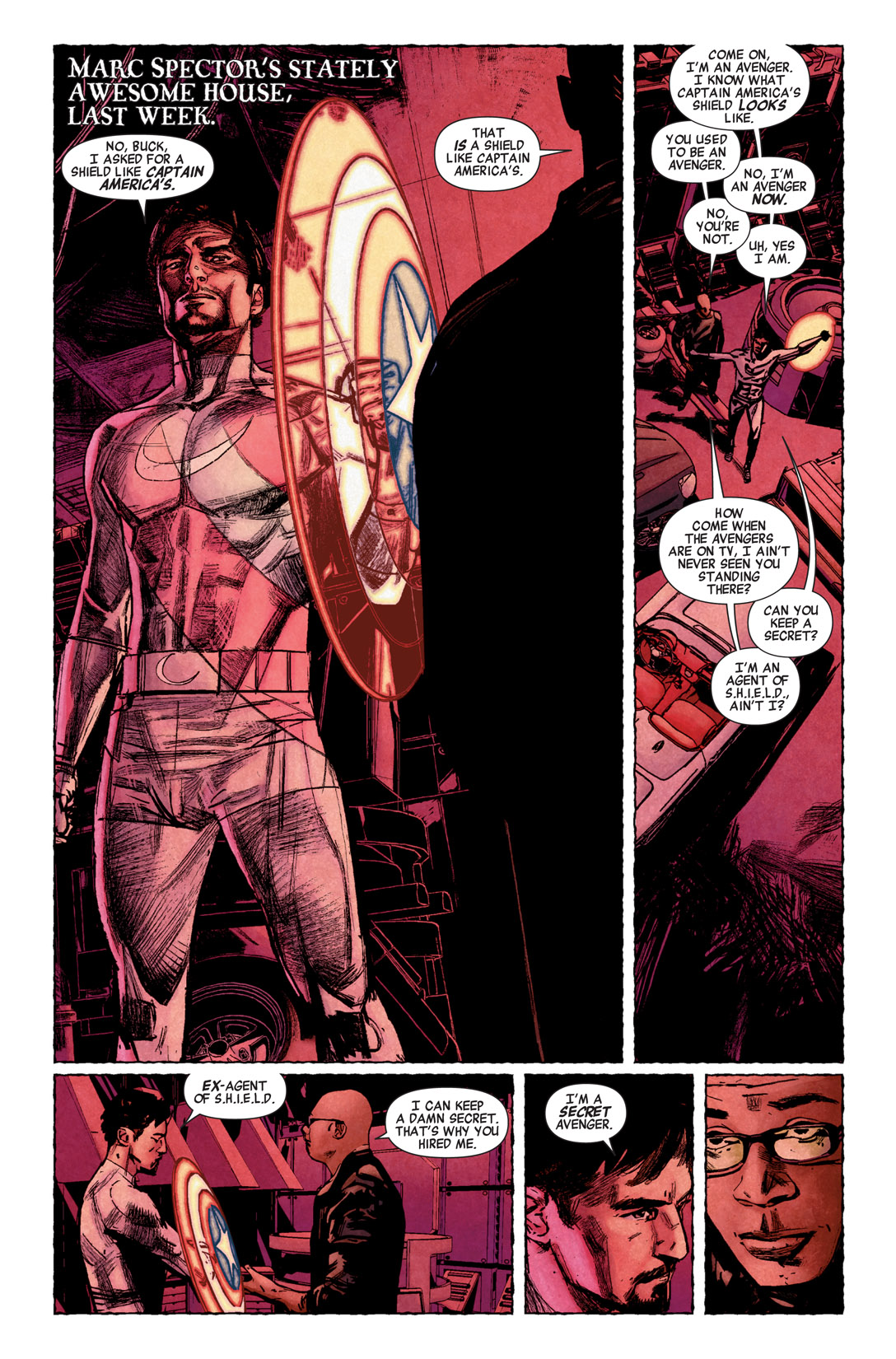
– Echo’s ghostly appearance toward the end makes for a nice scene, and it manages to bring a few things full circle. Granted, it’s a total rip off of Obi Wan in A New Hope, but the bit plunges right down to a key piece of Marc Spector’s character and bluntly calls attention to it.

“Then show me. Don’t just tell me.”

Sums up a lot about a guy who spends more time in his head than anywhere else, and as sad as it may be, the moment emphasizes a relatable theme for the reader. Although the message comes from within, the part Marc’s trying escape, the message isn’t diluted or misplaced. Instead, Echo’s spirit is now a new, little voice inside of him, and and it allows Marc to tell himself to kick his own ass into gear. No better help than self-help, right?

– This one, small panel of Ultron is cool.

The panel provides a menacing flair even though it’s randomly spliced into the page. Dead hollow eyes  cut into a cold, chrome object, and it feels as if this brawl is under the eyes of something larger.  But, aside from tone, the panel reminds the reader why exactly these characters are fighting, making a nice attempt by Maleev to make this entire fight sequence feel like it may have a reason.

– Thoughts

– Too bad that reason’s overshadowed because while the fighting between Moon Knight and Madame Masque revolves around a plot point present since issue one, one of the character’s involved hasn’t been around that long, and her spontaneous appearance hasn’t exactly sported a very good cause. Basing what should be a thrilling struggle on the involvement of a character with little development was a bad move, leaving the entire fight sequence uninspired rather than thrilling. Much of the issue reads like page filler, and it perfectly captures the groan and hiss angry comic readers release when they complain these books contain too many fights. “It’s apart of the genre,” usually encapsulates my typical excuse, but here I only felt the groan most people utter.  Masque may be a fine character in her own right, but here she serves little purpose other than Big Bad’s daughter, and when Big Bad appears to already be back in the game by this issue’s finale, you start to wonder … why transition to Masque at all? What was the point? To show a father/daughter relationship? To show Moon Knight’s apart of some larger, fictional world? You thought it’d be fun? I don’t know. I don’t know other than what I’ve already written – that it connects one Bendis book to another. Which is fine, but this is a poor connection which, ultimately, only drug out this series another issue.

– What’s worse is that the fight’s not even drawn that well. Maleev’s artwork isn’t awful, but something about his contribution in this issue feels off. I’ve enjoyed his work on this series thus far, but issue 11 features a Maleev prone to stiffness and awkward placements of both characters and objects.

This doesn’t work when more than half your issue involves people punching each other. If anything, the artwork only emphasizes what’s wrong with the comic because stiff and poorly composed are about all that describe it.  

Verdict

Weak issue. Not the way to lead into your finale, and right now I’m only hoping Bendis can wrap this up to some degree (although, history says he won’t). When people complain about Bendis for drawn out plots, I usually roll my eyes a bit, but this example has me in agreement- a poor representation of this series and both men’s work.

Leave a comment

Filed under Moon Knight, Thoughts

Joe Casey, Nathan Fox, Haunt

Yep. I remember the joke this idea was originally. Some bet between Robert Kirkman and Todd McFarlane (the businessmen of comics) made at some convention because, hell, they knew it would sell and fashion a TV option somewhere along the line. Of course, that’s complete speculation on my part, but really, such a stretch? Of course, though, like the monthly junkie I’ve been for years, I bought Haunt #1 the moment it dropped and read it like every other pulse pounder on the comics internet. Reassuringly though, I did not enjoy it.  I found the book predictable and weak minded, offering little but some candy coated McFarlane inks over dynamic Ryan Ottley line work. That part, I will admit, was fun. But Kirkman … the dude took a decent concept and cut the balls clean off, crafting Haunt into another comic influenced by everything wrong with the early Image titles and slapping a shit ridden cliffhanger on it. One issue, and I was out. Little did I know I’d be back …

Two years later. Issue 19. Joe Casey. Nathan Fox. Boom. I’m back. And while I am enjoying the comic much more this time around, my feelings aren’t exactly clean cut and gleeful. I have an issue or two with what’s been established, yet that aside, Haunt is now, at least, interesting and energized. Casey and Fox have come onto this project like Alan Moore post-Martin Pasko on Swamp Thing and have given purpose to what essentially started as a purposeless endeavor. The work on Haunt applies Casey’s Butcher Baker, the Righteous Maker philosophy to an already living, breathing comic book series, showing that any bland super hero story can be more than it’s made out to be. Thematically, I think the point’s hard to ignore as Daniel Kilgore, the main character, seems to be on a mission to truly embrace what he is, showing that even Haunt, a bullshit mainstream comic, can dig down, find something within itself and present a vivid package.

To do that though, a hard shift had to occur. Casey and Fox quickly pushed away from the status quo on this one, and they went ahead and set their own direction for it. The team kept one essential ingredient via the actual Haunt character, but between killing his girl, having the cast disappear and throwing our protagonist into a whole new situation, Casey and Fox dissolved everything established about this series and basically said, “fuck it, we’re starting fresh.” This mindset has also dictated the structure and pacing of the run, thus far, as little of the upheaval has been explained. The plot’s been more about doing rather than discussing.  Or, as Casey puts it:

The approach relates to what Casey and Fox want to do with this comic. They’re not here to exactly just continue the tale in place by Kirkman and McFarlane. Instead, these guys are hitting a hard left, trying their best to do something new with Haunt because, obviously, what was already happening wasn’t really going anywhere. These first four issues read like a rescue mission as Casey and Fox do what they can to save this comic book from the path of bullshit it’s on and rehabilitate it into a fine piece of genre work. It’s  no coincidence then that the actual story involves a rescue mission – with Joe Casey, via Still Harvey Tubman, in story saving the protagonist from all sorts of terrible torture.  Granted, Casey could take time to explain story details and keep to this mantra of “fuck it, we’re starting fresh,” but I think the raw “let’s go” mentality of the writing speaks to Casey’s own personality as well as contrasts against a majority of what’s done in mainstream comics. Not slowing down, simply, has a greater visceral impact on the reader as well as offers a grander statement.

And Fox’s artwork compliments all of this. He’s using many midsized panels on this book, but he’s stacking them on the page in a way which moves your eye at a brisk pace. But it’s his style which accomplishes the most, as surface a detail as that is. Fox’s style takes what Paul Pope’s does and removes the iconography from it, boiling the line work down into something a bit more savage. In fight sequences though, I wouldn’t want anything but Fox’s style on my side as the savagery in his line emphasizes the fast pace Casey’s script moves at. For the most part, I’m not aware of any technical tricks or fundamentals Fox may use to tell the story, but there’s clearly more to the actual style and drawings than aesthetic points as the look of his art reflects what this comic is about at the moment. I’d say it’s effective. Plus pretty.

With all this said though, the jumbled manner of the comic hasn’t entirely been pleasing to read.  Not that I need answers or explanations to enjoy a story, but without a reason for an evil church, how can I hinge any weight on the conflict between Haunt and an evil church? My bigger complaint, though, is that I find the chaos a little bit too messy. While I enjoy the freewheelin’ nature of Casey and Fox’s Haunt, the pacing doesn’t exactly read like it’s under the control of the writer. Obviously, I know the hectic pacing exists for a reason, but Casey seems to have maybe even let it get away from him. Ultimately though, it’s more an issue of what this comic book will be. I realize we’re only at the beginning, but I feel after four issues everything’s still up in the air too much, gravity free, waiting on mission control to provide a tad bit of information.

Whether or not, I’m in, but I’m hoping for some development soon. That’s what this book needs at this point. It’s made the rift from the previous material and established a plan. Now, Haunt just needs a little more thought in it to really achieve the More it can potentially be.

Leave a comment

Filed under Uncategorized

Tonci Zonjic on Lobster Johnson

from zonjic's blog: lungbug.blogspot.com

I read these comics while sitting on a park bench, under a comfortably warm sun, class behind me, with college girls in short shorts and retro sunglasses passing by, and still, even with all these pleasantries, this Lobster Johnson mini series felt like the most important thing I could partake in at the time. Looking back, this was probably a pathetic reaction, but I’d like to think I gained a little mental stimulation from the experience. Plus, I have all summer for girls in retro sunglasses.

Aside from the pulpy spirit, Lobster Johnson: The Burning Hand sports a wonderful tempo and evenness which seems overwhelmingly welcoming. The comic comes off as an item comfortable with what it is yet neither is the book afraid to reach for achievement, carrying the standard Mignola mindset which is aware of craftsmanship and structure. There’s a script here that drives the story in a very determined, episodic fashion with character development clearly in concern, but I’d say it’s the work of Tonci Zonjic who really shapes this Lobster Johnson tale into a comic book worth owning.

Zonjic’s work on Who is Jake Ellis? puts forth a tone of Jason Bourne  espionage and a Moby soundtrack song by mixing sexy blacks with saturated colors. In fact, I’d maybe say most of his work on that project was more tone-centric than anything, and while I’m not suggesting one attempt is better than the other, this work on Lobster Johnson chisels out a more technical focus by relying a lot of the artwork’s impact on panel composition and raw storytelling.

from zonjic's blog: lungbug.blogspot.com/

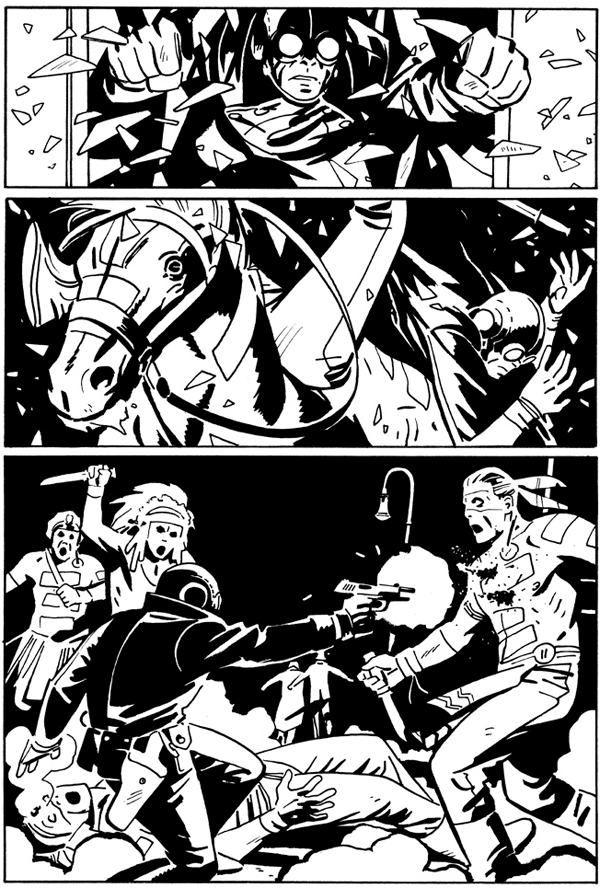
Take the base panel on the above page for example. Your eye starts out with the charging Native Americans, jumps to Lobster Johnson, flows to the gun, follows the bullets into the other Native American, and you follow the shot Native American’s falling arm to the fleeing couple, ending the story contained within this box. Or, something like this:

I love Paint

What’s odd though is that I read this work on the same day I listened to an Inkstuds interview with cartoonist Frank Santoro, in which he discusses how most budding comics creators are so obsessed with style that they lack the skills to construct and maintain a simple narrative. Reading these issues, and then hearing that interview, really reminded me of the comic book artist’s true mission: moving the reader’s eyes.

We live in this era where surface appearance matters so much we forget about the mechanics. I’m guilty of this quite often as I enjoy falling victim to aesthetically charged elements like style and color, and while it’s important to possess unique examples of such things … a story needs a storyteller. Zonjic exemplifies such a thought in Lobster Johnson, and I think some of that focus may come from the script itself because, if you look at it, a majority of Mignola’s books work on the basis of mechanics and grinding gears rather than spunk or sexy spy swag. Zonjic’s illustrating this book rather than making it look cool. He’s telling the story, first and foremost.

Yet, while all of this is true, he does possess a style – a style that evokes certain well known cartoonists like Alex Toth or Sean Phillips, yet while the aesthetic pleasure resides present in the work, Zonjic doesn’t sacrifice anything for it. He’s blended both attributes of his art together for a full effect. I must admit though, Zonjic’s line really hits me. I love the way it blends to what’s contained within it, especially on his figures where the blacks of an arm fold or something mash with the line, making it appear almost nonexistent.

As I did pump up the notion of attitude over mechanics in a previous blog post, I must say, well-functioning mechanics can certainly hit a sweet spot and push a comic beyond common muck. I like that such a thing can remind me of the time and work put into a comic book. The visibility of the artist’s storytelling can really, almost, connect you to that moment when the lines were laid down at the drawing board, and the thought was first thunk.

1 Comment

Filed under Uncategorized

Thoughts: Moon Knight #10

There’s a tiny bit of crying in this issue, but little of it sticks as the story quickly beats on to the falling action. Aside from Spector, Detective Hall and Snapdragon reappear, and for some reason Madame Masque is now involved.  The matter of the Ultron head also veers its head into the scenario, and … Ah, whatever. Just read the comic.

+ Thoughts

– The first two pages of this issue are pretty strong, even though the first page is just a repeat of last issue’s finale. The inclusion of it here works though since, one, it’s a pretty cool page and, two, it reestablishes the stakes and places page two in context. As for page two, eight horizontal panels work well to convey a sense of carnage and mean spirit. The reds in place by Matt Hollingsworth bring out the pain, and Maleev’s choice of stacking the panels in such a way, with use of two vertically streaked, solid red shots, creates a clear idea of speed, moving the reader through the reading experience in a fast, bold, brutal fashion. In one page, Maleev translates the core of the fight we barely even see, and we understand it completely. Plus, this execution simply declares Echo as dead without any dramatic last word or final breath. She’s fucking dead, and Marc’s pissed. That’s all we need.

– The scene with Marlene at first concerned me. While reading, I was caught off guard, and I thought Bendis was all of the sudden bringing back past baggage. But really, it’s another dream/headtrip thing, and it’s in place to remind the reader of where Marc Spector’s been before and, not unlike Spider-man, the dude possesses some guilt. The scene works, feels appropriate and places the circumstance of Echo’s death into even more context. It also presents some indication of mourning from Marc’s character without getting too sappy or unnecessary. Also, the shot of Marc’s face in the last panel on page five presents a wonder example of Maleev’s talent for facial expressions and human likeness. Someone make that a Twitter avatar.

– “Wolverine” telling Marc to suck it up and quit moaning was cool. “Quit bitchin, bub!”

+/- Thoughts (neutral ground)

– The overhead shot of Echo’s body on the autopsy table is a shot that often reoccurs in Bendis’ work, conveniently placed lamps and all. In an early issue of New Avengers, it’s done with Spider-woman. Later in Secret Invasion, it’s Elektra’s skrullified corpse. I have to assume the writer indicates the artist to draw this particular shot in this situation, as this same shot has occurred with three different artists (that I know of). It’s no surprise that a comic book artist would have familiar, go-to shots, but I find the practice by a writer interesting. Could say a few things about Bendis’ scripting style.

– Detective Hall and Snapdragon … I guess I’m happy to see them again? I don’t know. No opinion.

– Thoughts

– Madame Masque really comes off like a poor excuse to connect this dying series to Bendis’ larger catalog of work, and ultimately her appearance can only mean just that. It just seems a little late in the game to introduce a new villain to the story, and the reason for it is simply weak. Count Nefaria is hurt. OK, but isn’t that more interesting? Having this crumbling villain, who has lived most of his villainous career as a figure of power, go up against what is essentially a normal man? That scenario contains much more conflict and emotion than this substitute, tie-in shit we’re about to witness. Also, the whole thing voids the build-up of Nefaria as West Coast kingpin, making me wonder: why not Madame Masque from the start? Why wait until issue ten, of a twelve issue tale, to introduce her? Because, Bendis and Marvel need a story next summer. Plant those seeds now.

Verdict

This issue doesn’t loose much steam. While a death has occurred, Bendis and Maleev keep the story on task and weave the plot together so it marches the complete narrative to its planned destination. Madame Masque though, man. WTF?

Leave a comment

Filed under Moon Knight, Thoughts

BlahBlahBlah-Attitude-BlahBlahBlah

Sorry. I couldn’t think of a title.

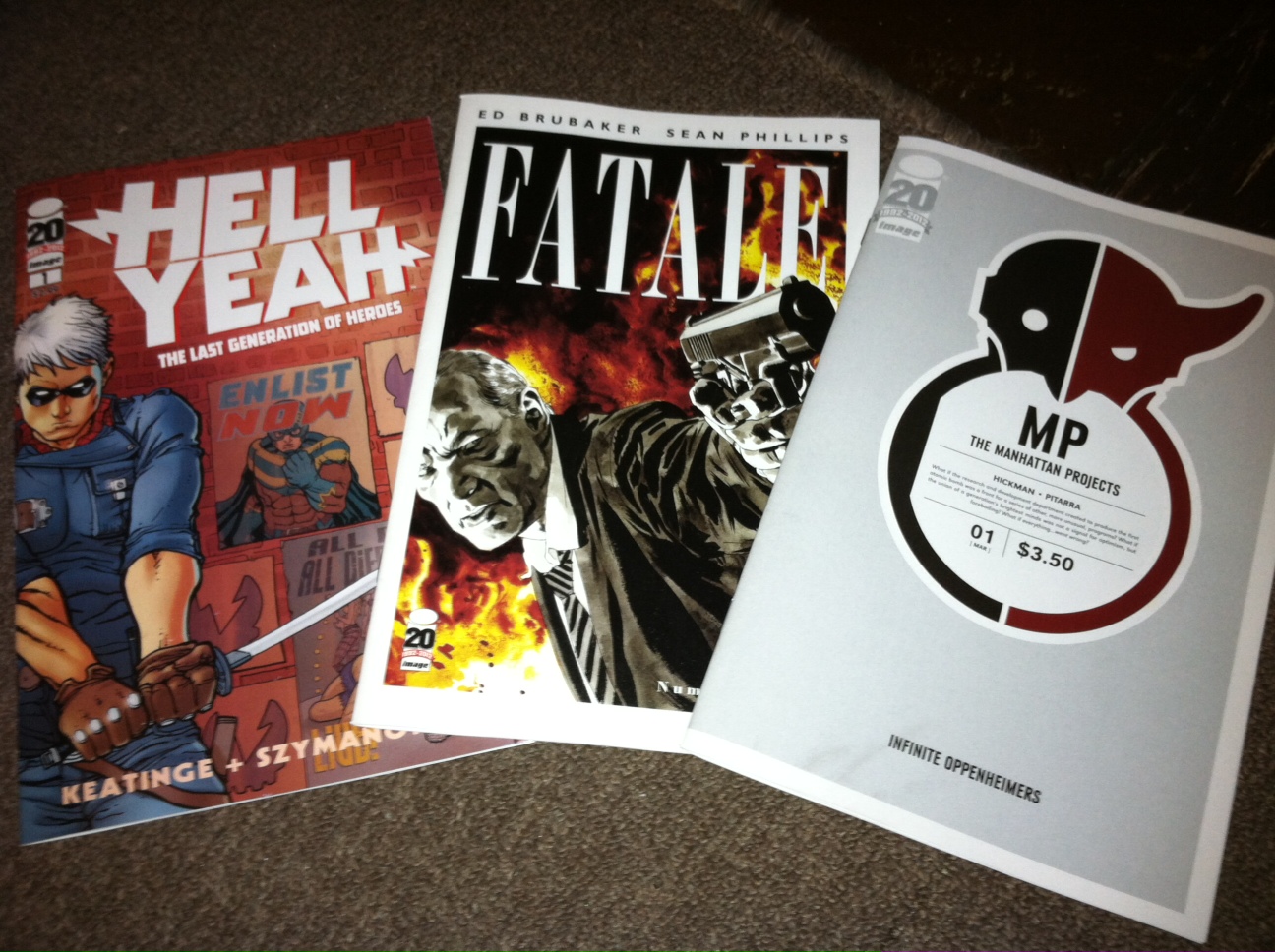
I bought and read three comics published by Image last week, and I wholeheartedly enjoyed each of them.

But aside from any craft or good time, something else about these comics struck me – the “newness.” Or, the energy.

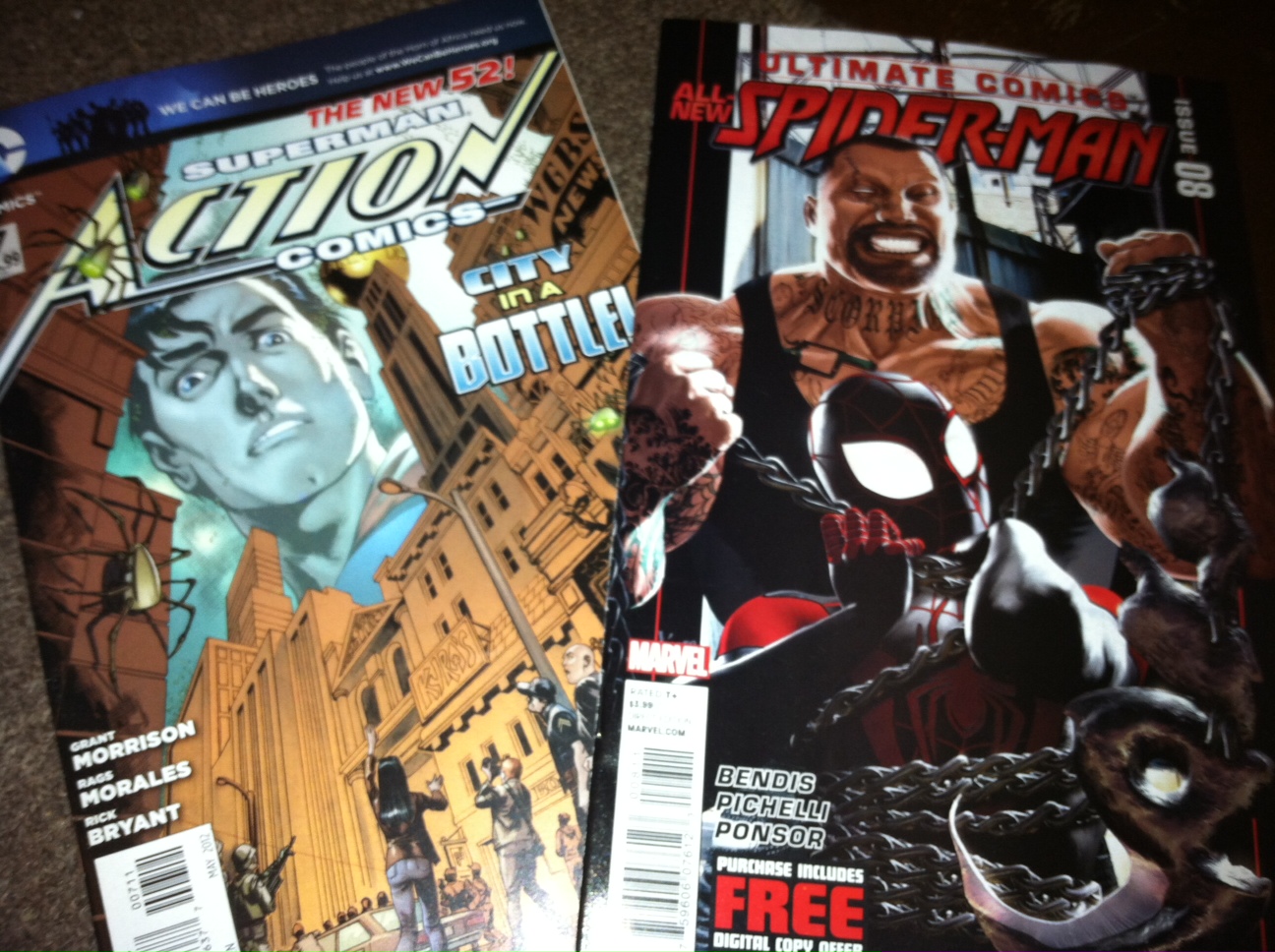
Because see, alongside these comics, I also read two tried and true establishments.

And while they were OK, I left the reading experience unaffected and neutral.

So I began considering why and how the energy of the Image books hit me and caused a genuine excitement. They weren’t the best comics I’d ever read, but for some reason I walked away refreshed and hyped up about comics again. Why? And why had the Marvel and DC books left me indifferent all together. I think I’ve come to a conclusion. The difference is attitude.

Beyond technicalities and skill sets, attitude always screams loudest. That’s the personality of a work; the objective set of details is just makeup around the face. Being an artist, or making art … the goal is to communicate an emotion or make the work reflect the personality of the maker. It’s never really about filling a position or meeting a deadline. An artist works to make pieces that represent him or her in order to share oneself with the world. By that definition, attitude really becomes key to the success of the work.

With books like Hell, Yeah, Fatale and Manhattan Projects, there exist certain genre types and tropes familiar to other stories. These comics are new, and feel new, but in reality they’re made up of other things. Hell, Yeah works with the common knowledge of the super hero while Manhattan Projects takes elements of history and twists them for fictional use. Fatale blends two genres under a version of Brubaker and Phillips tinkering with their manner of storytelling. These books are composites. Not exactly New.

But they feel new, and that’s because the creators behind these books are approaching the production with spunk, shifting these collages of concepts into ballsy, confident comics that really, actually, represent the creators rather than carry their names in order to pay them.

But aside from the outside factors and creative origins, the books themselves embody that spirit. Brubaker and Phillips, rather than selling another one of their projects or doing some oddball off-shoot project (Incognito), seem to actually be messing around with how they tell one of their stories. Especially Brubaker, who’s script on this one offers up some interesting characteristics unfamiliar with most of his previous work – things like the point of view of his narrator or the construction of the plot. He’s made the story enticing by switching it up, and Fatale doesn’t exactly read like another Bru/Phillips collaboration. Hell, Yeah, just from subject matter, captures a younger, rebellious outlook, but I’d also say Keatinge’s script, with it’s quick cuts and particular voice, signals something confident. And Manhattan Projects … Nick Pitarra’s line work may heavily evoke Quitely, Darrow and Moebius , but I’d still claim the work possesses a forceful ability to grab attention. Hickman even seems to have something a little different under his belt. I mean, the comic still stars a a bunch of powerful men in charge, trying to save the world from itself, but the way he’s writing these characters appears a little more thought out than most of his recent attempts. Because, you know what, they’re actually fucking characters and not stand-ins for concepts.

The Marvel and DC books I read completely lack any reason, spark or care. They rely on the subject matter rather than attitude because the common readers of those comics are invested in the characters and familiar worlds they typically read. Attitude does not matter to them. They’re spending money to witness fictional occurrences.

Either way is fine, and either way can be entertaining, but from my experience it feels like attitude really is the correct way to go. I’d even say a creator, if in the position, should sacrifice technical efficiency and craft purely to convey a spirit or voice because, for what I want out of comics – artworks- it’s much more ideal for an artist or writer to generate an emotion via a work rather than tell a story, necessarily. Don’t get me wrong, I always want a sound story, but an emotional response to a work seems to invite a much more satisfying reading experience. Of course, though, the ideal route involves both.

The Image books do tell stories, though. They’re far from abstract. They’re genre comics. I found it refreshing to read a handful of genre books which exuberate such enthusiasm and primal response, though. Because, honestly, I walked away from those books hyped up and ready for more. That’s an emotional response I’ve forgotten to experience when reading my monthly comics – pure, childlike excitement. Which for genre comics, should always be the goal. The super hero market has sort of twisted that, though. The game is now more about continuing the soap opera than making the blood pump.

It may read cliche to type this, but the statement “creator owned comics offer exciting work because the creators are free to do as they please” works here. Between the last Marvel books I read by Hickman and Brubaker and these Image titles from the same writers, these Image titles clearly win out. These guys are making these comics because they want to not because they have a mortgage to pay. But, the statement “creator owned = better” isn’t always true. Sometimes the creator owned market can remain just as contrived and pointless as mass market comics. Oni Press knows what I’m talking about. Even other Image comics portray this (Thief of Thieves). And the stream can also flow the other way. Mass market super hero books can also channel an attitude and evoke an emotional connection. It’s possible. It’s been done. Read Uncanny X-force, for example.

So, what’s the point? Inspired work beats out soulless tradition every time, and while that point isn’t exactly new or profound, I feel a few of these new books in publication at Image exemplify the point in a nice, clean, current example, and I find the enthusiasm they’re bringing to genre books, the recent stepchild of the medium, engrossing as well as needed.

Of course, attitude, while I prefer it, can’t always be the ultimate decider of whether or not a work stands the test of quality. Some case of objectiveness has to enter the debate at some point to keep things in order. Otherwise, things tend to get a little too unpredictable as well as unmeasurable. But, maybe reading comics isn’t really about taking measurements or ranking books according to some universal rubric? Maybe the heart of the matter is simply about what you take away from what you read and the reaction you have?

To be clear though, my focus on attitude isn’t just some excuse for the quality of these comics so that I may praise them. This also isn’t some rallying cry or Team Comics fuckshit for creator-owned books. I just enjoyed what I read. Even without the aesthetic charge or surface buzz or the claim that they’re “trying something different,” I’d still cite these comics better than, not only Action Comics or Ultimate Spider-man, but most other monthly stuff I’ve read recently. These books are sound and well put together.

You be the judge, though. I know some people completely hated these new Image books, and I can respect that. But fuck it, I’m having fun.

3 Comments

Filed under Uncategorized

Thoughts: Moon Knight #9

Two months later, and I’ve finally decided to jot down my thoughts on Brian Bendis and Alex Maleev’s Moon Knight once again. Between laziness and realizing the meticulous behavior of doing issue-by-issue commentary, as well as trying not to repeat myself with every new issue, these MK posts took a backseat, but since it’s been announced the series will end with issue 12, I figure I should at least finish the task I took on. I can’t promise these last few posts will be as heavy as the first 8, but I’ll make them as interesting as I can, and once it’s all over, I’ll write a nice overview essay of the series. That’ll last longer anyway. For now though, some quick thoughts for the sake of putting them out there.

So this issue contains a lot of fighting and internal struggle, making it a pretty fitting climax for a story about an uncertain super hero with a multiple personality complex. Count Nefaria, the owner of a monocle and power boner, who’s fought Thor, the Avengers and some X-dudes, comes back from his last appearance to belittle and beat Marc Spector, and he chooses to do so by killing Spector’s girl and driving him up an emotional wall. After 20 pages of combat and dialogue between Spector and the voices in his head, the issue ends with Spector loosing his crayons and adopting his Wolverine persona in a whole new way, leaving the reader on a cliffhanger of rage and bloody fists. Sorry. I hate summaries.

So, Random Thoughts style, here’s the rundown.

+ Thoughts

– I definitely consider this to be one of the better issues of the series. Maybe the best, but I’m not sure as I haven’t read the others in quite some time.  But it’s up there. Why? While it may sound cheap, the book gave me what I really wanted to see, which was a visually enticing fight involving Moon Knight, in costume, drawn by Alex Maleev. Say what you will, but I enjoyed the payoff because, unlike almost every other super hero comic, Bendis and Maleev’s Moon Knight hasn’t involved much fighting or super hero action. The series has kept those elements to a minimum, building the tension between the reader and what’s on the page. This was a necessary fight, and while the battle involved a villain, the real fight took place in Spector’s head which, at the heart of this book, has been the scene of conflict all along.

– This comic incorporates the downward spiral of the story into the pacing and plot. If you notice, the issue begins with Marc on the roof of a building, and it ends with him in an alley. The entire fight moves from top to bottom, reflecting the events within the issue as Marc enjoys some classic hero versus villain fisticuffs until he’s in the street, watching his lady friend die. The consideration on this level speaks of the craft put into the issue, and it reminds that not all Big 2 books are thrown together chunks of shit. Thought went into this, and it’s an especially wonderful touch as the descent provides Maleev’s artwork with an extra bit of movement. A lot of his shots in this issue are horizontal or slanted to accommodate the high-to-low battle, and from this Maleev works the fight into a fluid, lively piece. And, of course, the descent in setting reflects the peril of our lead.

– I found the cuts between Buck/Marc scenes and Marc/Cap/Spidey/Wolverine scenes affective for their ability to present some background and explain the origin of Marc’s new weapons, yet I also feel these scenes simply act as quality transitions in order to introduce each personality Marc’s carrying around in his head before we witness the internal dialogues of the issue. These back-and-forths come off as bold and stylish.

– Thoughts

– This is sort of cheap, but I honestly was a bit bummed about Echo’s apparent death. I liked her. She made a lot of sense in this series, and it seemed there was much more to the character than previously hinted. But, for the story at hand, her death is the most logical way to progress the narrative and place Marc Spector where Bendis wants him. So, on a matter of storytelling, this move works. And anyway, I’m sure she’ll be back in some other Bendis project somewhere down the line. That’s the way this shit works. But, for now, I’ll honestly kind of miss her. Pathetic, I know.

Verdict

Good fucking issue. It certainly positioned the story in a new way. I’m ready for more, and I guess, the coming conclusion.

Leave a comment

Filed under Moon Knight, Thoughts

No Clever Title Needed | 02-06-2012

I’m alive, I assure you. Just trapped in this schedule of real life responsibilities and other online writing duties I’ve made for myself. But, hey, I’m not complaining. I could be waaaaay worse off. I like working. I just hate how bad I procrastinate because it’s beginning to bury me in all the work I have in front of me.

I updated this blog exactly one month ago, and since, nothing new from me has surfaced on here. I apologize. By now, my planned posts of Ultimate Spider-man nonsense should be long settled, yet I haven’t even begun essay #2. No fear. I haven’t given up. Not by a long shot. I’m just taking care of the priorities at the moment  – like wonderful school. As soon as the time presents itself, this blog will receive my full attention. I still love writing about comics. That shit still remains.

So where do I pick up? God, so much has happened in terms of comics. Ah, fuck, why don’t I just begin with some good old self promotion? I’ve been up to things.

I’m unsure whether I ever officially made the announcement here, but I am now an actual staff writer for Spandexless.com. I couldn’t be happier. Honest. I’ve dabbled in other site writing gigs before, *cough*PopMatters *cough*, and I can say Spandexless has yet to enforce a strict, tyrannical stance or tamper with my writing. Both Beth and Alex, the editors, are way cool, and seem to be open to anything I’d like to write. And better yet, they let my words go, only editing the necessary bits. I enjoy that. PopMatters completely rewrote shit and left my name on it to take the fall …

So, go check out a few of my favorite pieces posted over there thus far. Especially this interview I conducted with Twisted Savage Dragon Funnies editor Michel Fiffe in which we discussed process and his comic book Zegas. I had fun with this, and Michel is an ultra nice guy.

There’s also this review of The Black Forest, an anthology published by a Pittsburgh art collective.

Whoo!

I recently received a promotion at the college radio station I’m involved with, U92-FM, to head up their local music show known as The Morgantown Sound. While it’s certainly a radio show, Morgantown Sound also involves booking and recording live bands from the region for eventual broadcast. In fact, that aspect of the program is quickly becoming the main feature.

So far, I’ve had some success with it, and I’m quickly falling more and more into the project. As of now, I’m the show’s producer and receiving a pay check. Can’t complain there. More importantly though, I see this as an opportunity to actually have an affect on the local community and possibly build a hub for local music and add to the Morgantown culture.

There’s a great history there, and I’m looking to build Morgantown Sound into a living document of the city’s music scene, both past and present.

For now, you can check out this newspaper article I was interviewed for as well as the actual Morgantown Sound blog. Right now, it hosts a few recordings we’ve done. In the future, it will be home to much, much more, and I’m sure you’ll hear me mention it again.

Before Watchmen. I’m not into it. Here are my thoughts, which I posted on a forum after reading page after page of odd support for the project.

I’m going to sit in the cynics camp for this argument as well.

DC legally has every right to make this move, and I’m sure it’ll make them more money than I’ll ever personally make. That’s cool. I won’t even argue DC fucked over Alan Moore. I’m not subscribing to any thought that they slid their hands together and giggled as they signed the original deal. if anything, Moore thought Watchmen would be his after a year, and DC would have contractually given it to him if the book would have gone out of print. The drive of capitalism kept the book in print, though, so DC kept to their side of the deal. Moore’s smart enough to have possibly thought of such an outcome.

No, my beef is purely with what I think this announcement says about comics at this point. It shows that the industry has come as far to no longer honor anything. Nothing remains sacred. Not that anything has ever been sacred in comics. Ideas have been exploited for decades, but it seemed that even past that Comics had a little class to recognize and protect a few, specific ideas and works. Before Watchmen says that Comics has moved past that. There’s no longer any honor, not even a %. Instead, everything’s for sale, and comics is now entirely an industry rather than partially being one. In my eyes, at least.

I know. It’s cynical. it’s a childish stand to take, and I’m sure most will laugh as they read this post, but I honestly felt a bit sick when I read this thread because it even cemented the idea a little more in my head. No one cares anymore. Instead, everyone wants what they want at the end of the day. They want more Watchmen. They want sales. They want Darwyn Cooke. And it’ll all be justified any way possible.

And don’t even give me the argument that “comics are all about exploitation.” Yeah, that’s true, but I find it very sad when people seem to just except that idea rather than want to change it. Before Watchmen is just another mark in the long history of exploitation comics holds. And not just creator exploitation, but idea exploitation. Moore’s right when he says DC is running off his ideas from 25 years ago. Before Watchmen is completely derivative of something he made. And, yeah, he did make it. Sure, it’s inspired by Charlton, but I think Watchmen’s finished product stands so far from Charlton it’s its own idea.

And Moore’s not a hypocrite. Chris Mautner says it well:

“And the fact that Moore has frequently drawn upon classic literary material in works like Lost Girls and League of Extraordinary Gentlemen is also irrelevant (although let me make an aside here to say that there’s a big difference between building a pastiche using familiar characters and motifs to create something new and original, and rehashing familiar material to make a quick and cynical cash grab).” http://robot6.comicbookresources.com/2012/02/weve-come-so-far-on-before-watchmen-and-creators-rights/#more-105188

Basically, I feel Before Watchmen has taken Comics over the edge. The mainstream side of things has been dying away in my eyes for months now, and this has managed to kill it completely. It’s simply not a matter of “should they or shouldn’t” or even Watchmen itself. Instead, this is about something larger. Is Comic just enough cog in capitalism’s machine or is it the special, intimate, thoughtful industry we’ve all made it out to be? Before Watchmen surely says cog.

Later, after being called naive because I thought the comics industry was nice and rainbow-like, I posted:

It’s not about bubble bursting. It’s more about the acceptance. This seems like a clear instance where people could, understanding the circumstance of it, turn their backs on Before Watchmen. DC will publish it nontheless, but audience reaction will determine it’s success. From where it currently stands, it seems DC will win out.

I’m not sure if that would have been the case 5 years ago, but after Alan Moore’s code seemed to get in the way of everybody’s fun, people seemed ready to rebel against the old man. I guess this is the result.

I don’t know. The entire argument is dumb. If anything, read these two pieces.

http://4thletter.net/2012/02/newsarama-needs-to-do-better/

http://robot6.comicbookresources.com/2012/02/weve-come-so-far-on-before-watchmen-and-creators-rights/#more-105188

—-

I’m tired. Bye.

Leave a comment

Filed under No Clever Titled Needed

Those Issues of Ultimate Spider-man I Didn’t Read | Part 1

I know it’s technically Ultimate Comics Ultimate Man Spider-comics Spider-man now, but to me the Brian Michael Bendis series is simply Ultimate Spider-man. Three words. One hyphen. That’s it.

Some time between 2008 and 2009, Marvel Comics decided to publish a comic book mini series entitled Ultimatum. It’s purpose? Totally wash away Marvel’s special line of comics known as the “Ultimate Line” and leave the debris in a position to rebuild after – a little retcon fueled disaster event to get all the fans up in arms. Written by Jeph Loeb and drawn by David Finch, Ultimatum took Marvel’s line of “limited continuity,” “free from Marvel mainline crud” comics and injected it with its own dose of Marvel hysteria and event comic chaos. Ultimate Comics, a subdivision of Marvel Comics traditional 6-1-6 line, suddenly found itself uprooted in limbo after nearly ten years of consistent focus and “left alone” mindset.

It was right at this time I dropped Ultimate Spider-man. And when I say dropped Ultimate Spider-man, I don’t mean “I bought it for 3 issues and then tossed it off my pull list.” No. I dropped Ultimate Spider-man. Like a “after buying it for 60-some issues and then going on a fanboy rampage” kind of drop.

To cut it short, the entire reason for dropping the title was an extremely dumb one. Basically, David Lafuente did not equal Mark Bagley (clearly because he is much better), and without the visual voice of Mark Bagley Ultimate Spider-man was no longer Ultimate Spider-man. Granted, I did buy the Stuart Immonen stuff, and I tolerated it (I clearly had poor judgement in the early days),  but when Lafuente showed up, it pushed such a drastic change that the title I came to count on left me hanging. I dropped that shit cold. Cried about it on the internet. Did the fanboy thing. Hard.

Looking back, the whole thing was not my most respectable moment. The excuses I had for “hating” the Lafuente work are things I would easily laugh at anyone else for saying today. But, at the time, my interest in Ultimate Spider-man suffered a fatal blow, and from then on I would do my best to avoid the book. Just up until recently.

I’ve gone back, and after a little back issue hunting (remember that shit?), I’ve managed to read the entirety of Ultimate Spider-man Phase 2 a.k.a. what I’ll term the “Lafuente Era” as well as “Death of Spider-man,” which is everything I missed during  my great purge. And what’s funny is, “Death of Spider-man” aside, this is probably the best portion of Ultimate Spider-man overall, and I skipped it. I’d even consider it a little crown jewel in Bendis’ entire career at Marvel because the “Lafuente Era” of Ultimate Spider-man did it right. Between a combination of aesthetics and pure storytelling, Bendis and Lafuente captured the essence of the teenage super hero story, fulfilling the entire concept of Ultimate Spider-man, at a higher level of craft, some 140 issues from its beginning.

But something had to be sacrificed in order to achieve that short stretch of issues. A notion of consistency. Maybe the above bits of my personal back story were simply that – personal bits – but I feel the interruption or shift I felt as a long time reader actually reflects an overall shift in this long running comic book series. Look back at it. Ultimate Spider-man, for something like 8 years, marched on at a steady pace, with consistent aesthetics, telling the same, focused story. 8 years.Ultimate Spider-man may be one of the last comics of its kind to accomplish such a run, and between the book’s own determined focus and my infantile attachment to it, the crashing wave of Ultimatum, and the shake up that followed, put the whole operation in rough waters.

So this, ladies and gentlemen, is the story of how Brian Michael Bendis did his best to steer his saga of “power and responsibility” clear of murky waters and keep it afloat. Of how a relaunch, a renumbering, a death and a rebirth – all in the course of two years – tried their hardest to derail Bendis’ solid 8 year train. For my next few blog pieces, I’m going to take a look at the period of Ultimate Spider-man I didn’t read. The “Lafuente Era,” but also the PR stunt known as “Death of Spider-man,” and I’ll even dive into the more recent version of the title featuring the character Miles Morales. The purpose? To discuss each as an individual work, but to also try and connect the three shifts – “Lafeunte,” “Death,” “Miles” – and see how they each represent their own version of Ultimate Spider-man as well as represent a period of identity crisis for a title that was once so sure of itself.

But I’m getting ahead of myself. Up first, the “Lafuente Era.”

None of these issues are perfect, and neither when paired together do they create a perfect work, but I’d mark the first 6 issues of Lafuente Spider-man closer to perfect Ultimate Spider-man than anything else.

Big, hyperbolic statement. Maybe I should back down, but it’s true.

What this initial arc accomplishes so well is providing the perspective of Peter Parker, or more or less, really putting the reader behind the eyes of a teenage super hero, placing him or her into that world. Which makes sense. The title of the arc is “The New World According to Peter Parker.” And while it’s clearly a mark of Bendis’ pen that brings about this focus, David Lafuente obviously makes the huge impact because it’s his contribution that inspires the youthful attitude as well as energetic bounce.

Looking at his artwork, the energy comes across as hard to deny. Speed lines up in your face. Expressive style. The vibrant colors dubbed on by Justin Ponsor. The elements are there for explosive comic book art, but the component that really catches the attention and sells the performance is the roundness and curve of Lafuente’s line work. It’s the element that captures that sense of motion you experience while reading a Lafuente drawn comic book. The curves seem to suggest a youthful vitality and plumpness, and it’s such a contrast from the muscle tight, skinny aesthetic Mark Bagley provided. There’s life there. A freshness, versus the 1990s-heyday look Bagley performs.

But motion derives itself from another element important to this comic. Lafuente uses a nice array of vertical panel structures throughout his entire stay on Ultimate Spider-man, which I found to be an interesting choice in page design as well as storytelling. First, the focus on vertical direction relates itself well to the Spider-man character, the subject of the piece. The character travels and fights in an acrobatic, vertically dependent fashion. The panel structure Lafuente insights sort of places the subject in an ideal environment, allowing the actual illustration to rest in a frame that works with it rather than simply houses it. Second, this is Lafuente’s way of dealing with the “Bendis Problem” I think most artists face when drawing one of his scripts – talking heads. Where long, horizontal panels tend to slow down a story in order to suggest a widescreen affect, vertical panels seem to quicken the pace by providing this quick cut movement to the page. This speeds up the scenes drenched in dialogue while making it visually exciting. But it also effects the actual dialogue. As a reader, you’re reading these sequences in a cut-to-cut fashion, so you’re reading faster. Which works. Teens tend to talk fast, and it’s already a tone Bendis writes in when writing Ultimate Spider-man so Lafuente’s contribution to the storytelling matches up very well, emphasizing what Bendis does.

So while curved lines and vertical panels suggest youthful energy, I would also suggest the actual style Lafuente draws in adds to the youthful perspective. I’m not at all an expert in manga, but Lafuente’s style is certainly manga influenced. Manga stylings have been creeping their way into American animation for years, and in this day and age it’s sort of won out with the younger audience. Anime, manga … it’s what the kids are into, and I know from experience, most high school kids that like to draw … they draw in an anime-inspired style. This suggests to me that a lot of younger people sort of automatically dub a manga influence to maybe the things they imagine – as in cartoons, drawings. So the visual design sort represents that teenage perspective in terms of illustration and what else, but more importantly, it simply represents an aesthetic that’s popular at the moment, popular especially with a younger demographic.

Bendis certainly does not freeload on Lafuente’s talent, though. While the writer plays up the usual plot elements of supporting cast and riff-heavy dialogue, it’s Bendis’ attention to teenage specific conflicts that really cements the desired perspective. I think issue 1 lays everything out so smoothly, especially the first page in which we see a single close up of Peter Parker’s face as he reviews the details of his life.

“My name is Peter Parker. I am Spider-man.”
“I was bit by a one-of-a-kind spider and now I have one-of-a-kind spider-powers.”
“I’ve saved the world. Or at least helped save it.”
“I almost died doing it. A couple of times. For real. But I didn’t.”
“I’ve fought bad guys of every shape and size. True bad guys. World-class villains. Bad bad guys.”
“I’ve met super heroes, icons. Captain America. Yep.”
“You’re talking to a sixteen-year-old who can swing across the city on a web line he actually invented.”
“A guy who can life a city bus over his head. A guy who has fought the Hulk and walked away from it.”
“We’re talkin’ vampires, mutants, Doctor Doom, Sandman, Green Goblin, Doctor Octopus …”
“I have already seen and done more than most people will ever get to do in their whole lives.”
“And now I have one question, and I want you to think about this very carefully.”
“I want you to look my in the eye and I want you to tell me:”

“Do you want fries with that?”

Turn the page, and you discover Peter works at some shitty fast food joint.

I love this opener for its flow and build up, but even more for the attitude it suggests – and it’s something I can completely relate to. That feeling, that when you’re a teenager, you know everything, have done it all, yet you’re still subjected to adults looking down on you. Now, while Peter certainly has done it all, the scene still captures that vibe of “desired verification” from an adult audience by simply its setting. Peter’s out of the costume here. He’s on the job, looking like any plain slub who can work a cash register. No one sees how special he is, or how special he sees himself. He’s just on the job, doing what anyone could, in an environment where adults run the show. And that’s shown when an elderly woman confronts Peter’s manager, another adult, and falsely accuses him of being a smart ass. While falsely accused, the manger automatically assumes the old woman is in the right and degrades Peter without hearing anything Peter has to say.Because he’s a “kid.”

The writing here even backs a classic “Peter Parkerism” – you know, “Puny Parker. He’s nothing special.” It’s a sort of cast off line Stan Lee would write for Flash Thompson all the time, but it sort of comes along and lives in this scene, summing up a very real thought felt by many people in their teenage years.  That sensation of not being  understood and the desire for respect from those older than you.

But that’s one, specific example. Really, it’s a case of the first 6 issues as a whole. To sum it up, when read together, “The New World According to Peter Parker” just reads like a very solid pop super hero comic in which the youth perspective is at the forefront. Whether it’s simply being placed in a house full of 16-somethings as Aunt May continues to take in and house many of Peter’s friends or the high school relationship drama, the first six issues of Bendis and Lafuente’s run are all about a youthful aesthetic and voice. And it’s done. Well.

The antagonist of the first arc, Mysterio, even supports what the creators are after as the character is really one of the few adults shown in the story. His villainy, then, comes as no surprise. He’s that adult looking to crash the party and subject his creed on the kids. This thought eventually reaches its climax as Mysterio learns of Peter’s super hero secret and attacks him at his very school, suggesting no place is safe.

A fair criticism of the Mysterio plot line may be it’s seeming lack of motivation, but I felt the character’s unexplained presence actually supports the theory I’m implying. Mysterio, as the original Steve Ditko sprawl of fog and green latex, worked under a faceless guise, and such a tradition is carried over to this new vision of the character where facelessness works in favor of an unexplained origin or purpose. What we know is that the character’s a bad guy who wants Spider-man, or “Spider-boy” as he once refers to him as, dead, and that makes him scary. It’s not the reason for his villainy or his background. It’s the simple surface of the character’s guise which suggests a sensation of the unknown that makes him frightening, and it’s the idea of a faceless threat which suggests something untouchable. A greater projection of an idea – which is certainly something Mysterio usually concocts with his “super power.” What better way to represent the “evil” adults than a single, identity-free super villain who just happens to be one of the few adults in the story? Why not represent that in a character who’s more like a force than just a individual man? Of course he doesn’t need a motivation. He’s just an old man trying to ruin the youth’s fun.

So that’s really, kind of the first 6 issues. If I were to sum it up in one word, I’d go with immersion.

The latter half of the Bendis/Lafuente run is, however, not necessarily as solid. Instead, the plotting sort of suffers from a usual Bendis fault in which too many plot beats are stacked on top of one another. They’re not bad comics. The aesthetics still ride high and please the senses. The problem lies more in the structure of the plot, and because Bendis is determined to make so much happen, certain plot lines suffer and are lost in the mix. Name example, the Kitty Pryde stuff.

I like how Bendis brings Kitty into this incarnation of Ultimate Spider-man, and how he uses her to handle the entire ‘Mutants in the Ultimate Marvel Universe” thing. Her story really ends up representing another tried and true conflict felt in teenage wasteland, only her’s is a drastic extension of the thought I was on earlier with Peter Parker and the shitty fast food job: being misunderstood. Bendis’ writing of her and her situation call on the typical X-men story – mutants hated by the public – but he pivots the usual plot detail into a position where it resonates with the teen mantra of “the world doesn’t get me.” It’s a nice touch and well represented by Kitty’s new identity of  ‘The Shroud,’ where she literally is dressed head-to-toe in a cloak, hidden from the world.

When Bendis decides to really open up the Kitty can of worms though, he does it, brings the drama, but quickly sidetracks and moves onto something else. Which, I guess, in itself would be fine, but he does so in the midst of one story arc, after selling the reader on the Kitty plot line. “Tainted Love” starts out taking two issues to focus on the Kitty thing and by issue three dovetails into this out-of-no-where Chameleon plot. The comic gains this tangential sensation around this point, and the move sort of cheapens some of the importance placed on Kitty’s story. You know, by making it only a “plot mechanism” to plant the seeds for the Chameleon story. Which, eventually, proves to be a lesser, done-to-death story. Although, like the Mysterio stuff, Chameleon is another villain who’s identity is a question, continuing the theme from the first arc, yet only upping the ante when he robs Peter of his identity.

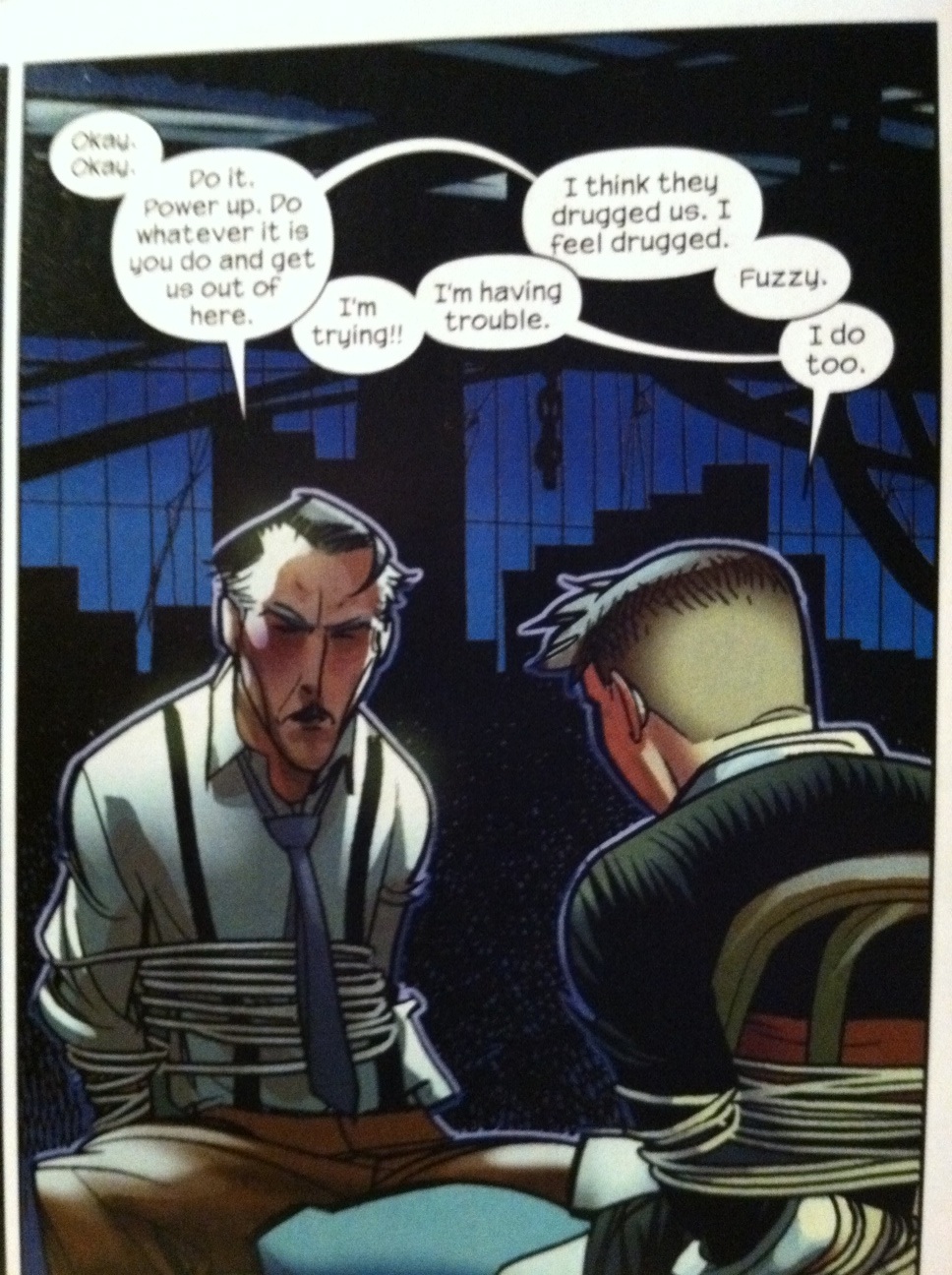
The real gold moment of “Tainted Love” comes with J. Jonah Jameson, though, who’s ever-passionate hatred of Spider-man comes to a head as he uncovers who Peter Parker really is. This scene illustrates the adult perspective and the teenage perspective colliding, or better yet, becoming one as both Peter and Jameson are in the same predicament. They’ve both had their identities hijacked by Chameleon, and they are both now tied up and held captive. There’s no separation. Neither one is better than the other. They’re just both drugged hostages seeing the world from the same, poorly lit room.

I wouldn’t say this run of Ultimate Spider-man comes to any conclusions by its finish. I didn’t receive any great speech or answer to any of life’s great questions. It’s not that kind of comic. Instead, these 15 issues crafted by the likes of Bendis, Lafuente and Ponsor, are more about setting a certain tone and letting a reader live in that. Immersion, or like I said at some point in this post, capturing the essence of the teenager. Which is what the core of Spider-man – all the way back to Ditko – is. And it’s what Ultimate Spider-man has always been about. The teenager.

Out of the three shifts, I’d call the “Lafuente Era” the ideal version of Ultimate Spider-man. While Bendis and Bagley captured the concept early on in their run, the work the team produced eventually piled up into a heaping mass that sort of negated what Ultimate Comics was about: continuity free tales. Granted, this run may continue that continuity plagued narrative, but in some ways the Bendis/Lafuente run feels like a reboot of Ultimate Spider-man. Any new reader could pick up Ultimate Spider-man here and get a complete – or semi-complete – picture. The voice is here. The core of the Spider-man concept is here. And the aesthetics are superb.

If I were to guess, when Bendis saw the chance to start over, you know,  post-Ultimatum, I think he took it – like really took it. Because this version of Ultimate Spider-man may be similar, but it’s also entirely different.

I feel David Lafuente made the difference. What he brought to the table changed this book, giving it this new, magical charm. His style, his line work – those things embody the spirit of Ultimate Spider-man. New, fresh, exciting, energized. That’s what Ultimate Comics was meant to be.

The “Lafuente Era” feels like the start of an entirely new title rather than some continuation of an 8 year plot, and I feel Bendis and Co. would have kept it going if not for the loud interruption known as “Death of Spider-man,” which, ultimately, left the end of this run somewhat unfinished and keeps it from existing as a complete, closed story.

That interruption is what I’ll write about next.

Next time: I go over “Death of Spider-man” in a much shorter blog post.

2 Comments

Filed under Uncategorized