Category Archives: Uncategorized

Prez: Smells Like Teen President | Ed Brubaker, Eric Shanower

Originally published at Spandexless.com

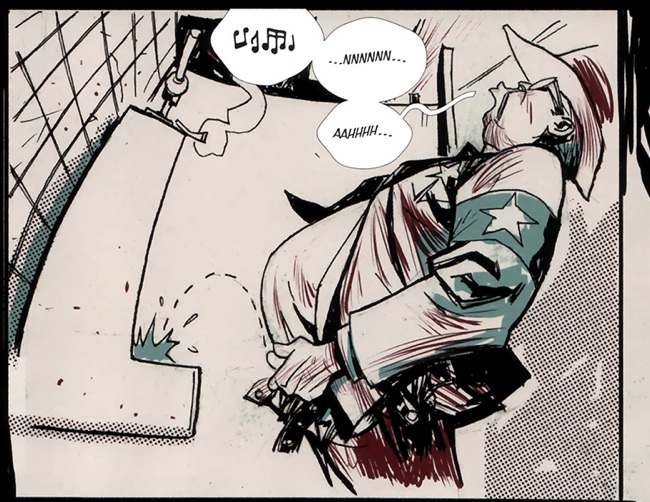
While the sludge of semester woes and college antics have slowed my reading, I’ve still managed to make a little time to retread, as well as “first tread,” some of Ed Brubaker’s work. Things like Sleeper, Point Blank, Criminal, Incognito and Scene of the Crime  have all shot across my radar, but I’d say, without a doubt, this odd “Vertigo Visions” one-shot takes the cake as, well, most peculiar.

Set in the mids 90s, amidst the cultural “movement” known as grunge, Brubaker and artist Eric Shanower pick up on an old Joe Simon concept known as Prez: First Teen President and expand the matter by introducing a slacker, generation x type, who’s believed to be his son, to foil Simon’s activist with a Kurt Cobain-type, complete with traits of self-hatred and existential question. Yet, while two sides, both characters are of the same coin and come together to form this grander picture of adolescence, delivering themes I’d say we could have all related to at some point.

Plus, the comic contains a nice little back matter bit from Brubaker in which he states:

“Once again, the mainstream media has stolen youth rebellion and sold us back a blander version at a higher price. By portraying today’s youth as ‘slackers,’ they’ve given us permission to be lazy and stupid. Knowing obscure facts about the Brady Bunch, or Charles Manson, or the names of every indie-rock band on K Records does not constitute intelligence. Where’s the real victory in winning a game of Trivial Pursuit? We all spend too much time worrying about being cool, and not nearly enough on just being human.”

If you ever wanted Brubaker’s opinion on hipsters, well, there you have it.

Aside from the clear time stamp and relatability, though, Prez: Smells Like Teen President sticks out for its unashamed honesty, even while in the face of preachy speech giving. Before “Marvel Architects” and a David Slade partnership, Brubaker was just another dude doing comics, and not just freelance mainstream work. Dude was producing the kind of work The Comics Journal salivates to, auto-bio sulk fests complete with meaning and all sorts of good, wholesome stuff. He wasn’t Ed Brubaker, the writer; he was Ed Brubaker, the cartoonist (check out Lowlife, if you haven’t), and he was clearly apart of a different area of the grander comics culture. Of course, he moved on eventually, losing the cool points in some eyes, but I’d like to say the guy grew up and took his craft to another area.

But Prez: Smells Like Teen President sort of sits in between those two crafts as it sort of represents the last few days of cartoonist Brubaker, even though he doesn’t draw the damn thing. The voice clearly exemplifies a younger, broader creator, though. Broader than what eventually becomes a more tuned perspective, tuned to mainstream comic book storytelling – a transition you clearly see in 1999s Scene of the Crime. Prez’s like someone writing an auto-bio story through the lens of a pre-established concept. PJ acts as an easy stand in for Brubaker or anyone else via his commonality, and the heavy use of setting and time period only strengthen the notion that this story belongs to an actual someone versus a fictional being, even though it does. Not to say Brubaker is PJ or shares his experience, but I think much of the detail, subtext and even back matter create this honesty which make the narrative more personal than some preachy genre comic.  There’s simply a sense that this tale came from somewhere real, and the tone and voice only bring the idea home.

From a pure storytelling level though, Prez succeeds. As I’ve noted, it can become a bit preachy at times, especially toward the end, but aside from that this comic works as a well oiled machine plot wise. Shanower draws in Vertigo’s classic 90s house style, but there’s enough of him there to give the book a unique look. His work completely lives to tell the story, straying from all sense of splash until the very last few pages. From another visual standpoint, I also really love PJ’s appearance – blonde, blue eyed American kid wearing a smeared t-shirt, in need of a hair cut, bathing in public restrooms. Works as a nice little visual metaphor.

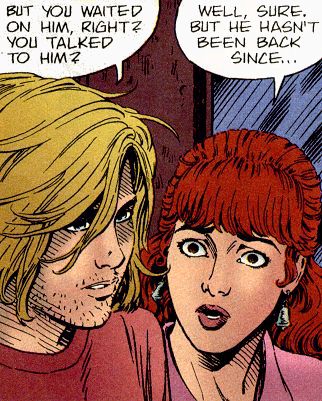
There’s also a cool change in perspective which provides some sense of unique storytelling. Rather than introduce his audience to PJ via a weird 3rd/1st person combo, Brubaker uses the POVs of the character’s two road trip companions to shape this somewhat outsider opinion on the guy. The choice attributes to Brubaker’s point of “looking cool” while also building the character up as someone who’s maybe trapped in his own head a bit, or more like, empty, unable to actually tell us about himself. Which makes sense because most of this comic book centers on the conflict of PJ not knowing who he is, a reason why he’s so adamant about finding his mystery father, Prez: First Teen President.

For the most part, this chunk of story comes across as pretty clean cut, but I like what’s going on here. At the end of the day, this book sticks out as something specific to its time, and more importantly, reminds readers of where this writer’s been. It can definitely be categorized as one of this odd ball early works, and as a matter of subtext, Prez says something pretty true. You’ve gotta get yourself together before you can save others.

Leave a comment

Filed under Uncategorized

AN EXTREME DIALOGUE

a.k.a. “No arrows. These words will have to do.”

originally published over at Spandexless

written by two guys who have little else to do.

Alec Berry: I forget why we decided to do this, but here we are … preparing to discuss the legend himself, Rob Liefeld, and the legacy-drenched comic book that is Youngblood #1. I would be lying if I said I was not interested in having this conversation.

Of course, it is a big year for Liefeld what with the relaunch of Extreme Studios and his involvement with DC Comics, so it seems appropriate to state Liefeld as a figment of the current zeitgeist. That’s probably why we’re here.

And we need an excuse to talk about Liefeld.

Honestly, I like the guy, and in some sense I feel we’re all way past the days of stunted conversation based solely on “hating” him. Few of those claims possessed any evidence to begin with. People just needed a scapegoat for the trash of 1990s comic books that they took it out on the guy who established one of the decades key aesthetics rather than the numerous imitators who wrung it dry and cannibalized the thing. Liefeld may not produce deep or even always technically efficient comics, but the one thing he has up on a lot of creators is his uncontainable energy, passion and overall voice. That stuff overpowers the mechanical flaws, for me, and while all the energy and love only produces over the top action, I feel that’s wildly appropriate, especially for superhero comics.

A guy like Liefeld humbles the medium, drawing us back from the ever present desire to legitimize what’s created and what’s read; the experience reminds a reader of the childlike wonderment which can be associated with the artform as well as the slightly exploitative element associated with the superhero genre.

And the best part … all of Liefeld’s work is genuine. He’s a genuine motherfucker making the comic books he wants to make while knowing exactly what it is he’s making. He’s not kidding you like a Matt Fraction Mighty Thor pitch which tries to get religious or is made out to be the next great work in modern comics. If Liefeld tells you’re getting a comic about Youngblood fighting terrorists, that’s exactly what you’ll get, no unnecessary varnish applied throughout.

Yet, while I say his work aims low and is low, I do hold this odd opinion that Liefeld’s visual style sort of reworks Kirby’s, in a sense. Kirby influenced super hero cartooning because of the language he created. Liefeld sort of did something similar, I think, but more in terms of an aesthetic and maybe tone. So, yeah, maybe there’s a argument for Liefeld’s higher importance. If you want to go there.

Could I only read Rob Liefeld comics? No. But as part of a varied industry, Liefeld has a place. And that’s without mentioning Image and the historical component you could place on his person.

So, Shawn, let’s get into this and discuss this somewhat larger than life personality and creator.

Where we going?

Shawn Starr: I’m fairly certain I broached the subject during a drunken email at 2 A.M, which is when all my great ideas occur. I’m kind of like Hemingway in that sense. I also like to take credit for other people’s ideas, so I’m kind of like Stan Lee too.

Why would anyone want to discuss Rob Liefeld’s Youngblood, especially after everyone’s told us how inept a creator he is? Simple, Liefeld is one of comics most interesting figures, and Youngblood is one of his most important works.

Also most of those criticisms (as you pointed out) are dubious.

Liefeld was selling 1 million copies of X-Force a month at the age of twenty-two. To put that in perspective, I’m twenty-two and do not sell 1 million copies of X-Force each month. In addition to simply selling comics by the metric ton, Liefeld single handedly defined a decade of comic art, and was a founding member of Image Comics, which, depending on who you ask (*cough* Gary Groth*cough*) represents one of the biggest leaps forward in comic publishing since the inception of the Direct Market.

And, while I don’t subscribe to the quantity equals quality idea, that’s a career which requires inspection.

As you noted, Liefeld has experienced a resurgence of late, with the recent relaunch of Extreme Studios and his work on several DC relaunch titles. Liefeld has at least one book out each week (he’s currently overseeing the production of nine books total) which is more than many small publishers. But, Liefeld wouldn’t be the topic of our discussion today just because he produces nine books a month. I mean IDW puts out at least that many and who cares about them.

There’s something else to Liefeld.

What makes Liefeld, well, Liefeld is his style. When you look at one of his pages or creations it just screams Liefeld, he imbues everything he touches with his essence. If Cable wasn’t weighed down by 500 pounds of guns and ammo, then he wouldn’t be Cable. And that’s Liefeld. Everything he creates is extreme, an action movie on every page, and not just a “failed movie pitch” that comics have recently become the repository for, a genuine action movie. Schwarzenegger in his heyday shit. Which, in an industry of endless possibilities, is a sight for sore eyes.

Liefeld is one of two direct heirs to Kirby, the other being art-comix god Gary Panter. Both creators filtered the essence of Kirby through their own distinct visions, creating dramatically different bodies of work, but always keeping Kirby’s kinetic energy in mind.

Panter filtered Kirby through a punk rock attitude and high art sensibility to create the definitive style of the art-comix movement. He reduced Kirby’s line work to a single jagged line, yet maintained all of the original’s energy. Panter is distilled Kirby. He was even able to capture Kirby’s sense of epic scale (Fourth World), with Jimbo (Panter’s most famous creation) embarking on a tour through Dante Alighieri’s Divine Comedy. Panter took Jimbo biblical, the closest thing he could do to capture Kirby’s cosmic ideals.

Liefeld, in stark contrast, took Kirby’s line work and added onto it (a reverse Vince Colletta of sorts) filtering it through Manga sensibilities and supercharging each page. If Panter was a reductionist, Liefeld was an expansionist. Throwing lines on top of lines, cross hatching each image like a schizophrenic who was about to discover the inner workings of the universe if only he could just ink one more line. And then throwing on some Manga infused speed lines to drive the point home.

His pages are a truly awesome experience.

Liefeld said (in a wonderful interview with Jim Rugg) that he never allowed an inker to touch his faces, because they could never capture that pure “Liefeld-ian” look. He also gave every page one final pass. Another round of rendering. Cross hatching to the nth degree. And that’s where the image becomes a Liefeld image. An entire decade’s worth of artists tried to ape his style, Multi-Media Conglomerates created house styles around him, and yet, no one can draw like Liefeld. Just like no one can draw like Kirby.

If Jaime Hernandez has distilled his art to a single line, Rob Liefeld has distilled his to a thousand.

You say Liefeld’s work plays to the lowest common denominator (in much kinder words), which in some respects is true. There’s no grand theory of life to be found in Youngblood. The first issue has some basal levels of satire, however strained, but it’s not particularly refined or biting. It’s definitely not Watchmen, but then again it was never trying to be. He just wanted to make fun comics, which is something few creators even attempt today. You call it genuine, I call it true to itself. It’s all the same.

What I see as Liefeld’s lasting legacy (besides his involvement with creator rights and Image) is his effect on the current generation of creators. While the initial crop of art-comix creators grew up on Crumb and later Panter, this new generation grew up on Liefeld and Image Comics. It may only be a fleeting moment, but for the next few years his importance is going to become increasingly evident, as the new vanguard of creators move away from the old and begin to reinterpret their childhood influences. Which, by and large, means Rob Liefeld, the defining artists of the 90’s.

The most important art-comix movement since RAW, the Fort Thunder Collective, were the first to begin this distancing from the past. The two most prominent members CF whose angelic line work was so different from what had come before that it redefined the look of much of the genre, and Brian Chippendale who is a self avowed Marvel Fanboy (writing one of the best review sites in comics), on an initial glance one would think of him as an acolyte of Panter, but, and I love this quote, he belongs to the 90’s “When I grew up I didn’t want to draw like Panter, I wanted to be Jim Lee” (this quote is second hand, from the RUB THE BLOOD Inkstuds podcast). Together they show a progression in the medium, away from the old guard and towards something new. To highjack Frank Santoro’s idea (and Comics Comics), they represent fusionism, taking from everything to create something new. And Liefeld is a key component as of late, he defined a decade of art. His influence is impossible to escape. I mean just look at the creators attached to last years RUB THE BLOOD, and you’ll see a who’s who of art-comix.

And that is not even going into the Extreme Studios relaunch, which has produced one of the best sci-fi comics of the decade (Prophet) along with what will soon be heralded as the most progressive take on a female superhero since Wonder Woman was created (Glory). Or the lasting popularity and resurgence of his Marvel work. There was a time (and it still may be) when Deadpool was the most popular character in comics, and just last year Uncanny X-Force and Deadpool MAX were two of the most critically praised Big 2 books being published. None of these titles are by him, but they required him to give them life.

As an aside, the criticisms of Liefeld are largely unfounded. Sure he ignores anatomy, but so does Ware, Crumb, and for a more mainstream and generally excepted example Jim Lee. It’s just that everyone of those guys is given a pass, it’s their “style”, which is true, but the same reasons it’s ok for them to ignore anatomy are, for some reason, not applicable to Liefeld.

Being critiqued for his lack of realism, a feature which his art has never attempted to capture, is missing the point of Liefeld. His art is decadent and expansive. It’s telling that this is what the masses of pseudo-critics jump onto. Realism is largely a constraint on art that individuals try to pass off as valid criticism against something they don’t understand. Kyle Baker summed it up best “in art, as in life, ‘realism’ is for the uncreative.” Of course this is what they latch onto, because they don’t or can’t understand what it is Liefeld is doing.

If Liefeld drew like Alex Ross, I could see the validity in this line of thought, but Liefeld has as much in common with Alex Ross (or Neal Adams) as Matt Brinkman. His style is an extension of himself, not a light-boxed photo from the recent Sports Illustrated Swimsuit Issue, it’s “abstract” and should not be constrained by the idea of realism.

Ok, thats my overlong re-contextualization of Liefeld. I may be completely wrong and participated in a one man historical whitewashing, so do you have anything you want to add, or should we begin this review of Youngblood #1 after our brisk 1,800 word introduction?

AB: That Kyle Baker quote is great.

SS: He posted that on Twitter a couple days ago, and I couldn’t not steal it.

AB: Would you go as far as to say Liefeld is this generation’s Kirby or do you feel his impact isn’t exactly that wide? I feel he’s influential, but I wouldn’t exactly claim his influence to be widespread like Kirby’s. Kirby’s thumb prints are on everything because of the grammar he developed while Liefeld falls more in the camp of an attitude rather than a fundamental. He’s kind of optional, but even then, from the handful of alt comics I’ve touched and the blogs I read, it does appear that some of Liefeld’s brashness works its way through.

I do find it funny, though, that Liefeld suddenly has received this reevaluation. Like many influential people before him, hatred was their initial response. Maybe Liefeld fits that bill, although he was liked, generally, early on because of his difference to what was available at the time.

But, yeah, that’s sort of where we’re at with Liefeld: taking this despised dude and finally finding merit in his work. You could even work Benjamin Marra into your whole thesis as well because like Marra, Youngblood #1 is very much a comic book drawn in the back of some kid’s notebook. It lacks the more obscene elements, but it is still rich with boyhood fascinations. To steal from Ed Piskor, “the early Image comics are like guys playing with actions figures, going “boom!” “bam!” “grrrghh!”

To be honest with you, I didn’t read this and concern myself with the technicalities. I knew going in what it was, so instead, I went in for the spirit, and I think, with that mindset, Youngblood #1 really pays off. You mention this sense of satire that doesn’t exactly shape itself into anything, but I kind of feel it does simply through what the comic is. Youngblood #1, by its quality, does satirize the whole of superhero comics, especially the post-Watchmen mindset of the time, subverting this idea of serious super hero comics to complete ridiculous mish-mash.

The whole flip book approach sort of works to undermine the serious attitude too, bringing back some of that anthology flavor, like with Tales to Astonish.

SS: I’d describe Liefeld as Kirby-lite. I can’t think of any other artist in the past twenty years who has had as great an impact on the medium as Liefeld; he created hundreds of characters and defined the mediums style for a decade, but Kirby is Kirby.

Liefeld probably comes the closest, but Kirby is such a monumental and influential figure that no one could ever truly equal him. Tezuka (Manga), Crumb (Art) and Moebius (Europe) are the only ones who can match him, and even then they feel lacking. Kirby created the North American comics industry almost single handedly; romance comics Kirby, sci-fi comics Kirby super hero comics all Kirby; Liefeld revolutionized one of those, so there is something to be said of him, but I don’t think anyone can really be the “Kirby” of a generation. He’s too important.

Maybe you could describe him as the often trotted out “voice of a generation”, if that doesn’t sound like too shallow a description. I mean, there’s at least 20 “voices” to each generation nowadays so it seems like a meaningless term.

So I guess my answer is no, but with the caveat that no one could really be the Kirby of their generation.

It’s also interesting to point out the differences in Liefeld’s influence. The current “mainstream” comic culture seems to have latched onto his creations (Deadpool, Cable, X-Force) while the alt-comics scene has taken his visual aesthetic and attitude. That’s probably because of the “mainstreams” current incarnation as a Intellectual Property generator, and alt-comic’s focus on style and singular vision.

You mentioned the name of one of my favorite cartoonists Ben Marra, who I almost named dropped in my initial response, but decided not to for some reason. I can’t think of a creator more in tune with pure Liefeld-ian style out there today. His comics are brash and unforgiving, everything I love about Liefeld, and then he throws obscenity on top of it. Scrawlings in a notebook seems to be an apt description for both creators. There’s a childlike essence that exudes from both them that stands out from the rest of the industry. Marra is Liefeld brought up on Gangsta Rap instead of GI-Joes.

Your point on satire makes sense, but I’m not sure if that satire is intentional or not. Where the Image founders crafting a meta-textual Dr. Strangelove, or simply making a B-Movie. Did Liefeld create Youngblood as a reaction to Moore’s intellectualism, or a comic where things blew up. That’s one of those things you need a dig up a brilliant quote to find out. I have a feeling its perceived satire after the fact, and not a great mega-critique played out by Image Comics.

AB: Oh, yeah. I don’t feel it’s intentional. As you said, it’s an effect brought up after the fact, but still, it’s an effect.

SS: Yeah, we’re probably just projecting satire onto them. Us kids and our need for irony and satire in everything we find genuine.

The most likely candidate, by Liefeld, is his mega-event Judgement Day. Which title alone sounds like Final Crisis times ten thousand, but, and here’s the genius of it, it is really just a three issue meta-commentary on the idea of retconing in the guise of a courtroom case, written by Alan Moore.

Alan Moore!

The book reads like it was written for anyone but Liefeld, and in his hands becomes anything but the procedural drama Moore had intended. Imagine the courtroom scene in From Hell in the hands of Liefeld at his peak, that’s Judgement Day.

Liefeld has this ability to overpower the writer on every page. Liefeld renders each figure in such a way as to make their every action a dramatic moment. Dialogue that’s meant to be subtle becomes laden with invisible exclamation points in the hands of Liefeld; his cross hatching seems to spill over onto the dialogue balloons. The best example of this is his facial rendering (no one inks a Liefeld face except Liefeld for a reason!) where every expression is contorted until it turns into an abstraction that can only described as EXTREME! which even Moore can’t escape.

If Judgement Day isn’t a satire of the idea of comics as literature, and the ubiquitous mega event, then I’m not sure what it is. Besides a testament to Liefeld’s power to overwhelm authorial intent.

AB: That’s the Image era in total. Nothing mattered but the attitude and style, and all other elements either became obsolete or excused. I just like how Liefeld still performs in such a way, and in some sense, represents this era entirely by just being. Liefeld doing a book today is like Gerry Conway doing one. You read it, and it immediately takes you to a certain time like a novelty item.

But Liefeld, as we’ve mentioned, accomplishes a little more than a Gerry Conway retro comic.

Liefeld makes the visual end front and center, which for comic books should be a given, but our culture’s so dead set on writers we lack the necessary attention for the true writing. In some way, I think the Image guys were some odd first step in making the mainstream audience wake up and realize the importance of the artwork in comic books. Until then, plot was really everything for the super hero book. The Image guys didn’t exactly produce the best quality stuff, but by being so flamboyant, they made it impossible not to appreciate the illustration and just forget the plot.

SS: The swagger of youth …

AB: Think about that in context of the a-typical comic reader. Fanboys brushing off the plot to rave about line work (a lot of line work) instead. That’s nuts! It’s some twisted sense of an art comics mentality. I want that world again, but instead, with an even balance where both visual and script matter equally. If that’s possible.

A first step, but an important one in many ways, and sadly it seems with the crash and burn of the 90s, readers and creators buried that step because supposedly art over story generated the fall.

SS:  The 90’s were a time when the artist took over, but, and I think this is a key point many critics fail to mention, so were the 60’s. Kirby and Ditko ran Marvel Comics creatively. Stan Lee was merely a editor who dialogued books. When artists are in charge it seems to be indicative of an age of ideas over content. If you look at those era’s you see the creation of thousands of characters, all still in use today, and stories that exude creativity. Writers tend to constrain this expansionism. Look at the past 10 years in mainstream comics and show me a completely original idea from a writer, or even a creation that’s stuck. You might be able to squeak Damien past by Morrison, but he’s a derivative character, just like the Rainbow Patrol over at Green Lantern. I just don’t see that being the same as Kirby creating an entire universe or Liefeld creating the Extreme Studios line.

The problem is that writers have been copying and referencing each other since the start. Moore may have been a singular voice in the comics medium (at first), but he was borrowing from a dozen other writers, it’s just that no one in comics had heard of them. Writing’s a conservative field really, inbred, while art is all about taking a blank canvas and turning it into something more. There may be references and homages but that’s only one panel in a twenty two page pamphlet. It can’t sustain itself for any prolonged period, unlike writing.

Continuity hounds don’t get into comics to be artists, they’re writers for a reason.

Even the “Age of Awesome” collapsed in on itself around the mid-2000’s because it lacked artists capable of seeing it through. The writers of that movement were only able to succeed when they were paired with the best artists in the industry. Casanova needed (needs) Ba’ and Moon, Bulletproof Coffin needed (needs) Shaky Kane and Immortal Iron Fist needed David Aja. When you put Fraction on Iron Man with a lesser artist it all falls apart. Ideas in the hands of a writer can’t sustain themselves past their initial conception.

AB: While Ba’ and Moon give the book its agility, Casanova is Matt Fraction. That’s a book about a writer – showing the journey from wannabe professional to now comics company man, mixed with a sense of sorting through influences, whether they’re life experiences or pop culture tidbits. You can’t take Fraction out of Casanova.

You’re correct to a point. Sure, comic book writers need artists to carry their ideas across the finish line as well as to provide the true impact of these ideas – the visual – but to suggest it’s a one-sided issue seems a bit erroneous. Liefeld’s a great example. His artwork certainly provides the right stylistic punch, but beneath that style, what is there? A poor story lacking a lot of necessary structure and layer. The work needs a writer to give it a sound foundation.

That’s why comic books are most often produced through a team effort. The writer/artist team makes a lot of sense because where the artist can ignore constraints the writer applies them, offering a sound balance to keep a story in order. Stories need order, to a degree. They function through their structure, most of the time. The artist can certainly help add a sense of spontaneity, though, as well as help tell the story and even rewrite a writer’s script to a degree. The artist is most definitely important, but not every artist can be unleashed on their own. Liefeld’s sort of an example of that – as well as many other writer/artists in mainstream comics.

SS: Sure, you need the writer to provide structure. But I’m not sure if those are the kinds of comics I want to read anymore. There are maybe four or five writers who can craft a competent book, and they all reside in the “mainstream”. Artist run every other genre. There’s probably a reason why every major literary-comic is done by a single creator. Or why the art-comix movement is run by singular vision. Michel Fiffe just dropped the best DC comic of the year, as a self-published, one man operation. If you think putting Adam Glass on scripting duties would have improved that book…well I question your judgement.

AB: Singular vision is certainly a preferred circumstance, and it does seem to work well in art comics where I think the mindset is more set on making a complete piece rather than a story installment. But even then, it’s not like there’s one mindset going into the creative process. The mindset of the writer and the artist are two separate things, so even when you have one person writing and drawing a comic, it’s arguable that one person comes from two different places.

Of course, I’ve never made a comic book, so what’s my theory, really? Speculation.

To point out of my personal interest, though, I would agree with you in your current interest. I’m finding myself more and more attentive to cartoonists these days versus collaborative teams, and ideally, I suppose that’s how comics are meant to be. That’s not to say the writer/artist team up is worthless, though, or that writers can’t push their ideas out into the world mostly on their own. Look at Morrison. Quitely certainly adds a lot, but even without Quitely, Morrison still projects his voice.

One example, but it shows the possibility.

SS: I will backtrack a little and concede that Casanova is Matt Fraction, but without Ba’ and Moon going all Steranko on that bitch it would have lost its pop-comics feel. Pop art starts with pop artists. Fraction set the tone, but Ba’ and Moon perfected the aesthetic. That may have been that sweet spot you were waiting for, and it came and went in four years without any mainstream support.

Morrison has a distinct voice (and just to point this out, he did start out as an artist) and Quitely certainly does bring out the best in him, but here’s the thing, Morrison has been hammering home his ideas of hyper-sigils and Superman as god for nearly twenty years in hundreds of comics, and the only time they really resonate is when Frank Quitely comes into the fold. Flex Mentallo and All Star Superman are the clearest examples of Morrison’s ideas and both are illustrated by Quitely. Morrison needs Quitely.

But back to Liefeld…

AB: I’ll give you the point on Morrison. But, yes, Liefeld.

With all the praise we’ve given, we do need to be fair and recognize the faults. Liefeld has certainly influenced some bad. And not even just copycat artists but really whole publishing approaches.

You can either look at Marvel Comics in the mid 90s or just dive into Liefeld’s own back yard with Extreme Studios. With Extreme, North American comics took on a whole new sense of factory line assembly, and Marvel just really took the Image method and completely raped and bled dry any of the charm associated with it (although, third and fourth wave Image titles kind of did this too), creating this culture of comic books dependent on gimmicks above quality (without any of the energy Liefeld or the other Image guys put into the work).

You could even make a case Liefeld had a big influence on internet hate culture, being the shining beacon of it he has been. At least in comic book “discussion.”

Expand on these, Starr. I’m going outside.

SS: Yeah, this part’s inevitable when discussing Liefeld. For all his swagger and attitude, he certainly has his faults. Liefeld has this uncanny ability to overcome most of his artistic weaknesses; he certainly doesn’t care about page to page continuity like every critic on the internet  seems  to (unless the credits don’t read “Artist: Rob Liefeld”). And, like you, I don’t see most of this as a blasphemous act against comics. The rawness of his art saves it from most of its technical faults.

AB: Yeah. Oddly, enough, I started reading this Replacements oral history by Jim Walsh today, and there’s this great quote from Westerberg about their performance style:

“To like us, you have to try and understand us. You can’t come in and just let your first impression lead you. Because your first impression will be a band that doesn’t play real well, is very loud, and might be drunk. Beneath that is a band that values spirit and excitement more than musical prowess. To me, that’s rock and roll, and we’re a rock and roll band.”

That really sums up Liefeld for me, and in a lot of ways, that’s what I want comics to be. Twenty-some pages of spirit.

SS:  Yeah, Liefeld is all about spirit over technical prowess. When his work fails though, is when it starts to restrain itself. Conservatism is Liefeld’s death knell.

Youngblood #1 is split into two separate stories, sixteen pages each, and I think both stories highlight Liefeld’s faults.

“Youngblood: International” (the two teams aren’t distinguished, so I’m using this name for the non-Shaft lead team, and “Youngblood: Stateside” for the main team) is pure action; one page of framing in the post-DKR media lens format followed by fifteen pages of nonstop action. This segment is the most Liefeldian of the two, which makes it the most interesting overall. The story itself is fairly straightforward; the team goes into occupied Israel to take out a Saddam Hussein stand in. It’s choppy in the dialogue, and the middle bit seems to get away from Liefeld at a certain point, but the final sequence with Psi-Fire brings it back. It’s labeled the “1st Explosive Issue” which is a perfect title. Its Liefeld in all his glory and ruin. Pure artistic expression.

“Youngblood: Stateside” is the weaker of the two artistically, but a significant step up in a craft perspective. Everything flows, the pacing is sound and the exposition is a little heavy handed at points but nothing to complain about. This issue fails, though, where so many Liefeld projects fail; they are restrained at the very last moment. The story ends with a splash page showing Youngblood about to stop a gang, and results in this hard stop that kills the story. So many of Liefeld’s projects seem to restrain him at the last moment, forcing him to draw non-action, dialogue heavy, exposition scenes, and then once they get to the fight, stops dead and calls it a day. It’s not even Liefeld’s fault most of the time. It is just how comics are written nowadays.

Although the panel where Shaft throws a pen across a mall and knocks a would be assassin of a rail to his death is pure Liefeld.

“No Arrows. This pen will have to do.”

AB: I laughed, gleefully, at that scene, along with the scene of Chapel kicking his one night stand out.

SS: “You gotta give ‘em hope… As Shaft would say ‘it’s good P.R. !’” reads like a line out of  Gangsta Rap Posse.

AB: Great moments.

AB: I’m glad you pointed out the pacing of the Stateside story because I too found it to actually be way better than anything I would have expected from this comic. I mean, there are moments when the flow is so on, most comics today could actually take a lesson from it and improve. Particularly, I’m thinking of the scene in the headquarters as they receive the mission brief and Shaft ends the sequence by exclaiming: “Then let’s move it!”

That was some exciting shit, to be perfectly honest.

You’re completely right when you mention the story being cut short, because it is. Completely. And I really wonder what decision led to such a choice. Really, reading what was already there, who’s to say without the abrupt cliffhanger, this comic might have actually received some love and not gone down as the mistake it historically has. Up until then, the main story wasn’t exactly on a horrible track. Cheesy dialogue and situations, certainly, but not exactly bad.

Part two, or “Youngblood: International,” flipflops, like you mention, into a complete reversal of the plot beat Stateside is. Looking at the two halves, it really just seems like Liefeld split one script rather than constructing two complete stories. Blending the best aspects of both into one story could have really worked. Together, they possess everything necessary.

But, no, he splits them, and ultimately that’s a fault of trying to interject too many characters into one book. Liefeld’s concerned with setting both of these teams up in one issue, and to do so, he chooses a route that just sticks a knife in the gut of the script. I also think he was just trying to make this comic book feel packed by offering two “stories,” but instead the gimmick just offers two comic book halves rather than one whole.

To offer one positive critique, though, I love how he just drops us into the world with little explanation or definition of the rules. The comic’s actually pretty good about that. Liefeld takes the punch first, ask later approach, and, I think, does it well. Youngblood #1 is kind of an exciting first issue rather than another thesis statement, as we’re used to today.

What about Liefeld outside the comics, though? Do you have any opinions on Extreme Studios or the outside negative affect?

SS: I agree with you. If Liefeld had synthesized the two issues into one, it would have been a much more satisfying read. He just couldn’t get those stories to gel. So we get one competent, but short story, and one extended action scene.

I haven’t read any of the old Extreme Studios titles; this year’s relaunch was my first contact with them. As I said above, Prophet is the best comic coming out each month, Glory is strong and getting better and Bloodstrike was probably the weakest of the bunch. It fell into the classic Liefeld problem of restraining the artist. Every action scene was cut short so that talking heads can lay out some exposition to catch the reader up on continuity. I dropped that one after its first issue, so it may have found its bearings.

The relaunch of Youngblood was…I’m not sure if i can call it “good,” but I don’t really think that matters with Liefeld. It was certainly interesting, and that’s enough. It operates as a mini-critique of Liefeld’s legacy, and the internet culture surrounding him. Youngblood are described (in comic) as “a long running joke by legitimate super-heroes like Supreme,” which can easily be applied to Liefeld’s current status in the comics zeitgeist. He’s the butt of every shoulder pad joke.

The main plot of the story involves a PR agent being hired to rehabilitate Youngblood’s image, and while in story the team doesn’t change much from page one,when you compare it to the first issue there’s a massive change. The initial issue of Youngblood presented a professional U.S. sanctioned strike force. This iteration reads like an issue of Giffen and DeMatteis’ Justice League International. Slapstick humor mixed with four month old pop culture references and odd moments of gag humor-esque flirting and overt sexulization. There is literally a cloud of hearts at one point. It’s a weird comic, but from a meta context it works. Liefeld was always criticized for his book’s perceived seriousness, and juvenile content, so what does he do? Get the writer of one of the most critically acclaimed “artsy” films of the 2000’s (Black Swan) and has him turn Youngblood into this oddball humorous cape comic.

On his negative influence, I don’t really have much to say. People certainly aped his style and almost killed the industry. Liefeld should bear some of the blame for that, but not the lion’s share that’s often attributed to him. You still needed Marvel Comics going bankrupt and giving Diamond a distribution monopoly, the mass exodus of speculators, along with a dozen other things that had nothing to do with Liefeld to cause the industry’s collapse. He defined the style of the decade, so I guess people associate him with its failure.

Once you start looking at everything that was going on, it’s clear that Liefeld was just a scapegoat. That’s not to absolve him of any involvement, he was just a single player in a industry wide failure.

AB: I didn’t hate the new Youngblood, either. You summed it up pretty well, and I thought mostly the same of it. Although, I do feel it was an instance where Liefeld’s artwork actually didn’t add much to the work. It came off as an odd compliment to the tone the writer was trying to establish. As you said, this Giffen voice, but it’s met with Liefeld’s extreme aesthetic and creates this odd sensation of a comic book.

Interesting, for sure.

I haven’t read every release from the new take on Extreme Studios, but from what I have explored, I do feel this revamp really represents a lot of what we talked about here. While I feel Liefeld can produce fun, over the top comic books, his ultimate legacy lands more in his influence than his actual work. Whether it be the examples of art comics you brought to light or now these once lost concepts being utilized by the likes of Brandon Graham and Ross Campbell, it seems that Liefeld has managed to create certain elements that will, potentially, outlast him.

Being an artist, that seems to be the ultimate mission, and I like that this unlikely character seems to have accomplished that, in a sense. It’s kind of powerful as well as charming.

I know someone out there has read this and believes we’re both insane, but I feel at this point  it’s hard to deny Liefeld’s place. The guy at least deserves a chance to be reconsidered.

SS: The idea of re-contextualizing and re-interpreting a creator’s body of work has always interested me; it’s really the main point of the critic and criticism. There was an excellent Inkstuds episode featuring Ben Schwartz, Jeet Heer and Gary Groth (Americas Best Comics Criticism) which featured a large segment centered around the discussion of which creators needed a critical re-evaluation to cement their legacy. There certainly are a few creators who are undeniably great, but most need that extra push from an outside source. And that’s where critics come in.

It seems like a lot of re-contextualization is still coming from the print side of things. The (now) yearly Comics Journal along with the archive editions many book publishers put out, specifically Fantagraphics, have kind of cornered the market on this idea. Even as the net becomes more present, it’s still print that holds the reigns on “serious” criticism.

This probably stems from the financial structure of websites. When the newest thing drives site hits, it becomes difficult to justify talking about the past in any definitive sense (I’ve had three week old reviews deemed irrelevant). There’s a two week period when a new book comes out that it can be talked about (and maybe a third when “Best Of” lists start coming out) before they disappear off the main page and into the wasteland that is the site archives.

That’s why Tim Callahan is such an important figure in (web) criticism; he runs one of maybe three columns that focuses on contextualizing older works on a regular basis (Matt Seneca’s Robot 6 column and Jog’s Comics of the Week essay being the only other ones to my knowledge), and on the mediums biggest site to boot. It was Tim who brought Liefeld to the forefront of the comics discussion. I know thats where I became aware of him at least. So I guess that’s why we’re here.

But really, Liefeld was due for a reevaluation anyways. It has been over twenty years since he reshaped the medium, and ten years worth of (as Liefeld has wonderfully named them) Liefeld “Haters” being taken at their word. And no one at the Journal (who I adore in every sense of the word) is going to tackle Liefeld anytime soon.

Jesus, they’re still struggling with Kirby’s legacy.

So here we are, two brash, young critics trying to redefine an industry legend.

AB: I think “young” is a good way to describe us.

It’s a little off topic, but I tend to agree with your points about online comics criticism (and Tim is the man).

Sites do rely on hot topics to entertain their audiences, but they also rely heavily on short pieces. The long, in depth piece rarely exists on a comic book site. Why? I don’t really know, other than most people probably don’t have the attention span for them, so sites cater to that, keeping us in a constant ADHD state of channel surfing. Also, long pieces take a lot more work, and when you have a schedule to keep to, a big site’s better off living on small blurb articles to keep the updates constant.

When a good lengthy piece hits though, there’s little better (at least for my unusual enjoyment). Like this Michel Fiffe piece on the one man anthology comic. Best thing I’ve read in a while, and you can just tell he put the time and effort into it.

So, sadly Shawn, what I’m saying is: only three people will read this conversation we’ve spent the time typing. I hope you won’t kill yourself.

1 Comment

Filed under Uncategorized

The End of the Fucking World #1-5 by Charles Forsman

This.

This right here is why I read comics.

Yet, while so won over and ready to spill praise, I’ve sat staring at the previous two lines for, oh, two hours. A few Twitter visits in between, sure, but staring, staring … I’m not sure how to start this one. I think that’s the sign of when you’ve truly enjoyed something, though. It’s easy to be negative or tear something down, but to convey enjoyment or state why exactly something spoke to you … that’s hard. Because you want to get it just right, and ultimately you know you won’t because, well, there’s too much to say.

Charles Forsman’s The End of the Fucking World, like John Porcellino’s King-Cat, represents what I’d love to make if I were an artist, and beyond that, it just exemplifies what exactly it is I love about comics. It’s lo-fi yet stylistic, subtle yet visceral – a version of Bonnie and Clyde bled through the lens of Gus Van Sant’s Paranoid Park, and it’s completely been sown into a series of eight page mini comics cut to match the size of your hand.

And even then, I’ve just sold this thing short using a cliche “this meets this” label.

TEOTFW follows James and Alyssa – two teenagers living the classic teenage experience as they sort of face down the impending doom of oncoming adulthood. Forsman tells their story by adopting both character’s perspectives, jumping between first person points of views with each issue, using each leap in narrator to define the other character. So far, five issues deep into this however long saga, we understand James and Alyssa in one, clear way. That they hang onto each other because they seem to be afraid of the alternative: facing the future alone.

The book in general riffs on this nihilistic temperament – something I guess you could say is synonymous with adolescence – and in numerous ways Forsman illustrates, I think, the disdain, fear and existential search the teen years bring about. He may do so through a few extreme examples, like shoving a character’s fist into a garbage disposal, but the idea certainly resides under the, at times, harsh visuals. The comic’s pacing puts me on my ass, though, because Forsman only has eight, substantially smaller pages to accomplish all of this, yet he’s nailed the mission every time. Much of this comes from Forsman apparent understanding of timing and how long is long enough for a scene or moment, and he’s also just aware of what exactly needs to be seen. Every panel has a job, here. You can’t say the same for most other comics.

All together, this great, solid rhythm works its way into your reading. You feel the beat in Forsman’s storytelling, and it all sort of reminds you of how much can be done with less at your disposal. Which is sort of the bigger point here. I love that TEOTFW is printed on plain old white paper any of us could go and purchase at a Staples.  I love that it’s a mini comic. I love that it comes out monthly. None of it says high production or hype. No red tape. No middlemen. Instead, TEOTFW embodies the “let’s do it” mentality and just tells its story without any of the flare around it, as opposed to the gloss paper and PR of mainstream books or the hardback, book tour savvy graphic novels of high art. TEOTFW just goes in the face of all such examples of nonsense and extra and simply revitalizes the idea that, “hey, making comics is something open to every man, woman and child.” The lo-fi mechanics strengthen the ideal perception of comics being these very direct, timely expressions and reflections.

Yet, as I’ve noted, Forsman’s work doesn’t exactly live up to the minimal format, though, which is something else I truly love about this idea of comics being lo-fi and direct. There’s a dichotomy present, a phrase Joe Casey coined as “lo-fi futureshit.” I love that in these simple productions, these pulp mags, these Kinkos pamphlets there can exist ideas or emotions far beyond the grasp of the paper. That even though you may be reading something made on an HP printer and costs a dollar, you can spend a day, or a whole essay, reflecting on it as well as gain inspiration.

Something about such a dichotomy gives me goosebumps, and ultimately it’s kind of why I grow a little sad when I see such a push toward expensive book formats and year long waits for graphic novels. Suddenly, the production cost grows a little steeper, yet I’m not sure the truest impact comes along.

Because, to me, that’s the most amazing part about comics. Simplicity achieving complexity.

And above all the waxing thoughts of teenage conflict, storytelling or Peanuts art style transposed over seventeen year old deadpans (nod to Frank Santoro on that point), Forsman’s The End of the Fucking World hits me hardest because of its faith in lo-fi futureshit. Granted, I’m not sure if Charles Forsman intended any bit of such a thing, but when I read these mini comics, my head automatically goes there and I gleefully clap.

That said though, I would totally double-dip and buy a collection of this work because eventually I’m sure my copies of these comics will fall apart with age. And re-reading. Aside from my crazy beliefs on what comics are and how this series represents them, The End of the Fucking World showcases some wonderful storytelling, and it nails the bleak wonder lying behind the end of youth. I look forward to forthcoming chapters. Who knows what the future holds.

1 Comment

Filed under Uncategorized

Joe Casey, Nathan Fox, Haunt

Yep. I remember the joke this idea was originally. Some bet between Robert Kirkman and Todd McFarlane (the businessmen of comics) made at some convention because, hell, they knew it would sell and fashion a TV option somewhere along the line. Of course, that’s complete speculation on my part, but really, such a stretch? Of course, though, like the monthly junkie I’ve been for years, I bought Haunt #1 the moment it dropped and read it like every other pulse pounder on the comics internet. Reassuringly though, I did not enjoy it.  I found the book predictable and weak minded, offering little but some candy coated McFarlane inks over dynamic Ryan Ottley line work. That part, I will admit, was fun. But Kirkman … the dude took a decent concept and cut the balls clean off, crafting Haunt into another comic influenced by everything wrong with the early Image titles and slapping a shit ridden cliffhanger on it. One issue, and I was out. Little did I know I’d be back …

Two years later. Issue 19. Joe Casey. Nathan Fox. Boom. I’m back. And while I am enjoying the comic much more this time around, my feelings aren’t exactly clean cut and gleeful. I have an issue or two with what’s been established, yet that aside, Haunt is now, at least, interesting and energized. Casey and Fox have come onto this project like Alan Moore post-Martin Pasko on Swamp Thing and have given purpose to what essentially started as a purposeless endeavor. The work on Haunt applies Casey’s Butcher Baker, the Righteous Maker philosophy to an already living, breathing comic book series, showing that any bland super hero story can be more than it’s made out to be. Thematically, I think the point’s hard to ignore as Daniel Kilgore, the main character, seems to be on a mission to truly embrace what he is, showing that even Haunt, a bullshit mainstream comic, can dig down, find something within itself and present a vivid package.

To do that though, a hard shift had to occur. Casey and Fox quickly pushed away from the status quo on this one, and they went ahead and set their own direction for it. The team kept one essential ingredient via the actual Haunt character, but between killing his girl, having the cast disappear and throwing our protagonist into a whole new situation, Casey and Fox dissolved everything established about this series and basically said, “fuck it, we’re starting fresh.” This mindset has also dictated the structure and pacing of the run, thus far, as little of the upheaval has been explained. The plot’s been more about doing rather than discussing.  Or, as Casey puts it:

The approach relates to what Casey and Fox want to do with this comic. They’re not here to exactly just continue the tale in place by Kirkman and McFarlane. Instead, these guys are hitting a hard left, trying their best to do something new with Haunt because, obviously, what was already happening wasn’t really going anywhere. These first four issues read like a rescue mission as Casey and Fox do what they can to save this comic book from the path of bullshit it’s on and rehabilitate it into a fine piece of genre work. It’s  no coincidence then that the actual story involves a rescue mission – with Joe Casey, via Still Harvey Tubman, in story saving the protagonist from all sorts of terrible torture.  Granted, Casey could take time to explain story details and keep to this mantra of “fuck it, we’re starting fresh,” but I think the raw “let’s go” mentality of the writing speaks to Casey’s own personality as well as contrasts against a majority of what’s done in mainstream comics. Not slowing down, simply, has a greater visceral impact on the reader as well as offers a grander statement.

And Fox’s artwork compliments all of this. He’s using many midsized panels on this book, but he’s stacking them on the page in a way which moves your eye at a brisk pace. But it’s his style which accomplishes the most, as surface a detail as that is. Fox’s style takes what Paul Pope’s does and removes the iconography from it, boiling the line work down into something a bit more savage. In fight sequences though, I wouldn’t want anything but Fox’s style on my side as the savagery in his line emphasizes the fast pace Casey’s script moves at. For the most part, I’m not aware of any technical tricks or fundamentals Fox may use to tell the story, but there’s clearly more to the actual style and drawings than aesthetic points as the look of his art reflects what this comic is about at the moment. I’d say it’s effective. Plus pretty.

With all this said though, the jumbled manner of the comic hasn’t entirely been pleasing to read.  Not that I need answers or explanations to enjoy a story, but without a reason for an evil church, how can I hinge any weight on the conflict between Haunt and an evil church? My bigger complaint, though, is that I find the chaos a little bit too messy. While I enjoy the freewheelin’ nature of Casey and Fox’s Haunt, the pacing doesn’t exactly read like it’s under the control of the writer. Obviously, I know the hectic pacing exists for a reason, but Casey seems to have maybe even let it get away from him. Ultimately though, it’s more an issue of what this comic book will be. I realize we’re only at the beginning, but I feel after four issues everything’s still up in the air too much, gravity free, waiting on mission control to provide a tad bit of information.

Whether or not, I’m in, but I’m hoping for some development soon. That’s what this book needs at this point. It’s made the rift from the previous material and established a plan. Now, Haunt just needs a little more thought in it to really achieve the More it can potentially be.

Leave a comment

Filed under Uncategorized

Tonci Zonjic on Lobster Johnson

from zonjic's blog: lungbug.blogspot.com

I read these comics while sitting on a park bench, under a comfortably warm sun, class behind me, with college girls in short shorts and retro sunglasses passing by, and still, even with all these pleasantries, this Lobster Johnson mini series felt like the most important thing I could partake in at the time. Looking back, this was probably a pathetic reaction, but I’d like to think I gained a little mental stimulation from the experience. Plus, I have all summer for girls in retro sunglasses.

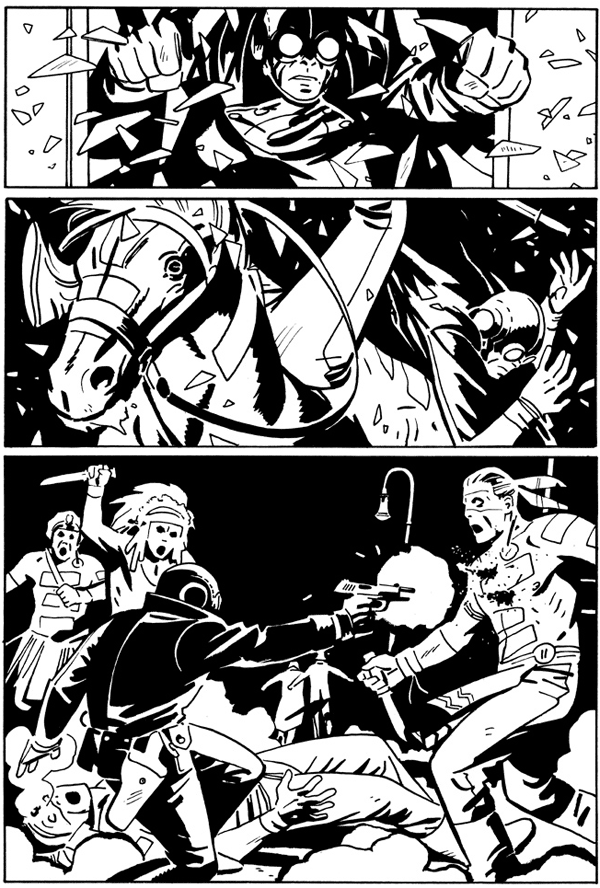
Aside from the pulpy spirit, Lobster Johnson: The Burning Hand sports a wonderful tempo and evenness which seems overwhelmingly welcoming. The comic comes off as an item comfortable with what it is yet neither is the book afraid to reach for achievement, carrying the standard Mignola mindset which is aware of craftsmanship and structure. There’s a script here that drives the story in a very determined, episodic fashion with character development clearly in concern, but I’d say it’s the work of Tonci Zonjic who really shapes this Lobster Johnson tale into a comic book worth owning.

Zonjic’s work on Who is Jake Ellis? puts forth a tone of Jason Bourne  espionage and a Moby soundtrack song by mixing sexy blacks with saturated colors. In fact, I’d maybe say most of his work on that project was more tone-centric than anything, and while I’m not suggesting one attempt is better than the other, this work on Lobster Johnson chisels out a more technical focus by relying a lot of the artwork’s impact on panel composition and raw storytelling.

from zonjic's blog: lungbug.blogspot.com/

Take the base panel on the above page for example. Your eye starts out with the charging Native Americans, jumps to Lobster Johnson, flows to the gun, follows the bullets into the other Native American, and you follow the shot Native American’s falling arm to the fleeing couple, ending the story contained within this box. Or, something like this:

I love Paint

What’s odd though is that I read this work on the same day I listened to an Inkstuds interview with cartoonist Frank Santoro, in which he discusses how most budding comics creators are so obsessed with style that they lack the skills to construct and maintain a simple narrative. Reading these issues, and then hearing that interview, really reminded me of the comic book artist’s true mission: moving the reader’s eyes.

We live in this era where surface appearance matters so much we forget about the mechanics. I’m guilty of this quite often as I enjoy falling victim to aesthetically charged elements like style and color, and while it’s important to possess unique examples of such things … a story needs a storyteller. Zonjic exemplifies such a thought in Lobster Johnson, and I think some of that focus may come from the script itself because, if you look at it, a majority of Mignola’s books work on the basis of mechanics and grinding gears rather than spunk or sexy spy swag. Zonjic’s illustrating this book rather than making it look cool. He’s telling the story, first and foremost.

Yet, while all of this is true, he does possess a style – a style that evokes certain well known cartoonists like Alex Toth or Sean Phillips, yet while the aesthetic pleasure resides present in the work, Zonjic doesn’t sacrifice anything for it. He’s blended both attributes of his art together for a full effect. I must admit though, Zonjic’s line really hits me. I love the way it blends to what’s contained within it, especially on his figures where the blacks of an arm fold or something mash with the line, making it appear almost nonexistent.

As I did pump up the notion of attitude over mechanics in a previous blog post, I must say, well-functioning mechanics can certainly hit a sweet spot and push a comic beyond common muck. I like that such a thing can remind me of the time and work put into a comic book. The visibility of the artist’s storytelling can really, almost, connect you to that moment when the lines were laid down at the drawing board, and the thought was first thunk.

1 Comment

Filed under Uncategorized

BlahBlahBlah-Attitude-BlahBlahBlah

Sorry. I couldn’t think of a title.

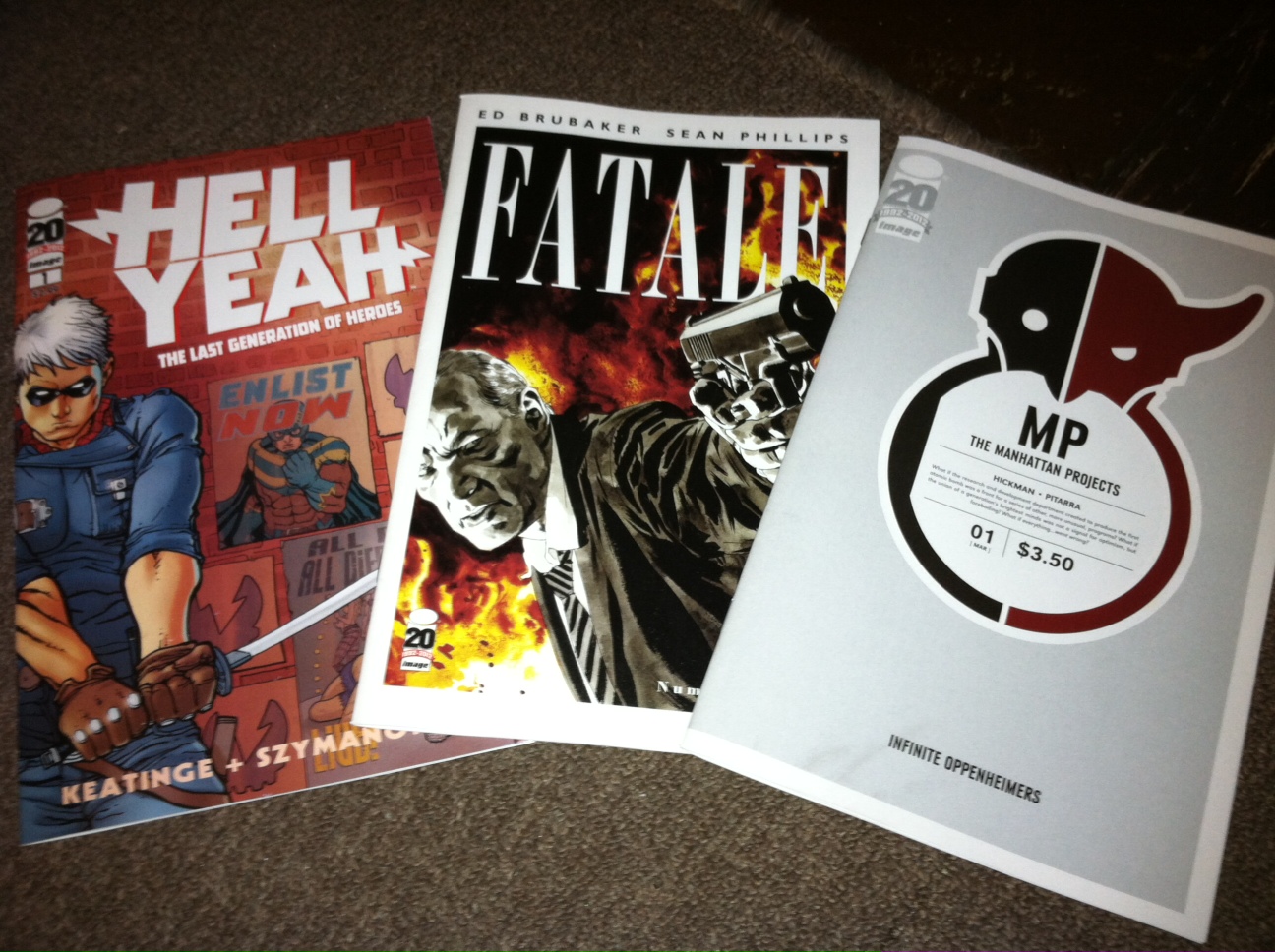
I bought and read three comics published by Image last week, and I wholeheartedly enjoyed each of them.

But aside from any craft or good time, something else about these comics struck me – the “newness.” Or, the energy.

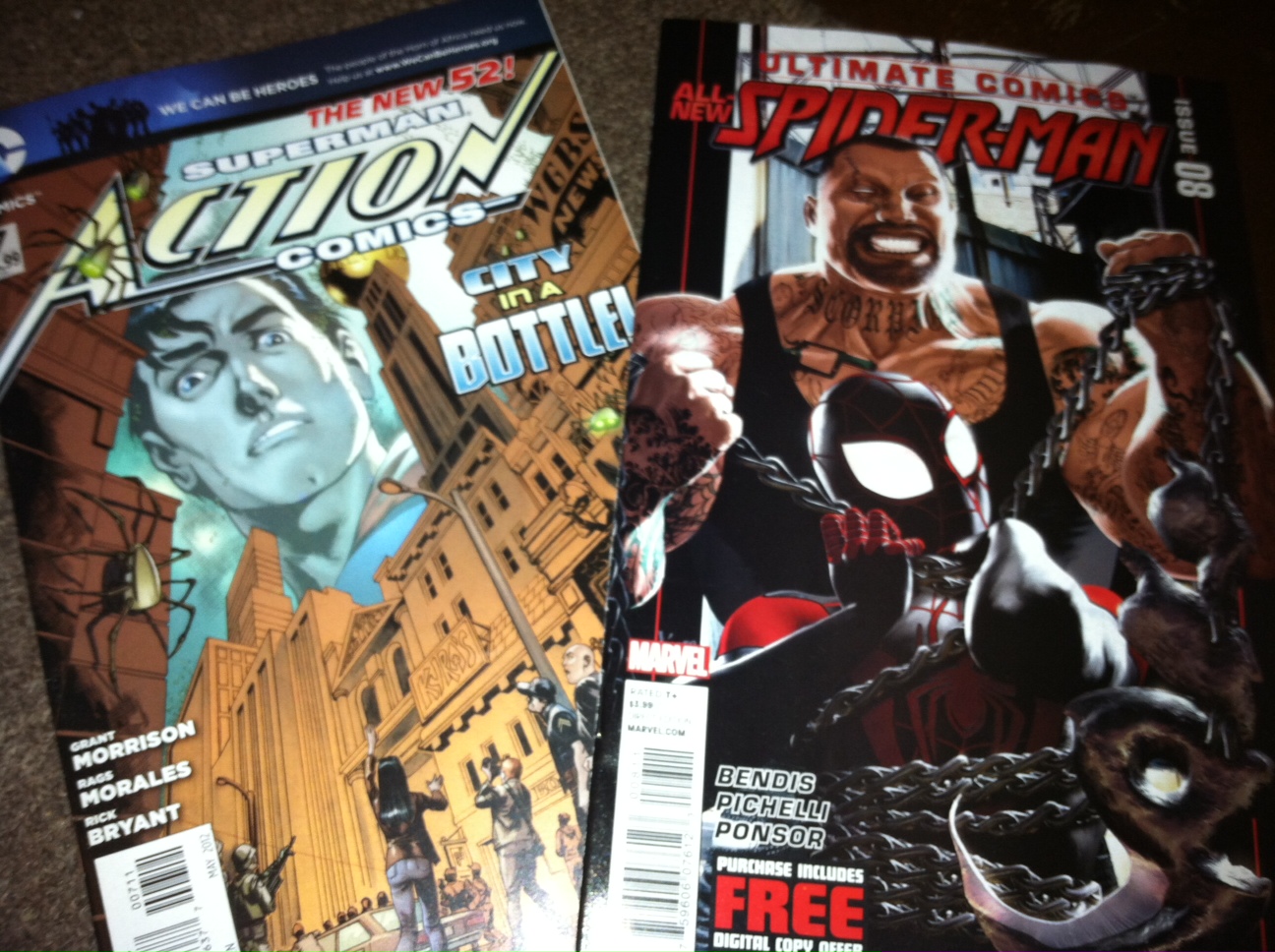
Because see, alongside these comics, I also read two tried and true establishments.

And while they were OK, I left the reading experience unaffected and neutral.

So I began considering why and how the energy of the Image books hit me and caused a genuine excitement. They weren’t the best comics I’d ever read, but for some reason I walked away refreshed and hyped up about comics again. Why? And why had the Marvel and DC books left me indifferent all together. I think I’ve come to a conclusion. The difference is attitude.

Beyond technicalities and skill sets, attitude always screams loudest. That’s the personality of a work; the objective set of details is just makeup around the face. Being an artist, or making art … the goal is to communicate an emotion or make the work reflect the personality of the maker. It’s never really about filling a position or meeting a deadline. An artist works to make pieces that represent him or her in order to share oneself with the world. By that definition, attitude really becomes key to the success of the work.

With books like Hell, Yeah, Fatale and Manhattan Projects, there exist certain genre types and tropes familiar to other stories. These comics are new, and feel new, but in reality they’re made up of other things. Hell, Yeah works with the common knowledge of the super hero while Manhattan Projects takes elements of history and twists them for fictional use. Fatale blends two genres under a version of Brubaker and Phillips tinkering with their manner of storytelling. These books are composites. Not exactly New.

But they feel new, and that’s because the creators behind these books are approaching the production with spunk, shifting these collages of concepts into ballsy, confident comics that really, actually, represent the creators rather than carry their names in order to pay them.

But aside from the outside factors and creative origins, the books themselves embody that spirit. Brubaker and Phillips, rather than selling another one of their projects or doing some oddball off-shoot project (Incognito), seem to actually be messing around with how they tell one of their stories. Especially Brubaker, who’s script on this one offers up some interesting characteristics unfamiliar with most of his previous work – things like the point of view of his narrator or the construction of the plot. He’s made the story enticing by switching it up, and Fatale doesn’t exactly read like another Bru/Phillips collaboration. Hell, Yeah, just from subject matter, captures a younger, rebellious outlook, but I’d also say Keatinge’s script, with it’s quick cuts and particular voice, signals something confident. And Manhattan Projects … Nick Pitarra’s line work may heavily evoke Quitely, Darrow and Moebius , but I’d still claim the work possesses a forceful ability to grab attention. Hickman even seems to have something a little different under his belt. I mean, the comic still stars a a bunch of powerful men in charge, trying to save the world from itself, but the way he’s writing these characters appears a little more thought out than most of his recent attempts. Because, you know what, they’re actually fucking characters and not stand-ins for concepts.

The Marvel and DC books I read completely lack any reason, spark or care. They rely on the subject matter rather than attitude because the common readers of those comics are invested in the characters and familiar worlds they typically read. Attitude does not matter to them. They’re spending money to witness fictional occurrences.

Either way is fine, and either way can be entertaining, but from my experience it feels like attitude really is the correct way to go. I’d even say a creator, if in the position, should sacrifice technical efficiency and craft purely to convey a spirit or voice because, for what I want out of comics – artworks- it’s much more ideal for an artist or writer to generate an emotion via a work rather than tell a story, necessarily. Don’t get me wrong, I always want a sound story, but an emotional response to a work seems to invite a much more satisfying reading experience. Of course, though, the ideal route involves both.

The Image books do tell stories, though. They’re far from abstract. They’re genre comics. I found it refreshing to read a handful of genre books which exuberate such enthusiasm and primal response, though. Because, honestly, I walked away from those books hyped up and ready for more. That’s an emotional response I’ve forgotten to experience when reading my monthly comics – pure, childlike excitement. Which for genre comics, should always be the goal. The super hero market has sort of twisted that, though. The game is now more about continuing the soap opera than making the blood pump.

It may read cliche to type this, but the statement “creator owned comics offer exciting work because the creators are free to do as they please” works here. Between the last Marvel books I read by Hickman and Brubaker and these Image titles from the same writers, these Image titles clearly win out. These guys are making these comics because they want to not because they have a mortgage to pay. But, the statement “creator owned = better” isn’t always true. Sometimes the creator owned market can remain just as contrived and pointless as mass market comics. Oni Press knows what I’m talking about. Even other Image comics portray this (Thief of Thieves). And the stream can also flow the other way. Mass market super hero books can also channel an attitude and evoke an emotional connection. It’s possible. It’s been done. Read Uncanny X-force, for example.

So, what’s the point? Inspired work beats out soulless tradition every time, and while that point isn’t exactly new or profound, I feel a few of these new books in publication at Image exemplify the point in a nice, clean, current example, and I find the enthusiasm they’re bringing to genre books, the recent stepchild of the medium, engrossing as well as needed.

Of course, attitude, while I prefer it, can’t always be the ultimate decider of whether or not a work stands the test of quality. Some case of objectiveness has to enter the debate at some point to keep things in order. Otherwise, things tend to get a little too unpredictable as well as unmeasurable. But, maybe reading comics isn’t really about taking measurements or ranking books according to some universal rubric? Maybe the heart of the matter is simply about what you take away from what you read and the reaction you have?

To be clear though, my focus on attitude isn’t just some excuse for the quality of these comics so that I may praise them. This also isn’t some rallying cry or Team Comics fuckshit for creator-owned books. I just enjoyed what I read. Even without the aesthetic charge or surface buzz or the claim that they’re “trying something different,” I’d still cite these comics better than, not only Action Comics or Ultimate Spider-man, but most other monthly stuff I’ve read recently. These books are sound and well put together.

You be the judge, though. I know some people completely hated these new Image books, and I can respect that. But fuck it, I’m having fun.

3 Comments

Filed under Uncategorized

Those Issues of Ultimate Spider-man I Didn’t Read | Part 1

I know it’s technically Ultimate Comics Ultimate Man Spider-comics Spider-man now, but to me the Brian Michael Bendis series is simply Ultimate Spider-man. Three words. One hyphen. That’s it.

Some time between 2008 and 2009, Marvel Comics decided to publish a comic book mini series entitled Ultimatum. It’s purpose? Totally wash away Marvel’s special line of comics known as the “Ultimate Line” and leave the debris in a position to rebuild after – a little retcon fueled disaster event to get all the fans up in arms. Written by Jeph Loeb and drawn by David Finch, Ultimatum took Marvel’s line of “limited continuity,” “free from Marvel mainline crud” comics and injected it with its own dose of Marvel hysteria and event comic chaos. Ultimate Comics, a subdivision of Marvel Comics traditional 6-1-6 line, suddenly found itself uprooted in limbo after nearly ten years of consistent focus and “left alone” mindset.

It was right at this time I dropped Ultimate Spider-man. And when I say dropped Ultimate Spider-man, I don’t mean “I bought it for 3 issues and then tossed it off my pull list.” No. I dropped Ultimate Spider-man. Like a “after buying it for 60-some issues and then going on a fanboy rampage” kind of drop.

To cut it short, the entire reason for dropping the title was an extremely dumb one. Basically, David Lafuente did not equal Mark Bagley (clearly because he is much better), and without the visual voice of Mark Bagley Ultimate Spider-man was no longer Ultimate Spider-man. Granted, I did buy the Stuart Immonen stuff, and I tolerated it (I clearly had poor judgement in the early days),  but when Lafuente showed up, it pushed such a drastic change that the title I came to count on left me hanging. I dropped that shit cold. Cried about it on the internet. Did the fanboy thing. Hard.

Looking back, the whole thing was not my most respectable moment. The excuses I had for “hating” the Lafuente work are things I would easily laugh at anyone else for saying today. But, at the time, my interest in Ultimate Spider-man suffered a fatal blow, and from then on I would do my best to avoid the book. Just up until recently.

I’ve gone back, and after a little back issue hunting (remember that shit?), I’ve managed to read the entirety of Ultimate Spider-man Phase 2 a.k.a. what I’ll term the “Lafuente Era” as well as “Death of Spider-man,” which is everything I missed during  my great purge. And what’s funny is, “Death of Spider-man” aside, this is probably the best portion of Ultimate Spider-man overall, and I skipped it. I’d even consider it a little crown jewel in Bendis’ entire career at Marvel because the “Lafuente Era” of Ultimate Spider-man did it right. Between a combination of aesthetics and pure storytelling, Bendis and Lafuente captured the essence of the teenage super hero story, fulfilling the entire concept of Ultimate Spider-man, at a higher level of craft, some 140 issues from its beginning.

But something had to be sacrificed in order to achieve that short stretch of issues. A notion of consistency. Maybe the above bits of my personal back story were simply that – personal bits – but I feel the interruption or shift I felt as a long time reader actually reflects an overall shift in this long running comic book series. Look back at it. Ultimate Spider-man, for something like 8 years, marched on at a steady pace, with consistent aesthetics, telling the same, focused story. 8 years.Ultimate Spider-man may be one of the last comics of its kind to accomplish such a run, and between the book’s own determined focus and my infantile attachment to it, the crashing wave of Ultimatum, and the shake up that followed, put the whole operation in rough waters.

So this, ladies and gentlemen, is the story of how Brian Michael Bendis did his best to steer his saga of “power and responsibility” clear of murky waters and keep it afloat. Of how a relaunch, a renumbering, a death and a rebirth – all in the course of two years – tried their hardest to derail Bendis’ solid 8 year train. For my next few blog pieces, I’m going to take a look at the period of Ultimate Spider-man I didn’t read. The “Lafuente Era,” but also the PR stunt known as “Death of Spider-man,” and I’ll even dive into the more recent version of the title featuring the character Miles Morales. The purpose? To discuss each as an individual work, but to also try and connect the three shifts – “Lafeunte,” “Death,” “Miles” – and see how they each represent their own version of Ultimate Spider-man as well as represent a period of identity crisis for a title that was once so sure of itself.
But I’m getting ahead of myself. Up first, the “Lafuente Era.”
None of these issues are perfect, and neither when paired together do they create a perfect work, but I’d mark the first 6 issues of Lafuente Spider-man closer to perfect Ultimate Spider-man than anything else.

Big, hyperbolic statement. Maybe I should back down, but it’s true.

What this initial arc accomplishes so well is providing the perspective of Peter Parker, or more or less, really putting the reader behind the eyes of a teenage super hero, placing him or her into that world. Which makes sense. The title of the arc is “The New World According to Peter Parker.” And while it’s clearly a mark of Bendis’ pen that brings about this focus, David Lafuente obviously makes the huge impact because it’s his contribution that inspires the youthful attitude as well as energetic bounce.

Looking at his artwork, the energy comes across as hard to deny. Speed lines up in your face. Expressive style. The vibrant colors dubbed on by Justin Ponsor. The elements are there for explosive comic book art, but the component that really catches the attention and sells the performance is the roundness and curve of Lafuente’s line work. It’s the element that captures that sense of motion you experience while reading a Lafuente drawn comic book. The curves seem to suggest a youthful vitality and plumpness, and it’s such a contrast from the muscle tight, skinny aesthetic Mark Bagley provided. There’s life there. A freshness, versus the 1990s-heyday look Bagley performs.

But motion derives itself from another element important to this comic. Lafuente uses a nice array of vertical panel structures throughout his entire stay on Ultimate Spider-man, which I found to be an interesting choice in page design as well as storytelling. First, the focus on vertical direction relates itself well to the Spider-man character, the subject of the piece. The character travels and fights in an acrobatic, vertically dependent fashion. The panel structure Lafuente insights sort of places the subject in an ideal environment, allowing the actual illustration to rest in a frame that works with it rather than simply houses it. Second, this is Lafuente’s way of dealing with the “Bendis Problem” I think most artists face when drawing one of his scripts – talking heads. Where long, horizontal panels tend to slow down a story in order to suggest a widescreen affect, vertical panels seem to quicken the pace by providing this quick cut movement to the page. This speeds up the scenes drenched in dialogue while making it visually exciting. But it also effects the actual dialogue. As a reader, you’re reading these sequences in a cut-to-cut fashion, so you’re reading faster. Which works. Teens tend to talk fast, and it’s already a tone Bendis writes in when writing Ultimate Spider-man so Lafuente’s contribution to the storytelling matches up very well, emphasizing what Bendis does.

So while curved lines and vertical panels suggest youthful energy, I would also suggest the actual style Lafuente draws in adds to the youthful perspective. I’m not at all an expert in manga, but Lafuente’s style is certainly manga influenced. Manga stylings have been creeping their way into American animation for years, and in this day and age it’s sort of won out with the younger audience. Anime, manga … it’s what the kids are into, and I know from experience, most high school kids that like to draw … they draw in an anime-inspired style. This suggests to me that a lot of younger people sort of automatically dub a manga influence to maybe the things they imagine – as in cartoons, drawings. So the visual design sort represents that teenage perspective in terms of illustration and what else, but more importantly, it simply represents an aesthetic that’s popular at the moment, popular especially with a younger demographic.

Bendis certainly does not freeload on Lafuente’s talent, though. While the writer plays up the usual plot elements of supporting cast and riff-heavy dialogue, it’s Bendis’ attention to teenage specific conflicts that really cements the desired perspective. I think issue 1 lays everything out so smoothly, especially the first page in which we see a single close up of Peter Parker’s face as he reviews the details of his life.

“My name is Peter Parker. I am Spider-man.”
“I was bit by a one-of-a-kind spider and now I have one-of-a-kind spider-powers.”
“I’ve saved the world. Or at least helped save it.”
“I almost died doing it. A couple of times. For real. But I didn’t.”
“I’ve fought bad guys of every shape and size. True bad guys. World-class villains. Bad bad guys.”
“I’ve met super heroes, icons. Captain America. Yep.”
“You’re talking to a sixteen-year-old who can swing across the city on a web line he actually invented.”
“A guy who can life a city bus over his head. A guy who has fought the Hulk and walked away from it.”
“We’re talkin’ vampires, mutants, Doctor Doom, Sandman, Green Goblin, Doctor Octopus …”
“I have already seen and done more than most people will ever get to do in their whole lives.”
“And now I have one question, and I want you to think about this very carefully.”
“I want you to look my in the eye and I want you to tell me:”

“Do you want fries with that?”

Turn the page, and you discover Peter works at some shitty fast food joint.

I love this opener for its flow and build up, but even more for the attitude it suggests – and it’s something I can completely relate to. That feeling, that when you’re a teenager, you know everything, have done it all, yet you’re still subjected to adults looking down on you. Now, while Peter certainly has done it all, the scene still captures that vibe of “desired verification” from an adult audience by simply its setting. Peter’s out of the costume here. He’s on the job, looking like any plain slub who can work a cash register. No one sees how special he is, or how special he sees himself. He’s just on the job, doing what anyone could, in an environment where adults run the show. And that’s shown when an elderly woman confronts Peter’s manager, another adult, and falsely accuses him of being a smart ass. While falsely accused, the manger automatically assumes the old woman is in the right and degrades Peter without hearing anything Peter has to say.Because he’s a “kid.”

The writing here even backs a classic “Peter Parkerism” – you know, “Puny Parker. He’s nothing special.” It’s a sort of cast off line Stan Lee would write for Flash Thompson all the time, but it sort of comes along and lives in this scene, summing up a very real thought felt by many people in their teenage years.  That sensation of not being  understood and the desire for respect from those older than you.

But that’s one, specific example. Really, it’s a case of the first 6 issues as a whole. To sum it up, when read together, “The New World According to Peter Parker” just reads like a very solid pop super hero comic in which the youth perspective is at the forefront. Whether it’s simply being placed in a house full of 16-somethings as Aunt May continues to take in and house many of Peter’s friends or the high school relationship drama, the first six issues of Bendis and Lafuente’s run are all about a youthful aesthetic and voice. And it’s done. Well.

The antagonist of the first arc, Mysterio, even supports what the creators are after as the character is really one of the few adults shown in the story. His villainy, then, comes as no surprise. He’s that adult looking to crash the party and subject his creed on the kids. This thought eventually reaches its climax as Mysterio learns of Peter’s super hero secret and attacks him at his very school, suggesting no place is safe.

A fair criticism of the Mysterio plot line may be it’s seeming lack of motivation, but I felt the character’s unexplained presence actually supports the theory I’m implying. Mysterio, as the original Steve Ditko sprawl of fog and green latex, worked under a faceless guise, and such a tradition is carried over to this new vision of the character where facelessness works in favor of an unexplained origin or purpose. What we know is that the character’s a bad guy who wants Spider-man, or “Spider-boy” as he once refers to him as, dead, and that makes him scary. It’s not the reason for his villainy or his background. It’s the simple surface of the character’s guise which suggests a sensation of the unknown that makes him frightening, and it’s the idea of a faceless threat which suggests something untouchable. A greater projection of an idea – which is certainly something Mysterio usually concocts with his “super power.” What better way to represent the “evil” adults than a single, identity-free super villain who just happens to be one of the few adults in the story? Why not represent that in a character who’s more like a force than just a individual man? Of course he doesn’t need a motivation. He’s just an old man trying to ruin the youth’s fun.

So that’s really, kind of the first 6 issues. If I were to sum it up in one word, I’d go with immersion.

The latter half of the Bendis/Lafuente run is, however, not necessarily as solid. Instead, the plotting sort of suffers from a usual Bendis fault in which too many plot beats are stacked on top of one another. They’re not bad comics. The aesthetics still ride high and please the senses. The problem lies more in the structure of the plot, and because Bendis is determined to make so much happen, certain plot lines suffer and are lost in the mix. Name example, the Kitty Pryde stuff.

I like how Bendis brings Kitty into this incarnation of Ultimate Spider-man, and how he uses her to handle the entire ‘Mutants in the Ultimate Marvel Universe” thing. Her story really ends up representing another tried and true conflict felt in teenage wasteland, only her’s is a drastic extension of the thought I was on earlier with Peter Parker and the shitty fast food job: being misunderstood. Bendis’ writing of her and her situation call on the typical X-men story – mutants hated by the public – but he pivots the usual plot detail into a position where it resonates with the teen mantra of “the world doesn’t get me.” It’s a nice touch and well represented by Kitty’s new identity of  ‘The Shroud,’ where she literally is dressed head-to-toe in a cloak, hidden from the world.

When Bendis decides to really open up the Kitty can of worms though, he does it, brings the drama, but quickly sidetracks and moves onto something else. Which, I guess, in itself would be fine, but he does so in the midst of one story arc, after selling the reader on the Kitty plot line. “Tainted Love” starts out taking two issues to focus on the Kitty thing and by issue three dovetails into this out-of-no-where Chameleon plot. The comic gains this tangential sensation around this point, and the move sort of cheapens some of the importance placed on Kitty’s story. You know, by making it only a “plot mechanism” to plant the seeds for the Chameleon story. Which, eventually, proves to be a lesser, done-to-death story. Although, like the Mysterio stuff, Chameleon is another villain who’s identity is a question, continuing the theme from the first arc, yet only upping the ante when he robs Peter of his identity.

The real gold moment of “Tainted Love” comes with J. Jonah Jameson, though, who’s ever-passionate hatred of Spider-man comes to a head as he uncovers who Peter Parker really is. This scene illustrates the adult perspective and the teenage perspective colliding, or better yet, becoming one as both Peter and Jameson are in the same predicament. They’ve both had their identities hijacked by Chameleon, and they are both now tied up and held captive. There’s no separation. Neither one is better than the other. They’re just both drugged hostages seeing the world from the same, poorly lit room.

I wouldn’t say this run of Ultimate Spider-man comes to any conclusions by its finish. I didn’t receive any great speech or answer to any of life’s great questions. It’s not that kind of comic. Instead, these 15 issues crafted by the likes of Bendis, Lafuente and Ponsor, are more about setting a certain tone and letting a reader live in that. Immersion, or like I said at some point in this post, capturing the essence of the teenager. Which is what the core of Spider-man – all the way back to Ditko – is. And it’s what Ultimate Spider-man has always been about. The teenager.

Out of the three shifts, I’d call the “Lafuente Era” the ideal version of Ultimate Spider-man. While Bendis and Bagley captured the concept early on in their run, the work the team produced eventually piled up into a heaping mass that sort of negated what Ultimate Comics was about: continuity free tales. Granted, this run may continue that continuity plagued narrative, but in some ways the Bendis/Lafuente run feels like a reboot of Ultimate Spider-man. Any new reader could pick up Ultimate Spider-man here and get a complete – or semi-complete – picture. The voice is here. The core of the Spider-man concept is here. And the aesthetics are superb.

If I were to guess, when Bendis saw the chance to start over, you know,  post-Ultimatum, I think he took it – like really took it. Because this version of Ultimate Spider-man may be similar, but it’s also entirely different.

I feel David Lafuente made the difference. What he brought to the table changed this book, giving it this new, magical charm. His style, his line work – those things embody the spirit of Ultimate Spider-man. New, fresh, exciting, energized. That’s what Ultimate Comics was meant to be.

The “Lafuente Era” feels like the start of an entirely new title rather than some continuation of an 8 year plot, and I feel Bendis and Co. would have kept it going if not for the loud interruption known as “Death of Spider-man,” which, ultimately, left the end of this run somewhat unfinished and keeps it from existing as a complete, closed story.

That interruption is what I’ll write about next.

Next time: I go over “Death of Spider-man” in a much shorter blog post.

2 Comments

Filed under Uncategorized

My Top 10 – 2011 Edition

Comic books. I read a bunch of them this year. Here are what I consider my favorite from 2011, ranked in some sort of particular order.

10. Moon Knight – Brian Michael Bendis and Alex Maleev

Technically, this probably shouldn’t be on any top 10 list because I’m not sure every issue has been crafted so well, but whatever, I’ve had a lot of fun reading Moon Knight every month. More fun than I can necessarily describe. I mean, fuck, I took the liberty to write about every issue of this comic, and I plan to do so on into the foreseeable future. Because this is my character, as lame as that sounds. Besides Greg Burgas, I’m probably the internet’s biggest Moon Knight fan, and I can’t tell you the time I’ve spent waiting for a legitimately good series starring the character. And now it’s here, and Bendis and Maleev are building a comfortable, best friend-type comic around the character. It looks great, the core’s there and I feel invested in the actual plot. I am a happy reader.

9. Spaceman – Brian Azzarello, Eduardo Risso, Patricia Mulvihill, Clem Robins, Dave Johnson

I only list each creator because this is one of the few comics in which collaboration actually fucking matters and produces the product you read. Whether Spaceman ends up as a compelling, mark-making science fiction yarn or a disappointing collection of pulp paper, one thing’s for sure – this comic houses the best team in comics. And not just Azz & Risso. No. Mulvihill, Robins, and Johnson too. It’s an entire squad producing this monthly adventure, and, God, it’s synced so well. While there’s only 2 issues out, Spaceman clearly has held more of my attention than all the rest of the mundane mush 2011 had to offer. Pay your dos. This is how mainstream comics should be made.

8. Zegas #1 – Michel Fiffe

Dammit if this isn’t one of the best looking comics this year. Fiffe creates slice of life parables and dresses them in peppery apocalyptic ash fires, elevating the impact of the story he’s after as well as providing his comic a declared visual identity. His cartooning is in league with King City scribe Brandon Graham, pulling influence from all kinds of line work – European and beyond. And, man, the color work. There’s this citrus Earth tone he’s goes for and completely nails to create this wonderful effect of twilight and swelling emotion. Zegas #1 reminds the reader of how impending doom can cause us to live and make the most of what we have. Fiffe captured my attention this year, and Zegas #1 is certainly a reason why. I can’t wait for a second issue, or simply anything he does next.

7. Daredevil – Mark Waid, Marcos Martin, Paolo Rivera

A very well crafted super hero comic which supplies the necessary drum beats and bass notes every thirty days. Why aren’t more mainstream comics like this? I don’t know. For some reason the formula of good creative talent and solid stories is impossible to nail down in the market we now know. But thank the higher up for Daredevil. It’s this sparkle of hope, I think. It’s this bright little bulb in the garage full of dust mites and broken glass. I can only hope it pushes onward to twenty issues. That is more than we deserve.

6. Uncanny X-force – Rick Remender, Jerome Opena, Esad Ribic, Dean White

And the Marvel streak continues. Another book like Daredevil in which I feel the goal of cape comics was really met: monthly satisfaction. But the one thing X-force had over Daredevil was its wonderful sense of threat and culmination. I’m not an X-men reader, but I couldn’t help but be swept away by Remender’s control of the subject matter and its history, combining all elements of X-men lore into this epic celebration of the property as well as reflecting on the idea of progression and our obsession with it. To me, this seemed to be the ultimate X-men comic book where everything came to a head. In terms of a super hero comic, I think it’s an instant classic like that of Morrison’s X-men, and I can’t help but say I’m proud to have experienced it on its monthly tour. Plus, it’s another book in which I actually gave a shit about the plot. I respect comics that can do that to me because 97% of them I read for other sad reasons. Also, it kept to the soap opera integrity X-men stories are known for – right down to the conclusion of the “Dark Angel Saga.”

5. Vengeance – Joe Casey and Nick Dragotta

If only all event comics read like this one. Joe Casey and Nick Dragotta’s hot middle finger to Fear Itself worked so well in the shadows of Marvel’s publishing plan that I’d call it one of the better punk rock comics I’ve read in some time. Each page makes a sham of the drawn out model of story telling we’ve come to cradle in mainstream comics, packing each and every issue with such detail that the singles themselves could be considered events. But what’s hot about Vengeance is its anger. This is Casey’s living example of how he wants super hero comics written. Where Butcher Baker sets the attitude and philosophy, Vengeance comes in to apply the theory, and that’s apparent from the very first page.  Vibrant, dense and capable of toying with all of the event conventions, Vengeance gave the reading populace what it wanted this year. Tight, meaningful hero comics, and most likely the people had no idea, missing it entirely.

4. Criminal: Last of the Innocent – Ed Brubaker, Sean Phillips, Val Staples, Dave Stewart

Just such a great story. That’s honestly all it comes down to with this one. A great story made from great construction. Fuck, Last of the Innocent all boiled down to that final page for me. Shit, the final panel. There was not one better image to sum up an idea. After a year and a half or so of bad/mediocre Brubaker comics, it felt good to read this. I missed Val Staples on the two final issues, but I feel Phillips and Brubaker pulled the work through and stuck the landing. This is a cold story. Cold, brutal and honest. It fits so well into Bru’s overall catalog. I’m proud to own this.

3. Butcher Baker, the Righteous Maker – Joe Casey and Mike Huddleston

This hot, synthy, peppermint green comic exuberates so much attitude and testosterone it burns your fingers when you pick it up. But that’s why I love it so. Butcher Baker was the war cry I followed all year. Between Huddleston’s beautiful illustrations and Casey’s madman text essays, BB does philosophy better than any comic book out there at the moment. It’s a fucking beast. Forget this quick quip your reading. Read the comic, or this essay I did on it months back.

2. Blast Furnace Funnies – Frank Santoro

A true poem in comic book form, Santoro sums up what a city or town can potentially mean. But that’s not the kicker. While emotionally packed as well as touching, what makes Blast Furnace Funnies special is its observation and meditation on process. Santoro comes off to me as a comic artist’s comic artist, and Blast Furnace is a testament to that. Originally apart of a museum exhibit in his hometown of Pittsburgh, Blast Furnace digs deep into how comics evolve from thought to a tangible mass of paper. Each panel within this thing tells a story because Santoro pays so much attention that each panel lives as its own independent painting. And the colors. They haunt yet warm you.  It’s a comic that as I now think about it I wish I gave more time to throughout the year, but I guess I can at least honor it somehow via this list. If anything, it’s one of the few things I read this year I know I’ll reread multiple times. It delivers a lasting impact.

1. Twisted Savage Dragon Funnies/ Savage Dragon – Erik Larsen, Michel Fiffe, various others

I think this earlier blog post spoiled the surprise, but whatever, this was a good year for Dragon readers. TSDF may make up most of the reason for a number 1 spot, but Larsen’s Dragon all by its lonesome would still easily rank somewhere on my top 10. Why? It’s comics. It’s larger than life, it’s issue-to-issue, it’s entertaining, it experiments, and it’s free, and even though it’s most always been those things, 2011 was the year Dragon juiced up a bit and showed the public what it could really do. I feel this was the year the book was somehow legitimized. It only had to plummet in sales to reach such a standard … But I believe bringing in Michel Fiffe and Co. helped as well because sharing the staples with Larsen’s comics were an assortment of art comic favorites. As my earlier essay states, TSDF embodies that ideal comic book, mashing super heroes with alternative story tellers to celebrate all of what the medium has to offer. I feel the project will only stand as an example for what’s possible in the future. Or if anything, it should because TSDF is the cue mainstream comics needs to take. I just love that the guy and book people enjoy so much to write off made the point and came away fueling the best comics of 2011. How’s that for justice?

1 Comment

Filed under Uncategorized

Mudman #1 | Paul Grist

My clock reads 2:28 am, yet for some reason I’m awake typing this review. My head hurts, and my body’s shouting at me with cold chills and lonesome aches. I feel some sort of illness charging my way, which of course “just figures.” Holiday break begins this weekend.

I’m compelled to tell you about Mudman #1, though. That’s sad, right? That I feel driven to tell you, the invisible reader, about this comic book? And it’s not even that good, which makes this activity even sadder. I should just get on with it, huh?

What’s funny about this new Paul Grist Image comic is that the book doesn’t even deliver what it states it will, which is a “story written for the comic book.” By now, most of you internet savy funny book fiends probably know of the open letter on the inside front cover of this printed item. I believe “news” blogs picked it up and gave it a few rounds. But, in case you’re unaware, here’s the gist of it …

“I’m not ‘Writing for the Trade’, I’m writing for the comic.”

Grist’s entire letter tells the infamous tale of how our comics and TV shows are now offered in narrative chunks. You know, the box set and the trade paper back… and Grist isn’t down with this. For him, these media are a means of serialized storytelling, so why experience the entire story at once? He then goes on to pledge his comic, this Mudman, will uphold the serialized mindset. That’s great. I completely agree with him.

Because I like comics. I like 20 page bundles, and I like staples. I like monthly installments. I like the idea of time adding to the narrative. Trades, to me, destroy all of that, and in some regard, like Grist notes, trades destroy the flow of comic book storytelling. I honestly kind of hate the fucking things. To me, you’re not getting everything when you read the story in a trade because time is not necessary involved to help supplement the tale. Instead, it’s all in your face. You’re not thinking as much as you should about it. Most likely, when you’re done, the story isn’t going to linger with you. Because you’re done with it, and it just becomes another book on a shelf where you house the rest of your shitty Fear Itself tie-in trades.

Which is itself a messed up situation … the fact that everything must now see a collection. No. Most of this shit deserves to rot in some box or backroom storage area. But whatever. Mudman.

So I agree with the intention, but Grist doesn’t translate that intention. Instead, Mudman reads like any other first issue you might see in the current landscape, except it’s little weaker. Script wise. Art wise, though, I’d say it’s a whole other story. I’ll offer a little praise first. I don’t want to be a complete asshole.

This comic looks like nothing else on the market right now. That’s safe to say. Style. Layouts. It’s pretty unique. What I appreciate the most is the abundance of white space left between the panels as well as in them. The book feels clean that way – clean and minty fresh. Which works very well when juxtaposed with the dark browns this mud-centric story implies. It also just bounces off of the majority of comics right now. So many of the big super hero titles resort to the muck coloring and “mature” stories in which Superman is a dick that this little comic suggests a breath of fresh air when you look at it. I can appreciate that just as I can appreciate the design aspect in each and every one of Grist’s pages. The panel placement suggests a sense of time invested in the creation, yet Grist’s expressionistic style offers up a quick cartooning look.

I think a lot of this comic, visually, is about emphasis. The book uses contrast to make specific elements stronger, and because of that I feel the comic keeps your eyes’ attention a little longer than most things.

But I was in ill-favor of this comic, wasn’t I? I should get back to that.

As Tim Callahan points out, intention is separate from what its actually on the page, and I agree with him, but I feel in this case intention is an element of the final product. For one, the intention is blatantly stated in the work, and two, the comic seems to be so much about offering an alternative that it cannot help but be connected to the statement of intention. I think Grist wants to do this comic because he wants to give people a monthly super hero story that is monthly as well as lighthearted, but he’s so much about that, that the comic really just seems to exist for the sake of an intention, or better yet, to be a public statement rather than to tell a story. So it’s with that I must hold the work up to the intention, and Grist doesn’t nail it.

The comic gets the lighthearted bit right, but it’s still written with an eventual trade paper back in mind. True, Grist has the notion of serialized narrative in mind, but this comic really leaves too much to be explained in future issues. There’s nothing here that’s solid or of its own. Instead, Mudman #1 sets up a lot of pieces without supplying anything concrete or satisfying for this monthly installment. The comic’s somewhat hypocritical.

But say we even remove intention from the argument and just focus on what is exactly on the page … Mudman still doesn’t really work. The plot is sown together in a disjointed fashion, going from numerous dream sequences to “real” world scenes. None of it flows together but rather makes you wonder what exactly is going on. There are even bits in the plot that don’t really work. For one example, our protagonist is at one point hit by a car – which is nonetheless driven by one of his teachers – but rather than being apologized to or taken care of, he is yelled at. That doesn’t make any sense.

But I’m not even sure if he was hit by a car because on the very next page the automobile is parked and its owner comes walking from the opposite direction, implying some weird sense that what we saw is not exactly so. Which is interesting for a mystery, but I’m not even sure if it is a mystery or just bad story telling.

The entire comic just makes for a disjointed read, and I was given very little in what is supposed to be a monthly installment to really say I received anything. That said, I’ll probably give issue 2 a shot because I’m still somewhat intrigued, but more importantly, Mudman looks really good. Can’t complain on that front.

Leave a comment

Filed under Uncategorized

You Are Always on My Mind | Kat Roberts

I’ve been trying to write this post for the past four hours, but between the distractions of G.I. Joe trailers, skittles, cute girls and Patrice O’Neal stand up, I have yet to accomplish anything up until the very typing of this God awful sentence. Fuck it. Gotta start somewhere.

This sense of procrastination exists because  I feel the need to be negative and critical as I review this comic by Kat Roberts. Not that I found it awful – quite the opposite – but because I’ve been on a positive, everything-is-flowers streak lately. I’m sure someone reading is questioning my integrity as a “critic,” and I feel that in this day and age of “comics criticism” where everything receives automatic love, I need to expect more of what I read and push my own critical bar. Or that in order to prove my blog worthy I need to rip something to shreds and then take a massive shit on those shreds. Because that’s what critics do, right? They’re the ultimate judges. The Comics Journal as well as individual dudes I enjoy reading work that way.

But see, those voices do negative within reason, and they provide fair analysis by way of their intellect. For the most part, I don’t believe any TCJ writer rips into things without a sound purpose. Those guys are considered professional critics, so they know better. Although, when it comes to the super hero, genre stuff … I think they can lose some of the self discipline and spit unnecessary insults.

I guess what I’m trying to say is I became self-conscious of my critical voice today after a few days of suspicion. I give a shit about this blog, and I’d like to be recognized as a legitimate voice of some sort at some point, you know? I’ve been reading a lot of pieces by a lot of different sites and individuals lately, and while not everyone has impressed me, each one that I’ve read has been able to hold to a high standard or expectation. I then look at my own stuff and wonder how I could improve, and I’m just wondering whether or not I’m critical enough to be a legit critic. So coming to type this review I’ve been searching for a way to not absolutely high-five Kat Roberts and this comic. Just, you know, looking at it tougher and pushing my own way of thinking about it.

So what does this “writer talking about his own writing” intro have to do with Kat Roberts and her comic? Not a whole lot besides being the context in which I am forming this blog post. Oh, and because even though I’ve been on a positive streak it doesn’t mean I should just tear something apart for no reason other than to shit. Sure, it’s one thing to be critical and set a high bar, but in this instance of reviewing this particular comic the tough attitude doesn’t seem necessary. You Are Always on My Mind deserves a pat on the back, and even though I’m looking at it hard in order to issue a complaint, I really can’t find a whole lot. So, whatever. I guess I’ll save the negative for another time and get this review started. Thanks for hanging out throughout that first couple hundred words. Just writing out thoughts.

*by the way, none of that intro is a rip or complaint of negative reviews. I’m not trying to make a point against them. I literally mean what I typed. I’m uncertain of my critical credibility.

So, the comic. I should write about that and get past this self-conscious, oh poor me bullshit. The internet’s seen enough of that lately, anyway.

In case you don’t know anything about Kat Roberts, she’s a cartoonist and all around creative person residing in Brooklyn. She has this blog about DIY fashion, and she’s also published this series of web comics called “Fever Dream.” I believe she’s relativity new to comics, but guessing from her work I’d say she already knows how to contribute a solid effort.

You Are Always on My Mind weighs in at 12 pages but packs 4 well-crafted shorts that invite you in and let you explore the notions of embarrassment and self-conscious worry. Roberts uses dreams as the base for her brief narratives.  Some are even said to be real ones she’s had. But, real or not, these dreams paint quirky situations that lend themselves to some discomfort as well as a good laugh.

What makes these shorts so enjoyable though are their execution. In terms of shorts, every beat counts. We all know that, but Roberts makes that fact feel fresh again. I don’t feel like I’ve had that thought before when I read her comics because the way in which she sets up her stories and hits the punchline per say makes you smile and turn the page. The progression in the narrative and the visual cues feels mechanical, yet not so that it comes off as stiff or hollow. Instead, the flow feels rich and tight. Like a well-oiled machine or a drummer hitting a snare drum on cue.

Roberts isn’t shy about implementing creative signals to move her stories along. There are quite a few instances in this comic in which she applies clever, even cute, visual bits. My favorites have to be the two panels above. The warped speaker box just oozes those “thoomps”, and the little blocks depicting fingers in a countdown descend so nicely. Just interesting tidbits like that turn a normal progression of panels into something a little more colorful and personable.

There’s also this use of facial express in which she completely capstones a whole story via one panel, and it’s done so well that the beat is met and I, as the reader, laugh.

And, hell, this one panel manages to look cool, tell the story and echo back to Abbey Road in a rock ‘n’ roll centered story about crushin’ on Jim Morrison.

But I like the order of the 4 stories the most, believe it or not. Roberts opens her comic with the short “I Lost My Virginity to Jim Morrison,” which reads more like a traditional comic book narrative, and closes it out with a dialogue-less, more subtle short entitled “Dream in June.” Between the two, Roberts expresses a bit of a dark side with tales like “Nude Suit” and “Sin Eater.” What I take from this progression is that Roberts structured the content of this mini comic in order to pull you in so you can’t escape her more awkward points. There’s a feeling of “easing in” all throughout the book up until you hit the heavy stuff. You go from “Nude Suit,” which is slightly awkward yet still packs a laugh, to the almost haunting green pallet of “Sin Eater,” and I think it’s in “Sin Eater” that the core of the book conveys itself. Think of the idea of sins and sinning. That shit’s supposed to stick with you. They are the mistakes and missteps you’ve made. They are your faults. The things that remain on your mind. It’s in that tale that Roberts’ fictionalized self must face her wrongdoings, yet even then it’s done with a chuckle as the cartoon version of the author makes a disgusted face after her first gulp of sin worms.

But it’s that idea of shit you can’t escape Roberts is after, and by selling the point through dreams I’d say she does an affective job. I mean, dreams are theorized to tell us things about ourselves, correct? Or more so, if you can’t escape something even in your sleep, where are you supposed to go? Same thought process as A Nightmare on Elm Street, but instead I think You Are Always on My Mind speaks more to self-conscious judgements than not being able to completely protect your kids.

The comic strays away from being a complete awkward downer though by way of its finale “Dream in June.” It’s here Roberts suggests a positive outlook and a way to escape the nags and worries. A fitting end, if I may say.

So, that’s my review. I hope it worked in some regard. I’ll probably ponder its faults tomorrow.

2 Comments

Filed under Uncategorized