Category Archives: Uncategorized

Eyes Shining Back

Sometimes, I don’t know if I want to be a writer. Writing isn’t really fun. 

I mean, think about book reports. 

Did you like those? Did you like making them?       I mean, maybe you did.

Or, maybe you just say you did. 

Or, maybe I’m too cynical. 

But, think about book reports.

Honestly?


Except it is kinda fun. 

Because you can write down anything you want to 

At any time of day or night. 

How is that not of value?

To you or me?

You can write whatever your mind gives you. Write it down as you think it! That’s — all your truths. That’s — all your fictions.           Two infinite landscapes, if you let them be. 

Now, I’m starting to understand confidence. I’m not afraid to say that. 

I can say that my mind isn’t small. 

It isn’t the best … But it’s better. 

Except sometimes it’s plagued by fucked fucked fucked anxiety and worry and spirals and spirals of possible bad outcomes for everything from what I’m eating, to what I’m doing at work, to what so-and-so might think of me holy shit — no. 

(For real. I am not chill inside.)

(Never have been.)

Having that kind of mind gets in the way of a lot of things. That’s what sucks about anxiety. 

It gets in the way. 

It holds you dangling outside the present.   

Now, I can’t pretend to know anything about Buddhism. 

But I think it’s important to be present as much as possible. 

My experience: Hanging on and looking forward are fantasies based on pictures in your head. 

They are stories you are telling. To keep hope alive. 

Or, throw you down a flight of stairs of pity.

And that’s fine. 

That’s being human. 

And in there, somewhere, are lessons to learn and goals to want. 

Pay attention to them. 


But, my mind isn’t too bad. It’s actually pretty good. I can feel that now. 

Because I feel confident. 

About writing, at least. 

I feel confident that I am a good writer. 

I have never felt this way. 

Why?

I have always just assumed that I am less or wrong or a burden. 

And in this frame of mind it’s hard to really do anything. 

Writing well takes concentration. It also takes belief. 

The writer must believe in what they say. 

And, I don’t know that I ever did. 

I guess, there was always a whisper of doubt

Wondering why bother. Why should you?


But like I said, my mind is good. More than that, I like using it. 

It’s my most entertaining hobby. 

Whatever the fuck I can create is in there. Whatever the fuck I can see. 

Or hear. 

Or smell. 

Or touch. 

I can be curious. I can look at what’s around me and just think about it.

From a small detail to a continent. Pick a topic and I can think about it. 

Study it. 

Understand it beyond facts. 

Intuit something from this —

Or, what’s something I’m not facing? That thing of mine I haven’t dealt with. 

Think about it. 

Maybe I can think through it. 

To study it 

Beyond facts and 

Intuit something from this.


But that takes confidence, too. 

More than that, I should want to. 

I should want to think. I should want to concentrate on the ideas that appeal to me. 

There is no other reason. It is not to inflate who I am. 

It is to focus on exactly what is. 

And I do my best to do this. 

I like what I have to offer. 

I like how granular I can get. 

I like my willingness to be myself. 

For me, writing makes it all real. It makes my mind real, and you can then read my mind. And we can form something.

This is our shared power. 

But, you know when writing sucks. 

It’s when the words don’t hold your attention. 

When it feels like reading a book. 

And we don’t like book reports, remember? 

I never did. 

I don’t know what holds someone’s attention. 

I don’t know you well enough to know.

But, I do know when my writing is at its best, 

When I’m just writing the way I talk to myself, embracing theatrics, actually sharing my thoughts and feelings directly but with care and commitment.

That is when I am at my best. 

In those small moments of realization. 

Looking in the mirror. 

Trusting those eyes shining back. 

And, for that, I do want to be a writer. 

To keep that picture there

And let it last. 

— If only in my eyes. 

That’s all I really want.

Leave a comment

Filed under Uncategorized

Caribou

How are you? I’m doing OK. Just felt like writing and posting something. 

I’ve (mostly) stayed away from social media in the last 5 or 6 months. I’ve realized that my sense of self-worth isn’t entirely healthy, and it hasn’t ever really been. 

Social media (namely Twitter) has only nurtured and exploited this insecurity. 

Sometimes to a point of real self-hatred. Driven by self-comparisons to all those who are so good at holding our attention on that platform, as well as the nobodies who put on a good show.

There are reasons for this. 

Reasons I’m working to identify and do something about. They’re behaviors long ago learned and programmed.

It’s frustrating, but I know it’ll be worth it down the road. It’s my way out.  

But in the meantime, I’ve concentrated on building for myself a smaller world or universe. Something filled with tangible people and hobbies that are grounded and in debt to routines. 

I want a life that is my own to experience and not to broadcast. 

Even if it’s forgettable to most everyone else. So long as it’s real, in a space where I can exist. 

That alone can be unique. 

Because you’ll never know life as I know it. Even if it’s the same as yours, it’s still not mine.

Just as mine is not yours. Even if yours is fairly textbook.

See, I joined Twitter in 2009 when I was 17 years old. 

I used it to promote a podcast I had then recently started. 

This show (for a 17-year-old) possessed a noteworthy, engaged audience, and I felt like I had potential.

From 2009 until about April 2021, I looked at Twitter every single day of my life. That’s 12 years.

Most days, I’d sign on many times at all hours. Waiting for someone to notice me. 

Using it as an extension of myself. 

To somehow make notable my personal, intimate interest in writing or being creative. A specific way that I am in touch with who I am, or how I explore who I am and the world around me. 

I wanted that thing to be important to other people, too. 

Internet people. Avatars and fictions that I’ve never met and will never meet. The Cool Ones hyping other Cool Ones in a feedback loop, anticipating an invitation to play in it, too. 

I hoped Twitter and those that I convinced to follow me would validate my efforts. They could bring me something seeming to be purpose and justify me. 

And that never happened. They never did.

And as the years went by, and life happened — good things in life, even  — I grew more bitter. 

I wondered what was wrong with me, and what was wrong with everyone else.

I blamed the world for my insignificance. And I blamed myself. And I blamed those around me.

I figured I must not have potential. And, honestly, I’m still wondering. Why am I alive? 

Now, all this goes back to something deeper. 

I can’t blame the Internet for irritating something that was already exposed. 

But there is poison in what we live with.

And while I know there’s value in contemplating your own smallness in the face of it all, I do not know that it is healthy to confront this daily through a cellphone, with advertisements flashing. 

It can be habitual. What, then, is the influence?

How do you begin to see the world, or your community, or other human beings? 

Do you hate them? Do you fear them? Do you believe yourself better, yet unrecognized? 

For myself, I can resonate with those questions and apply them to my perspective. Can you?

It’s OK if you can. I get it. I think there are many more of us than just you and me. 

The fact is, until social media, human beings lived in their small universes mostly unaware of all those other realities out there speeding by. 

We were more concerned with our immediate surroundings and real experience.

We knew of and interacted with other people and their wants and opinions and promotions, but we did not ingest this stimulus constantly, and the sample size was much smaller in comparison.

Social media is our collective nervous system. Our anxieties, neediness, and hucksterism are bottomless. And you are but a copy of a copy in it, seeking all the same shit.

Social media has the ability to affect two things incredibly important to human beings. 

Money and ego. 

Twitter can make or break them. 

It’ll push your confidence up-up-up in line with dopamine, convincing you of all of your myopic fantasies. It’ll fire you and estrange your relationships while inspiring mobs in your honor.

The President pays attention to it. All the other world leaders. Of course, we do, too. 

It’s a website made by a few business-minded individuals, who keep it going. 

It represents the worst of what we already cared about, hyper-ized. 

It makes us care even more.

But I can’t blame the Internet for my issues. 

That’s not how I’ll make any progress. 

But like writing, sometimes making a point from personal experience feels right. It’s satisfying. 

And while there’s that part of me still hoping for the approval of Cool Ones found in tweets about my excellence, welcoming me to their club, it’s nice to remember how small a blog post is. 

And that they didn’t write it. 

And that a blog post, or a story, or a podcast, or whatever it is I make owes them nothing. 

My life and how it happens or how it sounds has not a thing to do with theirs.

I wonder how they see it? Do they have the same awareness or humility? 

Do they feel insecure, too? Is that why they tweet like so and rely on others and their tweets?

Is that why they write books? Or edit websites? Or offer opinions? 

Are they just as fearful of insignificance as I am? 

I care to know, but honestly, why?  

I don’t know them. Let alone have shaken their hand. And I have my own things to do.

But I’ll answer that question someday because I need to know why I’m even asking it.

Which is maybe only human.

1 Comment

Filed under Uncategorized

You should drink water

Leave a comment

Filed under Uncategorized

DAX 97

Where I am, right now, it’s all sunshine and it’s all heat and it’s all just fine.

Two days ago, I wrote something bad, and I sent it to a publication I sometimes look at, and for a few seconds I felt like an idiot, but now I don’t really care.

Last night, I sat around a grill eating hot dogs with people I enjoy, out in some country hills, wondering what’s in the woods surrounding our heads, and they talked about farming internships and famous farmers and not showering and enemas and the sizes dogs can grow into, and I listened.

Before that, I drank beers shirtless out back of my parent’s house while a stereo played songs I picked. I caught a sunburn and remembered the beach.

The previous night, I ate steak sandwiches and sipped quality bourbons, the types of bourbons bourbon-people like and search for, in a bar — a real, open, operational, crowded bar — while an employee, off-the-clock, talked about different distilleries and American history as it relates to liquor and sweetness, and I’d normally dislike this experience, I’d normally find it annoying or pretentious or wasteful, but at that time I appreciated the enthusiasm and the want to share and that someone who makes $9 an hour has found a way to indulge the finer things, so I spent $100 and didn’t mind.

Leave a comment

Filed under Uncategorized

[?,~+++87&63 = !]

Alec: So let’s get this straight. This is a real work email from a lawyer at the law firm where you’re employed, yeah?

Alec: Yeah.

Alec: And he’s actually trying to be considerate here?

Alec: Yeah, I mean, I don’t think it’s a joke. There’s no way, right?

Alec: Yeah, no. There’s no way.

Alec: But they sent this at 11:18 p.m. Like, that’s joking hour, yeah? You joke around in work emails at that point because it’s after hours.

Alec: Yeah, man, but where are the “haha”s?

Alec: You’re right.

Alec: This guy is for real.

Alec: Fuck.

Alec: I mean, I complain about my job, and I do this a lot, and I do this thoroughly. Like, I’ve covered every angle of it, and I’m tired of hearing myself say the same few things over and over and over again, but the whole act blows off steam.

Alec: Yeah.

Alec: Maybe you do something similar?

Alec: Yeah, yeah. It’s all bad news. It’s all bad times.

Alec: But emails like this one justify talking shit.

Alec: Absolutely. Say any negative thing you feel. It’s your blog.

Alec: Yeah, yeah. Thanks. —

The sense of nobility in it is the worst part.

That, and that it was sent so late, and that I had to read it so late.

Alec: Well, he’s on the west coast.

Alec: Still, man, come on.

It reminds me of those dudes who want everybody to throw out all their stuff.

Alec: The minimalists?

Alec: Yeah.

Like, I get it, and they’re not totally off-base, but the whole identity created from it is annoying, and it’s become this way for dudes with money to act self-righteous and write books.

Alec: Yeah, man, you tell ‘em. ; )

Alec: Seriously.

Alec: I know, I know. Just fucking with you.

Alec: But, like, who is he being noble for? The private equity firm that’ll hire him? I mean, fuck. Charge that thing all the money you can get. He doesn’t work for the little guy.

Alec: Yeah. But that’s lawyers. Being a lawyer is a way to harbor respect and appear beneficial while pulling cash and being a fuck.

Alec: So you think he’s just doing it for himself?

Alec: I think he’s just doing it for himself.

Alec: Yeah. —

I guess we all are.

Alec: Hey, hey, bud. Don’t compare us to this fucking guy. We are not this guy.

This guy sits somewhere out in Silicon Valley and pats himself on the back for being apart of something “disruptive” or “innovative.” He’s out there everyday in California working his time away for another big business, to lead the way, to get the bones moving, thinking he’ll help remodel history, pocketing more green, selling another smile, thinking he’s so conscious of the world surrounding him, but he doesn’t know anything. I mean, he doesn’t know anything, and maybe he knows he knows nothing, but he won’t admit it, especially not to himself. You know?

We can admit that. He can’t.

The dude’s a wash. He’s another suit and tie thinking he really matters.

Alec: But can’t an argument be made that he really does? Like, considering the shape and play of our day-to-day life, driven by business, the dude is able to navigate all this much more than we can.

He’s probably got connections.

Alec: Fuck his connections. You’re not listening. This guy sucks. The email makes that clear.

Alec: But how can we say that if we, admittedly, don’t know anything?

Alec: Omg

Alec: Also, this format is getting old. It’s done its thing.

Alec: Look: Yeah, we don’t know what this guy’s childhood was like. We don’t know his beliefs, or what sad things have happened to him that have defined his perspective, or what his mom made him do, or what his frat made him do, or what America has made him do. It’s entirely possible the guy doesn’t actually suck but is just existing how he knows best to, just like so many of us, trying and trying and trying. And, yes, it’s simplistic to sit here and say tired things about wealth inequality or capitalism or corporate greed or recite the typical criticisms of the typical narrative of the typical individual in this country. I get you, man. I do. I hesitate to be that way, too. I like to consider things with some nuance.

But, look, you sat up late some Tuesday night and read this email and you had a reaction. A “fuck this guy, he sucks” reaction. You felt that, yes?

Alec: Yeah. But —

Alec: Own it. Just own it. That’s your perspective. And it isn’t even permanent. It was momentary, specific to an event. Let yourself have it.

Alec: Why is this about me now?

Alec: Idk

Alec: You know what else?

Alec: What?

Alec: I want to get this on the record now. —

In six months everybody will be wearing big rain jackets all the time. Like, that’ll be the look. I guarantee it. Hot girls in rain jackets.

Alec: Alright, yeah. Hot girls in rain jackets. Let’s go.

Leave a comment

Filed under Uncategorized

His Wife Leaves Him by Stephen Dixon

Stephen Dixon, man. I don’t revere the guy, but I appreciate from a limited perspective (some of) what he did. His Wife Leaves Him, his novel published in 2013, approaches story structure and time in a very playful way that’s also ambitious and serious and respectable for a “writer’s writer.” All of that is thought provoking and invigorating, but it’s a book that will annoy you (intentionally, I think, but still) in many instances because it’s literally about one guy thinking for 400 pages.

And not only that, but thinking to himself. As if in conversation. He spends the night after his wife’s funeral lying in bed, wide awake, reconsidering much of their marriage. Sometimes, he stands up to visit the bathroom and pee, and it’s in these spare instances that his train of thought halts, and the actual present tense of the novel exists. Much of the action is in the recollection. It’s in there that people walk around and pick up coffee cups and hail cabs. It’s in there that about a quarter of the book is dedicated to the narrator reconstructing – or trying to reconstruct – what it was like to call his now dead wife decades ago to ask her out for the first time.

It’s one of those books. It narrows in on small moments and blows them out into their own universes, and it really demands you take a seat in them. There’s a lot of stops and starts, trying to get the memories correct, tangents, weird dialogue that makes every character sound like a telephone receptionist, old people sex, and gooey, gooey love eyes, but above all that are these long, very long paragraphs (pages and pages and pages of the same paragraph) until those paragraphs grow short and the variety of the text expands. That’s the good stuff. All those paragraphs, I should say. That attention to framing the story in such a way is why it’s worth reading.

The paragraphs are (in a structural sense) divisions of time. They mark a particular moment in which the narrator’s thoughts turn to a certain subject or remembrance. Like, the longest paragraph in the book (I think?) is the one dedicated to the first date phone call. But there are layers to this. While the main focus of this particular paragraph is the first date phone call some decades ago, it also features a time when he and his wife made sandwiches or a time when they hugged or a time the narrator slept with someone else or whatever. The narrator jumps around his personal timeline and at times maintains the present tense to really pull the reader into those events, so much so you forget the first or second focal point of the paragraph, such as the first date phone call. It cycles through these layers blending them together, in essence creating this representation of time that is all present, everything at present, all happening at once.

That tells you something about how your brain works. It says memory isn’t imagery or a sensation but proof of a multiverse. It says the novel, or at least the written word, can do this. It can conjure all these moments at once.

Big concepts, you know? But what makes it impressive is that Dixon does all this through action that is, on its surface, basic. His sentences are brief, and they rely on small diction. They are about driving to Maine or classical music or wondering whether the dead wife liked pasta. There’s a lot of repetition and stammering because every word in this book is from the mind of one old guy who can’t fucking sleep. It appears simple, but it contains a lot.

Which is just good storytelling. And the use of paragraphs in this way is very effective because it’s easy to understand, and it utilizes the fundamental form of written words on a page. It resembles the formalism of panels within a comic book (sensible for Fantagraphics to publish this, yeah?). Dixon reminds you that paragraphs are units, and they can be dispensed to achieve a story structure and desired momentum.

But, many times, I almost gave up on His Wife Leaves Him. It’s a frustrating book because of who the characters are and what they do and how they entertain themselves. This is purely subjective. I can’t handle Upper West Side intellectuals who talk about Camus and dissertations and classical music, and the way the narrator and his wife speak to one another, depending on the timeline of the book (and maybe this is generational) is either so, so rigid or very overcooked, and I wanted them to shut up a lot, and I didn’t care about their relationship in the slightest.

That said, Dixon can write prose because every time I would pick it up, twenty, thirty pages would pass by like nothing. That dude knew how to sink a reader into a rhythm and take them. So you end up at the close of the novel, the narrator getting out of bed, 7 a.m., making breakfast on the first day of his new life, and you realize, though the book spanned so many different years and moods and images and conversations, that all of it only happened last night, and it will likely continue to happen. Maybe every night. Maybe all the time. Living all those different times. Until time is up for the narrator. It’s all macro in the micro. It’s all how you frame life.

Leave a comment

Filed under Uncategorized

Just keep counting

aci_00 copy

Tillie Walden – A City Inside

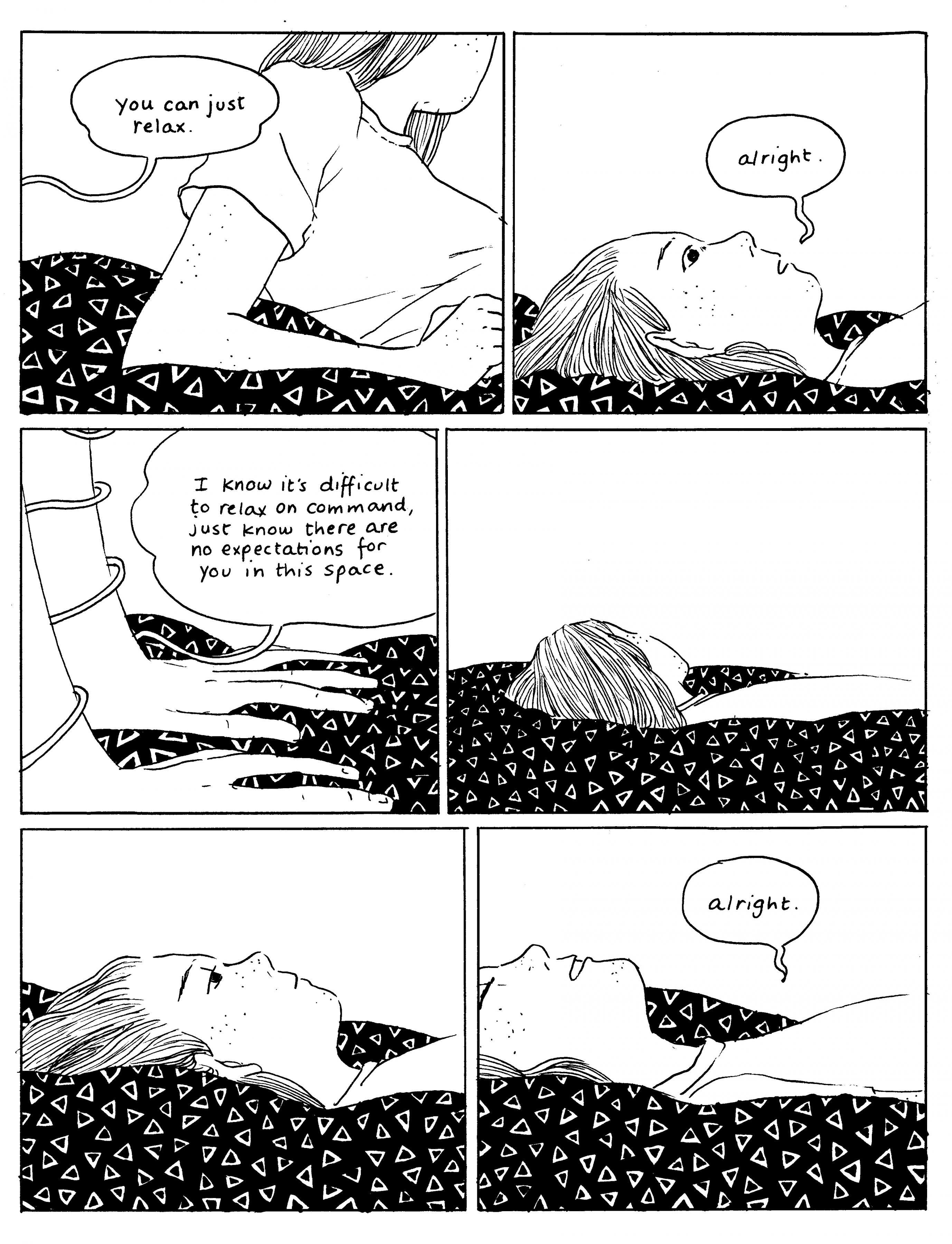
Tillie Walden’s new book, A City Inside, is an ode to the ebb and flow of living; it says that growth is a process, not a matter of time.

It’s a universally appealing piece of work that operates on lyrical narration and softly sequenced imagery, demonstrating the balance Walden can strike within the interplay of words and pictures. She paces her story with confidence. Her pieces of prose pull readers through the book as they float in succession, yet play so well into the images and panel compositions that they assure you read these bits in tandem with what Walden has drawn.

Her line art conveys both tangled vegetation and precise city landscapes. Walden wants us to attend to the thought that we age in physical spaces, whether they be farms, beds or offices. She suggests that locations both free and confine us, and that settings once habitable can turn toxic, or vice versa. In general, her setting selections diligently illustrate this concept, but it’s Walden’s exact lines that create these settings. They imbue texture and the hand that made them. They speak to where characters live and to why characters chose to live there, and how such decisions inform their lives.

Walden’s main character, a young woman, could be an analogue for the author, yet she’s neutral enough to represent us all. Again, the author strikes a balance. She provides the woman enough of a past, as well as a love interest to enable her to stand on her own, yet these attributes are not too specific, so that she’s not defined as someone particular. This appeases Walden’s grander interest in universal appeal while still lending some shape to the emotions within the story.

A City Inside is impressive because it says what’s on its mind so clearly, while maintaining a fluid, dream-like flow that other comics exploit to be flirtatiously vague.

Written here.

Leave a comment

Filed under Uncategorized

Priority shipping was a waste

Batman_Dark_Allegiances_01

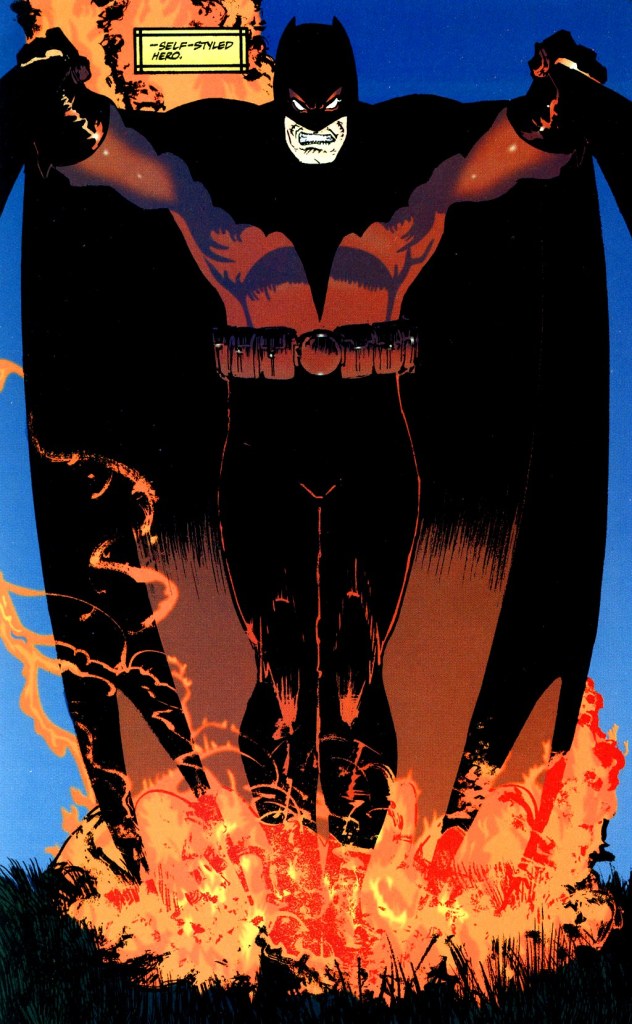
Howard Chaykin starts Batman: Dark Allegiances with a borrowed image. The iconic superhero is framed to fit Jack Welch’s 1955 Jello ad campaign, the conical element of his decorative cowl prominently on display. His eyes, though, suggest a man who’s lost the grip of his identity, it co-opted for another cause. Following this image, Bruce Wayne / Batman, via narrative captions scripted by Chaykin, explains to the reader why he’s different than a member of the KKK as he subsequently pounds this mob into the ground. He sees them as men “pushed to the wall of frustrated fury by the brutal nature of the times.” And while they wear masks, his is more like an onion skin, meant to be peeled to reveal the numerous, complicated angles that pertain to his person.

Chaykin imbues Bruce Wayne / Batman with a youthful vigor even when flamboyantly hateful people are his targets, and they to him. In this Elseworld’s interpretation (a DC Comics imprint dedicated to variations of familiar characters), Bruce, essentially, never grew up. He’s a playboy industrial designer who wants to offer the world a theme park as his next venture, playing cowboy on the side. Chaykin draws Batman as if he’s a coiled spring bouncing through combat. He glides through the air and blocks bullets, and in some panels it’s as if his arm detaches and simply maneuvers through a crowd of foes, knocking each of them out like soda cans along a level fence, subject to the hand of some passerby kid. Violence of little consequence. 

Chaykin’s Bruce Wayne is nothing but a guy equipped with a square jaw and blockhead smile, eager to say something clever. Despite Kitty Grimalkin’s (a Catwoman stand-in) task to threaten Wayne, he, knowing so, is only excited by the notion of having an attractive woman at his side involved in such a plot. He never takes her seriously. Even though she knows his secret identity, he won’t give her the credit of it. And when she explains what brought her to him (a case of blackmail involving a pornographic film Grimalkin is the star of), Wayne mocks the idea, suggesting they should steal the film back and watch it.

These interactions characterize Bruce Wayne / Batman as a man happily at home within his delusion. Others have offered the interpretation of Batman as someone who’s misunderstood himself, most notably Alan Moore with The Killing Joke, but Chaykin offers a character who sees the signs, and chooses to ignore them. As the character indicates in the comic’s opening sequence, “If I start worrying about that, I’m in deep trouble.” So rather he fights and smiles, clinging to his botched idea of world order because it gives him purpose and pleasure. Of course, this is also Chaykin just choosing to have some fun, and that choice reflects much of what Batman readers do when they pick up a Batman comic. They’re deciding to engage with a ridiculous idea simply because it seems like fun, and little thought is required.

But, with those elements in mind, Chaykin sheds some sort of truth, and you can certainly paint a damning portrait from it. That of a man conscious of a world and its bruises who looks the other way, with a hedonistic twinkle in his eye, aware of opportunity.

That man isn’t fiction.

The Welch ads show animals in profile eating or serving Jello, and they’re accompanied by captions describing their specific physical traits. Those traits then emphasize the great promise and excitement of Jello, as product, dining accessory, and conversation starter. Chaykin’s image lacks the dessert and caption, but the basic principal of the image is the same. A creature of the world removed of its habitat and self, held so a reader may stick it next to something else to take it apart and measure it. 

In essence, that’s Chaykin’s approach to Batman. Take a brooding totem away from its emotional ghetto, and supply an opportunity for it to laugh at itself. When Chaykin says the book is about “Hitler in a Hawaiian shirt” in Howard Chaykin: Conversations he’s not wrong. It is. But it’s not without the stoic Welch image at the front, placing the character in context as the pop culture product Batman is. A character under the cover of a plated cowl, protected from the world his eyes see. As a character – real in his own reality – he operates individually as his emperor of self, making decisions, inspiring consequence by taking the law into his own hands, but as an image he’s just something to be used or briefly considered. A figment of the mind, like Adolf today, he can be dressed in a Hawaiian shirt for laughs.

Leave a comment

Filed under Uncategorized

Crickets #4 by Sammy Harkham

crckts4_cover_color

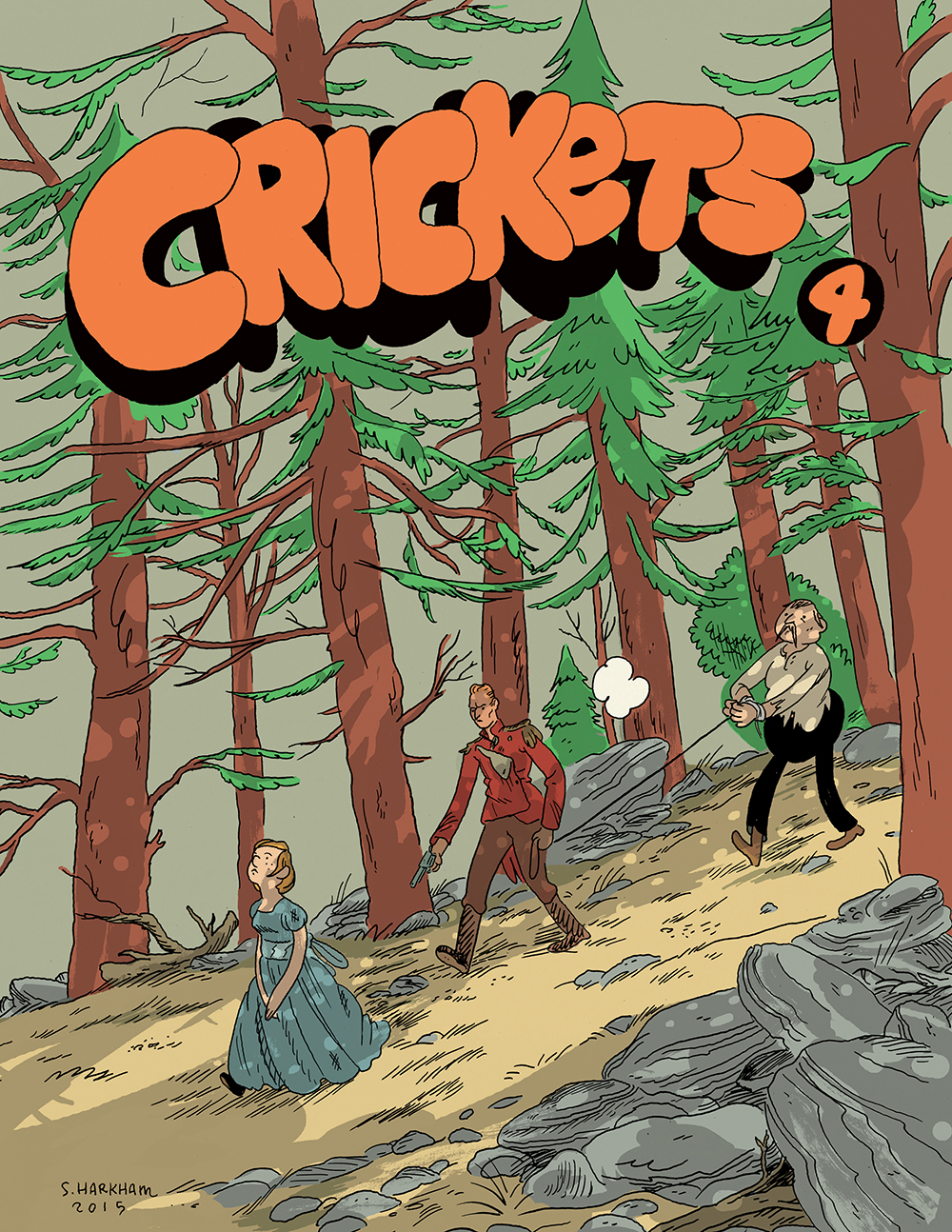
The American film set motivates and cages the cast of Sammy Harkham’s Crickets #4. The actors, crew members, director and writer all have agreed to make a film called Blood of the Virgin, even when it’s clear to them this film will be garbage, and it’s difficult to do.  They, like any American, are just chained to the idea of success. The notion of working on a Hollywood production to either be placed in front of the camera or control its every movement is intoxicating to a point of grand illusion. But Harkham never explicitly states this illusion. He only alludes to it through small nods, mostly when characters comment to one another about the film’s progress, asking if what they’re doing is even good.  For the most part, it’s our own understanding of why anyone would agree to a Hollywood production that suggests these characters’ reasons for working. We just know, because we live in their world, that they are after power and a chance to be understood.

On set, they adhere to a budget and a script, and the location commands them. Harkham frames it all through a series of tight panel grids, confining this cast of several to a shared setting, bouncing all the players back and forth between each other. He just guides us through these scenes as they happen, introducing characters in passing, giving us the briefest hint of what it is they contribute to the production. There are insults thrown, jokes shared, and Harkham crafts clever gag strips around them, despite already committing to a larger frame of dense, 16 to 20 panel comic pages. This choice layers a feeling of confinement. Characters find themselves hyper-focused within 3 to 4 panel strips as a larger operation of page design exists all around them, influencing their movements. In ways, Harkham’s characterizations subtly suggest who his cast members really are, but because they’re players in short strips their involvement often leads to a punchline.

These punchlines, while funny, can be fairly illuminating. They can straddle a few angles, and be complex. When the writer, Seymour, is asked to “approve the camp set,” he simply lights a cigarette and smashes what’s in front of him. Harkham, in three panels, makes us laugh, and externalizes Seymour’s angst of being subjugated by the film’s director.

Seymour is the creator of Blood of the Virgin, yet he needs the director, Oswald, to make his movie, even though their visions don’t always correlate. Blood of the Virgin pairs these men together (as the issue’s cover might suggest), but it’s a conflict of power, of who exactly is in charge of this thing and what he wants, that disrupts their relationship and introduces reality to everyone else’s magic moment.  Oswald argues with his lead actor because of a difference in creative choice, and the actor reacts by storming off, asking “is that how you see me, you lousy pecker-wood piece of shit?”. That actor, because of the reality of who has power over him, loses his grasp on his own perception of himself. He may be a creative contributor, but Oswald decides how the audience will see him.

Ironically, this display of authority unseats Oswald. When reports of turmoil between the lead actor and the director reach the film’s financier, it’s decided, by this figure of ultimate authority, that Oswald is unfit for the project, and Seymour is handed the role. Which is what Seymour secretly wants, but with the position he finds how authoritative he must be. It’s a realization Harkham cleverly illustrates when Seymour, as director, must decide whether a take was good or not, and he hesitates in his answer with the entire crew awaiting his response. The lack of confidence Harkham draws on Seymour’s face says it all. That he hasn’t really considered what a director does, but assumed he was capable of it.

At home, Seymour has a wife. She’s introduced as a woman masturbating on a couch despite her baby crying in the other room. Harkham frames this sequence by starting with a closeup on the kid, zooming out, cutting to a large, wide panel of the wife, and then zooming in on her and her ecstasy. He’s transitioning from one image to the other as well as crosscutting them. As a housewife, this mother has great responsibility, but this responsibility can be a cage. As we know, living in our world, plenty of housewives have wanted more, whether professional fulfillment or social freedom. Their position, though some many enjoy it, can be a personal limitation, especially when the husband gets to leave and pursue what he wants. Here, though, Harkham shows this character taking control by attending to herself even though a responsibility requires attention. That she’s doing so over the cries of her child feels a bit disturbing, but it makes the act even more rebellious. It shows that with Seymour away, she isn’t lost.

The comic ends with Seymour driving a drunk Oswald home through a desert town outside of Hollywood. A place known as “the palm of God’s hand,” somewhere you imagine great things are possible so long as they aren’t crushed. This is after they’ve fought, and Oswald has lost his position. It’s at a point when Seymour may have a right to ignore the guy. He doesn’t. He drives him home and dumps him on his front lawn. It seems harsh to do it that way, but the fact is Seymour was there when no one else was. He’s using his ability as a human being to care for someone else, in some way. You don’t know if this is where their relationship ends or just takes another turn, but you get the sense there’s some fact found. That off the film set they’re still connected. That they have some power over one another.

Leave a comment

Filed under Uncategorized

Godzilla in Hell by James Stokoe

godzilla

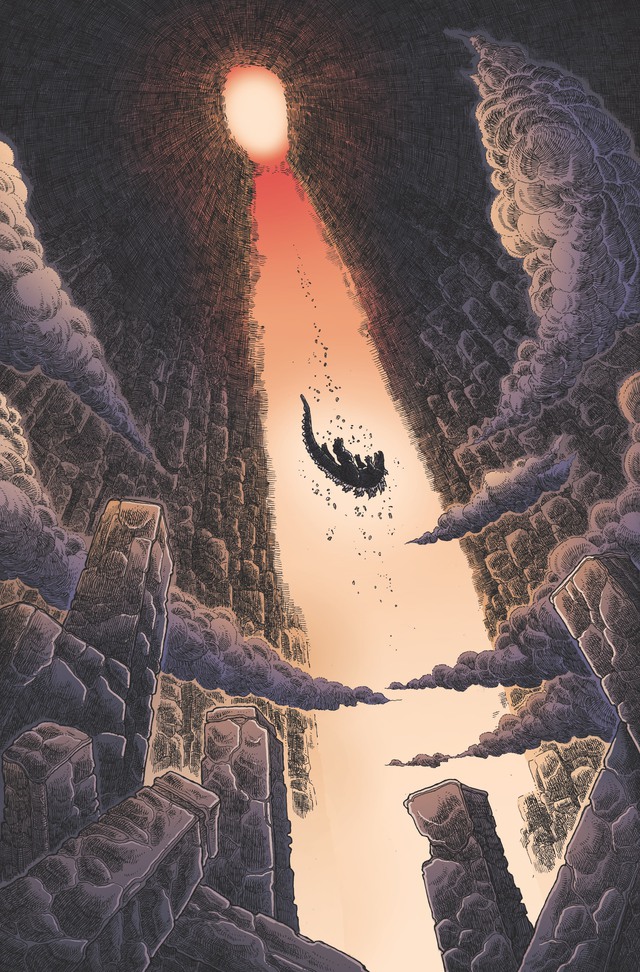
Godzilla in Hell surrounds the character with threats his height (or taller), undercutting his advantage of size. This evens the playing field for the fights James Stokoe stages throughout the comic. More importantly, though, it shows the audience a Godzilla that is at their level who must fight his way across a landscape anchored by various obstacles. These obstacles represent possible demons plaguing Godzilla (his nuclear origin, the people he’s killed, himself), and they trigger emotional responses from a character that’s typically shown as an unstoppable force, confident of his chosen direction.

The final battle, in numerous instances, features Godzilla being thrown around like a chew toy at the whim of an attacker. Stokoe draws the character’s body from low angles in this sequence and focuses more on the whole mass of Godzilla together, in the air, spinning out of control. He elevates this idea by composing the scene through a series of smaller panels that constrict the character. Godzilla’s true size is never far from the audience’s mind, though, because of a prior scene, in which a storm cloud of human beings nearly wipes him away. The cloud itself is huge, but Stokoe shows the tiny grains of its make up, which lends perspective. So when Godzilla breaks loose of the creature in the final battle and smashes him, you think about the absurdity of a 500 foot beast body slamming another 500 foot beast from what’s likely a 3 mile fall, and you’re at once aware of the mega-status of these characters, as well as their shared territory with us. 

The best moments are Stokoe’s brief pauses, where he breaks away from the action and provides us a quick shot of Godzilla’s foot or face reacting to the violence (either in surprise, pain or strain). He does this a few times, and they emphasize the severity of the conflict the character must face. It’s easy in a story like this to do spectacle and excite an audience with colorful images, but it’s an entirely different game to do that and characterize the spectacle with nods to the character’s internal process, even if momentarily. It says more, too, that these nods are close ups. They intimately lend an eye to the actual struggle of these battles, and some even show a physical tole. But Stokoe is smart to keep these leaps short as that’s how they are most interesting. As asides. The audience reads this comic book for the spectacle, mostly. The existential glimpses work as smaller pieces of a whole.

That said, Godzilla in Hell implies opportunity for a deeper reading, if you really wish to, but it’s identity as a battle comic is really enough because of the quieter visual touches Stokoe uses to elaborate Godzilla’s character. They’re proof of Stokoe’s thoughtfulness, even when drawing a Godzilla fight comic set in Hell. The brief, poetic nature of it, too, is all the more special. It reads with a certain pride, though one affected by reality. You can tell he’s thought about all this a long time.   

Leave a comment

Filed under Uncategorized