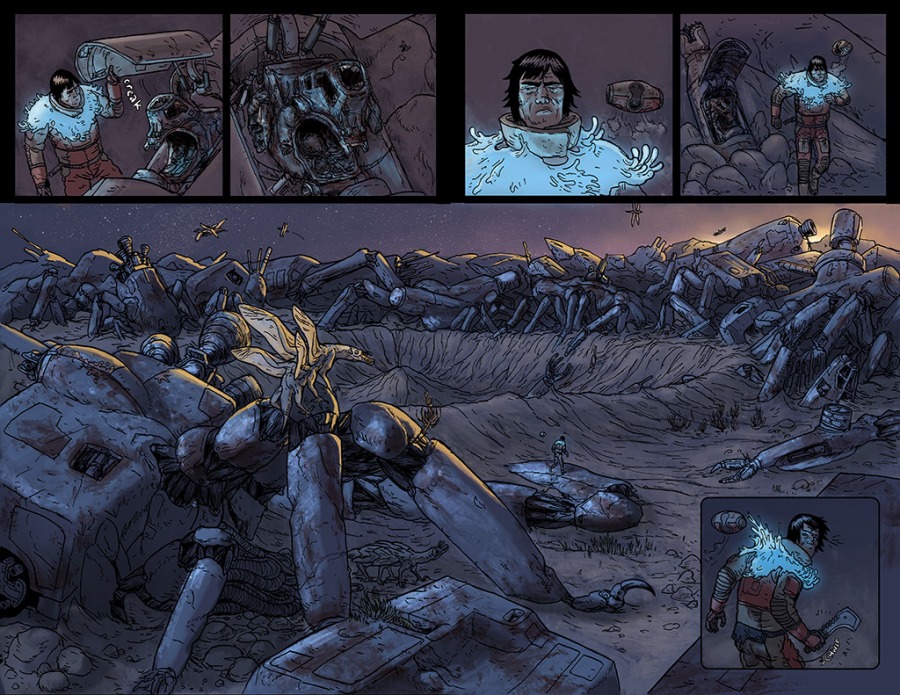
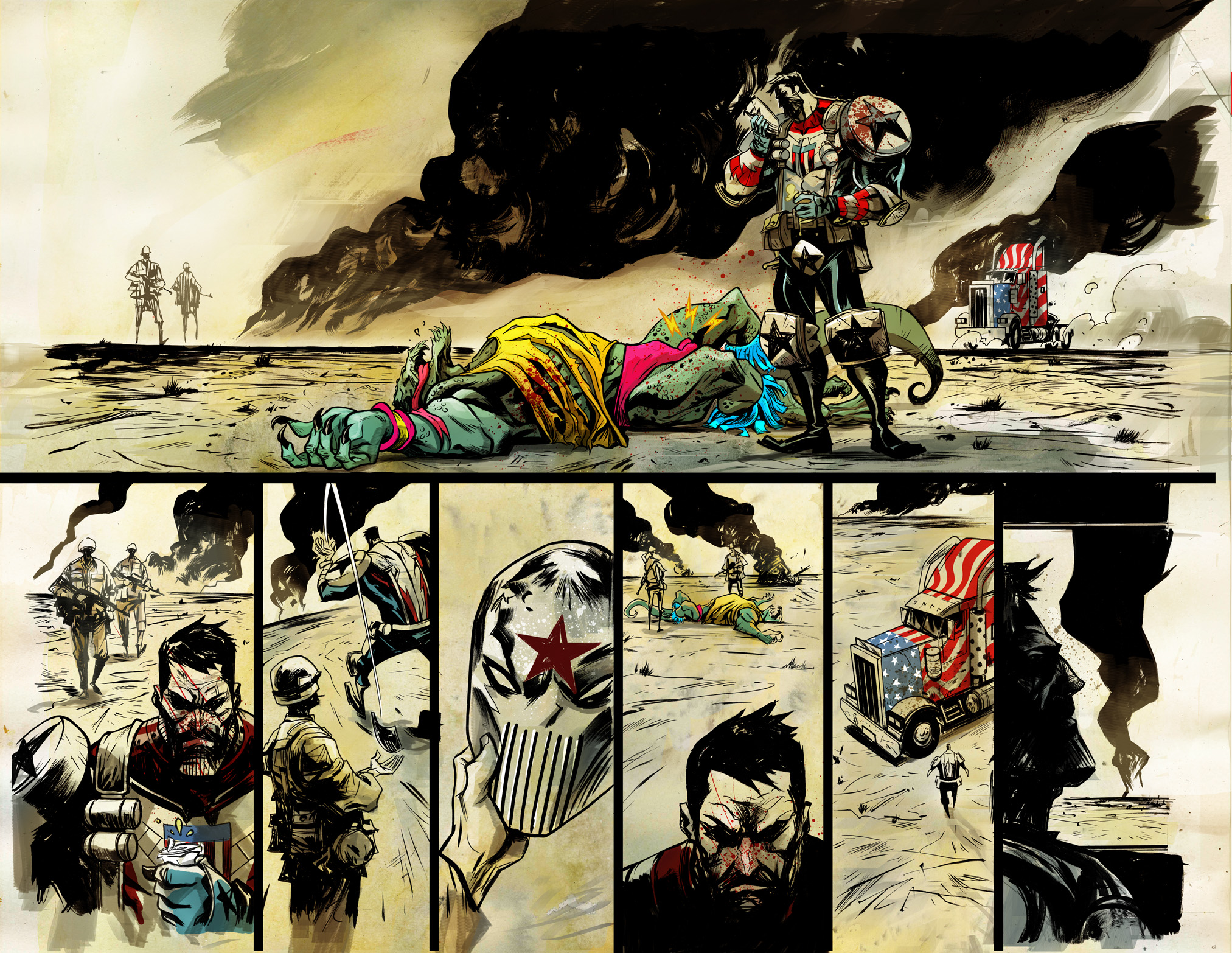
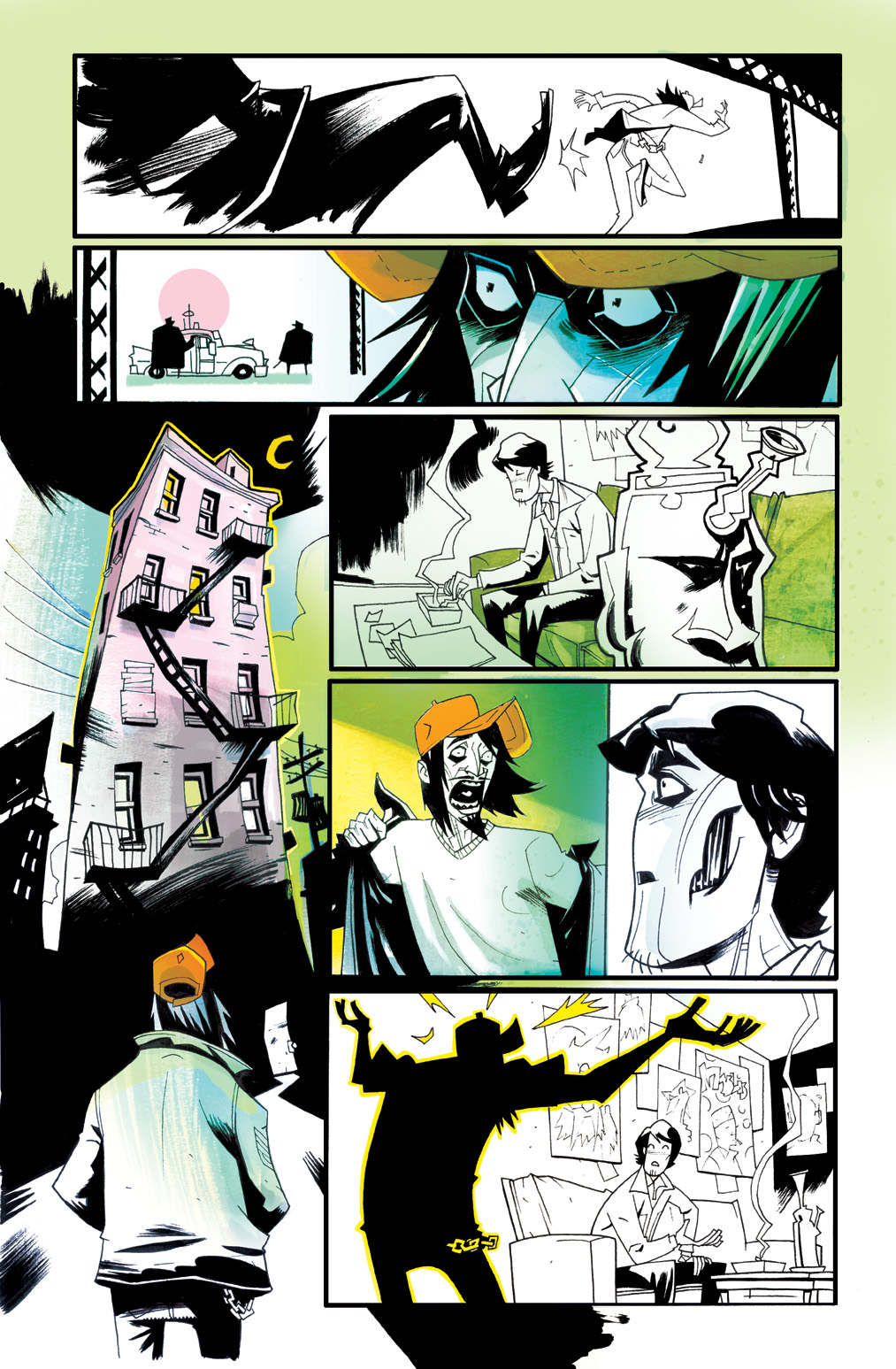
Casanova: Avaritia

Casanova / God-Fucking-Dammit / COMICS / How Bout That Last Issue?

This isn’t a piece of criticism or an essay. These are thoughts working toward a conclusion.

– Where Do I start with this? I’m not even sure how I feel.

– Avaritia’s just this giant guilt trip, spiraling down, way past the gluttony and filth of Gula into this whole new pool of dirt, puss and dank tears.

– Where do I fucking start?

– Fraction wants Casanova to be something other than what we perceive it as. He’s driven toward said goal, and in essence Avaritia exists to wipe away everything in order to establish the book as something else.

– That something else just seems to be something I’m a little unsure of.

– Hollywood.

– Fuck, do I now resent him for that last page? Do I join the mob and sharpen the pitchfork? Do I lose all faith in Matt Fraction?

– Questions.

– Why go to Hollywood? That seems like a place to start, to kick off this little mental exercise.

– Somewhere in the back matter of those Icon reprints, Fraction made it clear he’s not uncomfortable with the idea of “selling out” and making the pig fat. He admits it.

– Avaritia begins with a Casanova who hates his job, but by book end, may possibly like it once again.

– An arc.

– The last time Fraction wrote Casanova, Marvel just began for him. Avaritia, as he notes, took many false starts to finally find its footing. I’m guessing the dude had a rough start at the company and finally reached a point of comfort. Avaritia starts then.

– “It had to be lived.” – Fraction, letter page, Avaritia #4

– The book burns away old Fraction and introduces us to a new man. A man with responsibilities to up hold, who can no longer fuck around.

– Or does it?

– All we know is that last page. But is Cass happy on it? Home in Hollywood? Does he want to be there?  Or, objectively, is that just where he is?

– Avaritia’s all about escaping those past volumes and crashing the expectations of a Casanova comic. The ending seems to suggest more of a change and signal a new era than it does suggest “selling out.”

– Though, that location is no coincidence.

– But, again, objectivity. That’s where Fraction is: The big time. Yet he’s still making comics – he’s just making them at a different point in life.

– If anything, this book’s the work of an older man who’s killing his younger self in order to leap forward. Can’t say I dislike that.

– As actual comics, they very much vary from the previous volumes. References no longer make up the DNA. There’s more space within the plot. Wider color scheme. More brutal. More of its own thing. Some of the quirk, charm and spirit has been lost, though. Been traded in for the upgrade Fraction’s after.

– A transitional volume.

– The Charles Dickens bit made me laugh.

– The last pages, the destruction – those pages buuuuurrrrrrnnnn.

– I still love this book.

– At the end of the day, it’s all just about life, being a good person and owning up to your shit. All through comics and genre thrills. And while this volume might suggest running away from your problems as an answer, well, the story isn’t over. This isn’t the period.

– As for references, glad to see Fraction get a bit away from them. Yes, still there to a degree, but they don’t define the book as they used to. Now we’re at a point where Casanova can stand on its own, without piggy backing as much on other works.

– There’s a line in the letter pages of issue four about guilt:

Guilt for what?

Previous Casanova? Going “Hollywood”? Changing the book up?

Or was he guilty about going as far with this volume as he did, but then got over it, citing the bit “and that was what I needed to wrap Avaritia #4.”?

That’s going to stick with me. That last minute change of mind. That he had to be talked out of it.

– I hate that I’m doing the whole “personal reading of the author” thing right now, but I cannot help but not take the author out of this one. Casanova’s about that dude. At least, to a degree. Or, at least, it’s about creating the book.

– Casanova is about itself.

– Casanova is about life.

– I still love this comic.

– This is probably my Invisibles.

– How would I rank?

Gula, Avaritia, Luxuria

– If anything, it’s bold.

More on the next Chemical Box podcast.

Leave a comment

Filed under Uncategorized

Prophet | Graham, Roy, Dalrymple, Milogiannis

Like everybody else, I too am reading Prophet and find it to be quite an exceptional example of what mainstream comics can do and be. Unlike the mass of creator-owned or faux-indie books that jump out and scream their separation from Marvel and DC, Graham and company wish to join up with the mass culture and beat it at its own game. A noble effort, and while the “play the system from the inside” routine usually grows old and results in little outcome, the Prophet crew seem be to A-OK as of now, playing the cards they have and letting the bait be taken. And it’s being taken. By you and me and the the mix of general readers and Comics Journal crowd who nod their heads and note this Prophet comic as a decent, pleasant item to receive each month.

In some sense, Prophet feels more like a gift, digging up some of that initial excitement we all felt at the start of our great comic book binge, rather than adding to the same old sludge of new releases we, for some sad, pathetic reason, feel the need to study. The creators have brought back that enthusiasm we all once put toward genre comics, and they’re making the month long wait mean something again. That’s so important for comic books. Especially now when it seems all genuine love, lust, fun or concern, theory and debate happens off the page and in some movie theater somewhere  or through some industry Op/Ed. Comics has reached a point where the comic books almost don’t even matter, and I for one find that a little scary. But Prophet’s battling back against that, leaving all the magic and thought among those panels to make its speech mean a little something more. That speech … it says, “look, yo, remember these trashy things? yeah, we don’t have to give up on them.”

And to be clear, I don’t mean to say Prophet is alone in this effort or that Graham is really the first guy to consider this mission, but rather Prophet stands out. Through its various, almost now trademark tools of storytelling, this book has shown in a matter of seven issues that more can be done. And by more, that would mean the mainstream genre comic, where it seems now little substance, energy or thought resides: the creators have split; the bloggers and pundits have spit their contempt; and I, who for  months watched the rest of the Comics Internet burn its bridge and squash any hope of good mainstream books, have finally brushed off my own excuses and now see at least the corporate side of comics as the cold, fake void it really is.

Maybe it’s a good thing. Maybe now we’ll all be able to move on and challenge ourselves with something a little greater and complex as well as expand our own horizons on what exactly comics can be. Maybe the only thing stopping us all along was our allegiance to childish fantasies and their lowbrow construction. Maybe we needed to ditch this shit all along in order to push our medium forward.

Maybe.

But there is this push from certain creators to keep the thrill and octane alive: guys who say fuck legitimization for favor of poop jokes and violence. Though it’s also these guys, like a Marra, Ryan or DeForge, who while diving into the trash bring forth a careful and considered sense of craft, and it seems Graham wants to join the effort with Prophet and mix and match the adventure and cliffhangers of mainstream pop comics with the sense of craft, function and theme better comics are capable of.

So far, the approach seems to be working.

The most distinct quality of Prophet is its sense of atmosphere and place and how subtlety, versus blunt interaction, can build such a grand thing. This comic lives and breath “show don’t tell,” and while Graham’s stoic narration does play a large part of the series’ development  and tone, he really seems to embody his spirit as an artist here more than a writer, even though he doesn’t draw much of the comic, at all.  As the writer though, Graham lets his artists and the pictures they produce tell the story because he understands when to let his prose interject. Like a good comics writer, his bursts of narration come at the opportune time when a scene could use an extra push, and if he does describe or detail it’s always to compliment the visuals or catch something they cannot. But besides just knowing how to contribute to the book, the approach makes a lot of sense for what Prophet is: a visually intricate science fiction series. Why tell when Simon Roy can simply show you?

Prophet becomes a highly collaborative work that way, again, offering up some courteous advice to the rest of the comics mainstream. Graham works with his artists, and they in turn output something far more exciting, turning the book into more of a whole than a writer simply having a hired hand draw his words. A confidence exudes from this, as well, and rather than you, the reader, questioning the value of the book, you just kind of know this is good and roll with it. The confidence, though, does just really come from the subtlety of the work as Graham and Company trust the story gets across what it needs to without having to feed it to you via spoon.

We’re at a point with the book where visual styles are becoming characters themselves. Graham breaks his sub-plots up by artist assignment: Roy draws the initial John Prophet clone, Milogiannis presents Old Man Prophet, or the original, Dalrymple to John Prophet with a tail and Graham does the robots we see in issue twenty-six. All of these characters are established in Prophet’s initial story arc – or what makes up the first trade paperback – and it seems safe to assume these characters will be the major players of the plot Graham intends to spin. In one fashion, this works to separate a group of clones in order to make them decipherable to the reader, but the choice also suggests a pure attention to the visual presentation and what each individual artist can bring to the work.

That’s something a majority of mainstream comics have forgotten how to do as most of the industry still rides the wave of writer-driven series. The Prophet crew are transitioning away from that, creating this new set of cues for a reader to read by when they visit the book each and every month. Depending on the artist, a reader can take a guess at what plot point any specific issue may center around, and if it’s a new artist on the issue, well, you’re in for a surprise.

The whole thing brings the visual component of comic books back into the fold – especially for the genre driven side of the industry. That’s refreshing but also intelligent because it takes the reading experience of a comic book up from common slum activity to more of an area where your brain is involved with the process. You have to think about those visuals, for once, and ponder how they connect and contribute. Granted, it’s not exceptionally brilliant or worthy of intellectual study, necessary, but that much of a push in mainstream genre comics means a great deal. Take a look at most of them now; many are astoundingly dumb and easy to read. There’s no challenge or even involvement whatsoever. Prophet’s going back against that.

And while visually involved, Prophet does present some thematic elements of interest, whether its the boundaries of human potential or imperial conquest, this science fiction comic does seem to have a core group of ideas its commenting upon. And the level of imagination is off the charts. This thing didn’t stop at “what if humans were the enemy and not the zombies?”.

Where Prophet stands in ten years, who knows. It may not even rank at the end of this decade, but for now it feels significant, and if anything, it’s pushing mainstream comics into a more respectable territory. I’m in favor of that, because while I can get down with art comics, I do want a sense of bombast and fun in this stuff. That’s an essential aspect of the medium, I feel, and if we forget that we will lose something. Creators just need to work to hold this stuff up to a higher standard. Just because it’s adventure, doesn’t mean it’s stupid.

1 Comment

Filed under Uncategorized

Amazing Fantasy #15: man before hero

I found myself scribbling notes, prepping for this week’s Chemical Box recording, when I finally thought “why not just post this? I should post something.” Granted, this is more an exercise than a finished product, and while I’m sure some proper critic may shake his or her head, I figure this is the blog of a twenty year old asshole. I can post whatever. So what follows are words – poorly written words – concerning Amazing Fantasy #15 and the Spider-Man origin story.

– I mean, this is the stuff. The fucking blocks that build it all. How can these comics not be held up as something worthwhile? They birth the character but also the language, voice, grammar and gears. They birth the standard. Boom, like a thunderous thud on the table right when the baby pops out. The nurse unaware of what just happened.

– And the world comes together before you can flip the page, and all subsequent issues establish new notes within the greater measure: the villains, the cast, the usual Parker conflicts. The cliches of the character, though …

… they weren’t yet cliches.

– This was new. That’s what you have to imagine. You have to dawn the position of the reader in 1962/63 and only know Spider-Man, or Steve Ditko for that matter, from what was given to you in those first few issues of Amazing. Everything feels simpler in that mindset. The mess of later years had yet arrived. It was just Lee and Ditko and a kid in an awkward suit.

– Amazing Fantasy #15 – the origin story – still remains the character’s greatest. Nothing could have come after, and the story would mean just as much. All because of that final panel. Parker doesn’t do a damn heroic thing even when it’s sold as this new super hero yarn. There’s nothing fantastic. No impressive feat occurs. There’s only a dude, and he’s simply getting by, looking at himself, judging, like any other would do on a day-to-day basis. Parker’s just this dude, and when he puts on the suit, he’s still just that dude. Maybe just a little more awkward because he doesn’t transform or strike a stone pose. The tights don’t life him up like a Clark Kent removal of the glasses. They just wrap him and embody the human shape underneath.

– If anything, Ditko picks up on this and draws those awkward stances and quirky expressions of body language to further characterize.  Ditko embraces that “otherness” inherent in the character, going somewhere lesser artists seem to fear or miss. That’s a point Todd McFarlane would later continue, only maybe go a little too far with his uncomfortable, almost macabre, drawings. But, hey, it beats the soap opera, pretty boy Romita liked to draw.

– While Ditko establishes the pacing and language of the story, Lee still matters here. No matter his place in history or the wrongs he may be guilty of, Lee adds a significant element to this individual tale past the line about responsibility. His prose possesses a presence. It’s a narrator who clearly knows the outcome long before you do, yet neither is he/she over powering. Instead, the narrator keeps a pace away but certainly oversees this great escapade from somewhere beyond.

– The narration, and the tone of it, benefits this tale in a major way because it helps nail that responsibility point. The reader trusts the ethos of the narrator; therefore, he reigns triumphant, making his point.

– And while quaint, with narration decorated in the comics speak of the comics past, it still hits and performs like no other super hero yarn. Every ounce of quaint builds up the storybook tone, but while a storybook or childhood parable, is dark, mean and honest. Spider-Man’s origin is about being a man: leaving teenage-dom behind for the truth of adulthood. Ditko and Lee show the consequences, in a pretty bold fashion, of when you do not grasp the concept of responsibility  and ignore adulthood to instead act like a child. Uncle Ben dies to make that point. Over the top, but it worked. What matters.

– They bleed all of this through the super hero origin. From AF 15 up until Ditko’s final issue, they keep to the mission statement while slowly adding other elements to provide further example: job, girls, enemies/struggle. All of which leads to a high school graduation and the age of eighteen as well as a battle with Norman Osborn – the arch nemesis and the “adult” lost to selfish desires.

– AF 15 still stands as my favorite super hero origin story, even while it doesn’t birth a hero. It’s a story about a kid, but that kid has to overcome and become someone he’s not, yet, can be. When Parker walks away into the darkness in that final panel, he’s learned a lesson, and the reader knows he must live with it. The walk into the gloomy horizon commences the journey. The hero’s journey. That’s the point. That’s why it’s my favorite. The man before the hero … a vital aspect.

–  Too bad fifty years have occurred, and Parker’s still working toward the heroic finish. He hasn’t left the origin he’s so famous for but has rather occupied countless variations of it. The trap of the core. Or at least, the trap of a regressive publisher. But, sleep tight, Dan Slott still has a job.

Leave a comment

Filed under Uncategorized

Noir: a Collection of Crime Comics | Dark Horse

Originally published over at Spandexless.com

I’m not exactly sure what book kicked off last decade’s crime comicbook revival (Powers, probably), but 2009 was most definitely the peak of said “movement,” the year when crime went commercial and quickly lost its inseparable edge.

I remember this because that was the year I went diehard for the shit. Everything and anything that had to do with crime (minus the real thing) I immediately sucked up and deemed priority. I went from watching few movies ever to hand writing a must watch list containing anything from Out of the Past to Heat, and if I ever caught sight of a trench coat or dark alley on a comic book cover, said comic was bought. Ross MacDonald and Dashiell Hammet were also read, to a degree, and I even went as far as to brag to my friends that I was an expert on the genre in question when in reality, I was then, and still am, far, far from it. But I doubt they were very impressed to begin with.

But no matter my involvement, and as true as my enthusiasm may have been, this was sort of all spurred on by the growing popularity of the genre in my medium of choice: comicbooks.  Books like 100 Bullets, Powers and Criminal spent the 2000’s redefining the genre for comics, and while an entire essay or more could be written on such a topic, I’ll just skip ahead and say this redefinition culminated in 2009. It’s the year the trend caught on and died, but not before the industry gave us such things as Vertigo’s line of crime graphic novels, Marvel Noir (the nail in the coffin), Darwyn Cooke’s adaptation of Richard Stark’s Parker: The Hunter (which is really more than a cheap gimmick, but just go with it for the fact it’s another big crime project released in the year 2009) and this: Noir: a Collection of Crime Comics published by Dark Horse.

My memory of this has mostly been of it being a disappointment, and after a revisit just this week I still find Noir to be as bad as my recollection deems it. It’s underwhelming when you consider the list of talented creators involved. I placed a lot of hope on this project at the time of its release – hoping it would somehow be the next great anthology – but really all I read was another mediocre one, which makes Noir a comfortable member of today’s usual anthology output.

Most of the authors in this collection try to place a spin on the crime story or the concept of what a crime is, but really none of them land anything but a failed attempt. It’s really the guys who stick to the classic components, like Lapham, Brubaker and Azzarello, who produce anything memorable. I don’t find this to be a point scored for the argument of classicism or anything, just that the people being ambitious didn’t have the skill to pull it through. There’s no greater theme there. Some people just blew it, is all.

But they blew it enough. Because after reading this, my unstoppable interest for all things crime noir stopped. I already knew crime did not equal quality, but the blatancy of this project – from the title to the Georges Bataille quote on the inside cover – only reassured the point. Where Marvel Noir was the ultimate gimmick, Dark Horse’s book represented this common interest of the time. It attempted to showcase the best of said interest, but in the end, Noir really only shed light on an unhealthy curiosity. Because everyone wanted to tell a crime story, everyone wanted to script that gravely narration, and everyone wanted the twist ending, but only few people’s voices and styles of storytelling were suited for such things.

Noir spotlights a handful of people dubbing crime fiction characteristics over stories strongly penned in their individual styles, and while it’s nice to see all of them attempt, what really presents itself is this weird sense of “hey, I can do it too!” that’s stated like a true six year old.  It’s really just a collection of stories confused about their identities, as a guy like Jeff Lemire attempts to meld his sullen country boy routine to a cold-blooded plot.

Or when M.K. Perker marries Turkish culture with mass murder.

Or when Paul Grist does Paul Grist but on a detective story (Kane goes farther back than this project, I know, but in here, at least, it doesn’t do much).

And there’s also the desire to land the EC Comics fucked up twist ending, but when Chris Offutt or Gary Phllips go for it, the attempts only come off as cheap and highly derivative.

What happened here was this: Dark Horse editors picked the hot contributors – or the ones they could get – and said, “tell us a crime story. people like those right now,” and the creators did, but what Dark Horse failed to realize was that even though they handpicked the “hot” creators, they did not handpick “hot” creators who were also “hot” crime storytellers. Those editors went name above suitability to the project, so it’s really no surprise we got what we got.

But, for the select few who were suited, well, those stories worked.

Brubaker and Phillips’ Criminal insert carries the same pedigree as the all the mini series. The pacing’s on key, and even when the duo arrives at their own twist ending, things work out because throughout their however many pages, they’ve earned such an ending.

Azzarello works within a gimmick, but when Gabriel Ba and Fabio Moon present it, the story loosens its grip on the safety net and trusts itself, as a story, to do the job. Plus, Azzarello’s script doesn’t exactly force the surprise ending or shoehorn the catch. Instead, his pacing and dialogue let the reader arrive at the premise, making it more of an involved short story.

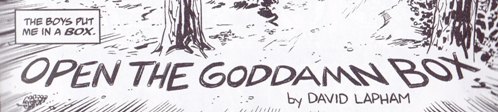
But the best of the collection resides in David Lapham’s “Open the Goddamn Box,” in which a young girl widdles her way out of a terrible situation through a sharp tongue and tensions on the side of her captors. What’s impressive about it, though, beside pure visceral reaction or the skill of Lapham’s line work is the story’s ability to really place you in a world in such a short amount of time. Lapham works within ten pages, but in those ten pages you really get an idea of who the three characters are – from background to now – as well as what the world they inhabit is particularly like. A lot of this comes down to pacing, obviously, so the author adjusts his grids on each page to accommodate such a thing. If you look at it, Lapham uses a majority of eight panels per page, and while design isn’t exactly a main concern, they do fine tune all the needed  beats of the narrative. Old fashioned storytelling for a comic book, but Lapham proves that its functionality still works now more than ever.

For those three stories alone, Noir: a Collection of Crime Comics is kind of worth picking up – especially at a discount. But you do have to sort through a heavy handful of mediocre imitations. Because that’s mostly what Noir is: imitations.

As for the crime comicbook, the genre still pleases many people, and guys like Brubaker and Phillips continue to produce some of the best. The trend subsided, though, thankfully, but science fiction, with books like Prophet and Saga, may be making a comeback. Who knows where that may lead.

Leave a comment

Filed under Uncategorized

How I Spent a Sunday in My UNairconditioned Apartment

Besides waking up wrapped in my own sweat stained sheets, considering again why I live exactly where I do, I sat my ass on the couch from roughly 2:30 PM to 8 PM and watched, back-to-back-to-back, all three of Sam Raimi’s Spider-man movies. Why? Because I felt an odd loyalty to the franchise  and that I should somehow prepare for the forth coming Marc Webb directed movie as well as this dumb need to fulfill nostalgic desires.

Or, “I do what I want.” (My defensive answer to my own question).

I owe a lot to Sam Raimi’s Spider-man movies. They were not only a large part of my childhood but also the origin point for my interest in comics, and returning to them yesterday, after a few years away, was a  mixture of both fun remembrance and gnashing teeth. Sort of what I expect my ten year high school reunion to be like.

But fuck it. While I didn’t love the return, here are a few quick paragraphs on Spider-man, Spider-man 2 and Spider-man 3. (Great titles by the way.)

Spider-man / 2002

This had a Nickelback song attached to it.

Besides the iconic or memorable moments and its push to somehow become this generation’s Superman: The Movie, Spider-man runs a bit dry, suffering from the stigmas adaptations usually suffer from, to now being remembered best for the upside down kiss and Kirsten Dunst’s wet nipple (which, at ten, was pretty fucking cool). I saw this movie for the first time at a drive-in theater with my grandma and mom, and I can clearly remember them saying to one another, “well, this is kind of a bit much for a kid’s movie.” And a kid’s movie it was, but watching it today, you can clearly see Raimi angling his Spider-story more toward the love connection than the action. Everything ends up revolving around it; Parker’s storybook voice over and the line “this is a story about a girl” solidify Raimi’s entire premise for his trilogy, and it gives him the opening to really meld the core details of the Spider-man story to the Peter Parker/MJ romance.

The approach works to a degree. As the sequels roll on, you see how Raimi balances the various themes of adulthood and proportions them to function with the trials and successes of the relationship – Spider-man 2 being the best example – but the ground work all goes down here, in an action movie where the action isn’t really shot or composed that well. For Dunst’s character, though, she’s nothing more than a prize. A prize with a bit of personality, but a prize nonetheless, and Dunst’s one layer performance doesn’t exactly spur on anything extra.

There’s also the case of Tobey Maguire, who I just can’t stand. Peter Parker embodies the shy child within us all. The lighthearted dork. The outcast. But Maguire’s presence takes these qualities and rams them into overdrive, making Parker more pathetic than an unsung hero. The film has those moments of wit and charm for the character to really show himself, but Maguire, with his 13-year-old boy voice drops them every time, resulting in a creepy expression rather than a showcase of confidence.

The film ultimately suffers for its concern of telling that classic tale most people know by heart and weaving it to fit a new set of performers, visuals and music, yet, ironically, it’s also why it’s memorable. In a sense, I do feel this is my generation’s Superman because, while stunted in areas, specific moments do still conjure that magic, and along with a pretty solid cast overall, this film created some lexicon. Especially for the super hero movie, which after Bryan Singer’s X-Men, only reaffirmed this new era of the super hero in Hollywood. For better or for worse.

I’d be curious to watch the James Cameron version, which apparently involved more penetration as well as curse words, but I still find the ability in myself to enjoy this movie. Spider-man made and has kept a connection.

Plus, the Randy Savage/Bruce Campbell shit still kills.

Spider-man 2 | 2004

It wasn’t until Spider-man 2 that I finally realized comicbooks were still being published and found the care within myself to hunt them down and devour them whole. I was twelve, and my friend’s babysitter drove us to the mall so we could watch this. She was in high school; I had a crush.

Also, this Dashboard Confessional song still ends up trapped in my brain at times.

http://youtu.be/8jOQYT3tRlU

This movie’s concern with being complete makes it work. Hands down, Spider-man 2 is the best of the three, and I think it’s where Raimi says the most with the character as well as makes Peter Parker most relatable or simply interesting. Movie one shapes him into a figure of shared experience, but it also keeps him in a constant state of being a caricature. Parker’s the nerd who gets power, but movie two humanizes the whole concept a tad more by really showing the gears of his life, the “Parker Luck” as well as the continuing whatever that is the Peter/MJ relationship. Where movie one is all about responsibility, movie two centers on the idea of choice, and as a theme close to super hero fiction, Raimi bases the theme on the relationship to force Parker into a position of uncertainty. But as  typed … this one’s concerned with being a movie rather than a storyboard. In some sense, you could criticize Spider-man 2 for possibly taking itself a bit too seriously, but I feel the movie consistently does a fine job of balancing the relationship stuff with Doc Ock (who is fucking awesome in this movie ). Really, at times, Spider-man 2 is more about the romance while the comic book, action stuff acts as a side project, but I’m not annoyed by that because Raimi’s entire story is about the romance, not really the action.  Although, this is probably some of best action in the entire series. Presentation wise. There’s more composition to the combat here, and it’s simply more entertaining to look at. Much of this comes from the nature of Spider-man’s antagonist. The Octopus arms give the camera a point of focus.

Of course, in a movie where the relationship between two characters reigns king, it would be important to have two actors who can carry such a thing, but Maguire and Dunst just fall. Along with my previous criticisms, I just don’t feel any chemistry between these two. Both are awkward together, and Parker still exemplifies this odd boyhood.  A line like “punch me, I bleed” should soar. He swallows it, leaving the audience to digest a bad inflection. Raimi only gets so far with his more dramatic sequel, and while it works in many spots, his two leads disable the film.

Alfred Molina picks up the duo’s spilled crackers, though. He’s a dude with real chops, and he comes in and nails the idea of the villain being more compelling than the hero. Doc Ock certainly is a grey villain, and while I tend to prefer my bad dudes to be real pieces of shit, I do find Ock and Spider-man’s dichotomy entertaining. He works toward the film’s theme of choice, and while some scenes show him ham-handedly talking to his mechanical arms, or reviewing his stretched, ill-sensed motivations, scenes like the hospital escape or train fight make up for the mishandles of the script.

I would label Spider-man 2 as good. Obviously better than its predecessor, it still performs well in the year 2012. Overall, a solid, complete story packed with an array of special moments. And, I won’t lie, the Aunt May hero speech kind of chokes me up. Rosemary Harris, ladies and gentlemen.

Spider-man 3 | 2007

The movie where I was finally an established comicbook guy. I was so excited for this piece of shit. SO EXCITED. Aged 15. In high school. And Venom – a character who I think is pretty fucking awesome, yet always ends up at the ass end of every joke. That Rick Remender comic included.

I walked out of the theater trying to convince myself I enjoyed this, and even months after the fact, until the DVD, I thought I did. Lies I’ve told myself.

Three people wrote this script, and from what I understand Avi Arad really pushed for Eddie Brock in this movie while Sam Raimi hated every ounce of the idea. And you can tell, because that’s the character who makes the least amount of sense in this entire movie. Even up against Proto-Goblin or whatever the fuck they named Harry Osborn’s snowboarder persona, Venom has real no reason to be in this picture. He’s just shoehorned, and Topher Grace just plays a dick the whole time. Ah, fuck it.The problem with this movie is both the ambition as well as the lack of point. Spider-man 3 redoes Spider-man 2‘s choice theme, but infuses it with more of a good vs. bad through line rather than a general “who do you want to be.” And then you get one of those Geoff Johns’ overhauls of past events as they try to work the Sandman into Uncle Ben’s death. Like Michael Papajohn needed help. And then the relationship goes up in smoke again for some really immature, unrealistic reasons while the butler apparently knew everything.

Fuck this movie.

It’s almost a parody of itself. The way it opens … with the music and the voice over. It all just suggests, “yep, and the story continues … ” And it does. To the point of a second Green Goblin and a purely fan beckoned appearance by a villain whom the director hated. Bryce Dallas Howard sort of saves it, but even then, her Gwen Stacy just makes you question the entire love story Raimi’s been spinning. Why not her the whole time rather than this entirely grouchy, uncharismatic women we’ve been following for three movies?

I could rip on the dancing and emo hair cut, but honestly, it’s not as bad I remember. In a way, those elements provide some of the only moments of seeming enjoyment through the whole movie. They’re really stupid, yes, but funny stupid.

Other than a cool Sandman creation sequence and the few moments of fan satisfaction brought on by the sight of Venom, I have no real reason to watch this. The Harry/Peter team-up in the end sort of tugs, but past that, nothing, man.

The Amazing Spider-man | 2012

Ten years from the original. I’m in college. A better sense of taste. Still love comics and the character.

This looks better than all Raimi’s work. From the action, to the story, to the cast, this movie appears more complete and more driven than the blueprint it’s working from. I will be in a theater come Friday, and I’m confident I’ll enjoy myself.

Brief thoughts, but how could it be more when I haven’t even seen it yet.

http://youtu.be/atCfTRMyjGU

Leave a comment

Filed under Uncategorized

The Nightly News | Jonathan Hickman

“If everyone is thinking alike, then no one is thinking.”

–          Benjamin Franklin

Funny that comes from him, though: a guy who had no trouble suggesting lifestyles to people as well as hinting at how they should treat the money they earn. But, hey, hypocrisy’s everything, and no matter the source, the point of the quote does fit the point of the comicbook, as Jonathan Hickman’s masterpiece certainly chases individuality in spades. It lives and breathes the quest. And while Hickman denounces all theories of cathartic involvement, it’s hard to read this work without seeing a guy chasing something.

Because past the rage you may or may not feel necessary to explore, the controversial subject matter, and the facetious subtitle “A Lie Told in Six Parts,” The Nightly News is still very much a part of its creator; a book which clearly suggests an artist cutting his own path and not giving a fuck what anyone thinks.

It spells out everything that Hickman is – from the design to the choice in storytelling. And at a time in mainstream comics when the writer spit unquestionable dominance while the artist became sort of a cast off, this book came to and broke many of the standards set. All the way from the blunt impact of a quick glance, to the actual reading process – tearing the traditional comicbook page apart and rebuilding it, The Nightly News wants nothing to do with the majority.

It is, in essence, the true individual, and I think in a day an age when we’re so quick to label the new thing “brilliant” or a “game changer,” this comicbook might actually live up to the labels. Yet, no matter its place in the grand ol’ scheme, Hickman clearly crafted a comicbook without any peers and did so without holding himself to any predisposed expectation. As Hickman notes in the trade paper back’s afterword …

“ … I’m telling a story.

And it’s one I expected more of you would hate.”

Yet he told it anyway.

As the afterword continues, he then goes on to list the book’s unmistakable qualities as reason for a potential backlash, and ends his authorial footnote by summing up his completed work.

“Concerning The Nightly News, for me it’s about believing in something so much you have to do it regardless of the cost.”

That “something” would be storytelling – his way; the “cost” is an unreceptive audience.

This may be a very “in-head” reading too closely associated with the author, but as for my personal stance on the work, the author cannot be removed from the picture. Know that.

Plus, Hickman says …

“Enjoy The Nightly News for what it is to you. That’s how it should be – it’s yours now.”

By those words, I’m OK with where I stand.

Jonathan Hickman claims to have been reborn in March of 2006. As he words it on his website

“After a certain amount of time you get tired of wasting talent. Of being part of a fraudulent profession — or actually being a fraud. And, most importantly, not living the life you are capable of having.”

Now, while it’s debatable he ever really escaped the “fraudulent profession” (Kirby supporters, unite!), the quote simply suggests Hickman didn’t enjoy his career previous to breaking into comics. And when you take the entirety of the bio on his website into consideration,  it’s clear that by being “reborn” a comics writer, his life now is more suitable and in line with his actual desires.

He also states in the afterword of The Nightly News’ trade paper back that, “All I’ve ever wanted to do is tell stories – it’s what I was meant to do (emphasis his). I know this because I spent ten years trying to convince myself I’d be happy doing other things.”

While the biography on his site comes off as romanticized and somewhat story-like, it works well enough to paint the usual picture of someone discovering themselves. The claim of “rebirth” may be a tad dramatic, but the adoption of a creative lifestyle that truly fits you after years of a soul-sucking job, I guess, would probably incite such a feeling of anew purpose. Because you’re going in an entirely different direction than you once previously were, and with the critical response that The Nightly News garnered,  you would have to suddenly feel at home. As if the community you’d been searching for all along just opened its arms to you and drew you in.

The same year as his apparent rebirth, The Nightly News saw publication. The book marked Hickman’s first major work in the medium, and it detailed a plot centered around a mistreated individual who seeks revenge on journalists and the media because he cites them as the source of his misfortune. It’s a very sardonic work, riffing on things such as Network and the story of Richard Jewell, the Olympic bomber.

If you’ve ever been on the comics internet, you know all of this already.

You probably even know The Nightly News as a unique piece of fiction – something that changed the idea of comics – and know it for its unorthodox visual style. But in this age of hyperbolic comicbook “journalism,” well, do you really know all the arguments behind these praises? Or that they even exist? Because the comics internet’s not wrong, but neither has it really broken down this work. And it should be broken down because The Nightly News isn’t just another Image comic that excited some diehard DC reader because he finally read something “indie.” No. It’s an actual machine complete with all the necessary gears, yet gears in need of a new inspection.

In this world of multimedia and visual mandates, it makes sense for Hickman to display this comicbook the way he does. If anything, he’s riffing on the state of things and bleeding into the info-graphic culture we inhabit. You could even say he’s using the weapon usually aimed for us and turning it back on its handler, subverting the norm as well as casting his own brand of spicy propaganda. This mindset works to the book’s cynical attitude as it furthers its point about the hypocritical cult, that no matter what side you choose, conformity’s on your mind and the same tactics are in use, all leading you no further from your enemy.

The entire visual layout is a representative piece, and while it livens up the overall style and contributes to the subtext, it also roots itself in the very foundation of the actual pages and transforms the reading experience. Because by doing what Hickman does he must rearrange the typical components. From word balloons, to gutters to the overall layout, things have to shift, but Hickman’s smart enough to not let these fundamental comicbook elements suffer because of a desire for a standout look. Not a sacrifice is made, and everything comes together for sort of a new reading experience.

As Hickman describes it

“One of the things I’m able to do is make a cohesive page instead of a panel a page with the whole spread working together. Now even though the pages are presented as two-page spreads, there’s enough stuff going on in the pages and there’s even panels in certain pages that makes it work like separate pages.”

Or as I would describe it …

“His pages ignore the typical grid expected of a comicbook page, and instead, a viewer’s eyes just flow to the appropriate moments or where the dialogue rests. Rather than the typical left-to-right, top-to-bottom, it’s more a top-to-bottom reading order, and your eyes just leap from scenario to scenario. All the while, extra tidbits work their way into the picture, offering these optional side thoughts within the narrative.  The Nightly News’ pages work more like advertisements than comics, giving it that extra splash of media ties.”

There’s a functionality here, but you can also see these pages as complete images, as if Hickman’s work carries Steranko’s love of a stylish and bold appearance but ignores the obsession of the image and doesn’t loose sight of the story. It’s really more J.H. Williams III that way, or even Sienkiewicz, when you consider the sense of atmosphere. I’m not so sure Hickman’s an excellent draftsman, though. While his layout and pure design appears top notch, I feel once you would take away the dressing, his line work wouldn’t impress. The artwork is so dependent on what decorates the surface. Although, it could be Hickman laid down a weak base intentionally, knowing for this particular project things would work out.

I guess you’d have to ask him.

It’s a very impression effort, overall, but that’s one large reason I’m upset with Hickman because he never continued this train of thought past Pax Romana. It’s something that, with proper time and energy given to it, could have really progressed into something. I hate to jump up and be the guy crying “why’d you ‘sell out’,” but man, “why’d you ‘sell out’?” Or even past “selling out,” why not illustrate another project? You’re burning the creator-owned torch once again.

I assume the guy may have, like Brian Michael Bendis, fallen into a train of thought in which he’s convinced himself he’s more comfortable as a writer, but I say fuck comfort. Go back to this. You were on to something.

. . . . .

So let’s consider Hickman, the writer. How’s he fare here? I’d say well.

From start to finish, The Nightly News already exemplifies the traits that now rest synonymous with Jonathan Hickman. Between the fascination of men in power, down to characters as embodiments of concepts, you’ll read this comicbook and distinctly know who penned it, but opposite works like The Red Wing, The Nightly News doesn’t find itself caught up in a weak cast or ill-used environment. In fact, things work very differently, and Hickman’s ticks as an author come together and perform here. And I think it’s all because of the actual passion in the work as well as the cultural zeitgeist anchored to it.

But let’s break down some stuff.

First, we have John Guyton (who oddly resembles Hickman, as well as shares a first name – interpret at will), our neither good guy nor bad guy who instead acts more as a puppet, up until the climax. Then there’s Alexander Jones, another puppet, but one who doesn’t escape. Both men are Hands of The Voice, an invisible messiah who encourages the rebellion, but they are entirely different people. Because both John and Alex are us – the reader – but they represent separate choices. Our potentials. John and Alex serve the The Voice, but only Alex falls completely into the cult while John realizes the hypocrisy of it and, in the end, breaks away by choosing for himself (although, you could debate this) in a final fiery gun fight.

No matter the fictional details, John and Alex break down to a core. John’s the individual who breaks away while Alex represents the man who went with the crowd. From the get go, Hickman zip ties these two together and weaves his larger narrative around them. It’s a smart way to construct the story because the structure allows a reader to peak into and read both sides of the argument evenly. We spend time here and there and see just how John and Alex differ while relate. Hickman even throws the audience into the boardroom and places you with the men in suits, and while you’ll quickly denounce them, he does represent their side and let you sneer into their thought process.

But while the back-and-forth covers all grounds of the plot, I would suggest it’s really about putting you into a place of making a decision. Especially with John and Alex. Do you act as Hand to The Voice and lead the revolution? Does it seem the thing to do? Or can you spot the hole in the cause?

The whole work begs you to ask questions, as all good journalism should.

But even though concepts, those characters are actually characterized by Hickman from a simple showcase of actions and decisions. Even consider the use of dialogue. Each character has their own tone, but John sort of fluctuates throughout the piece. In service of The Voice, his speech reads a little more stern and programmed because he mostly speaks from a position of being the PR man, but once he’s out of the trap, thinking for himself, a more personable tone resides with the character. These details from Hickman just go to show the concept of humanity, and that when you live by someone else’s rule, you sort of lose it.

You also have to consider Hickman’s use of the setting and how he builds it. The Nightly News resides in New York City, the media capital of the world, and while that’s obviously coherent with the subject matter, Hickman really uses setting to suggest a tone and fuel his characters’ motivations. By just implementing a caption that reads “News Capitol of the world” at the start of each issue, Hickman automatically creates the pulse of the world. You’re not reading from some safe distance; you’re at the fucking heart of it, and that should tell you how wired this cast will be. Because as characters they’re living there, fully exposed to what occurs in the “Capitol.”

From there, Hickman earns a little of the leeway to work in the info-graphics and graphs that he does, because with New York City as the setting, let allow a “News Capitol” New York City, you’re expecting it. The factoids and flashy signs complete the picture as well as flesh out the overall identity and none of it feels inappropriate. And the use of orange, a searing orange, ties it all off and shouts every ounce of frustration exerted by the grinding gears and minds existing in that space.

It’s an angry, busy body city, and in Hickman’s portrayal, the environment’s inescapable just like the media.

Which, we can’t forget, is a subject of this piece.

“The mass media serve as a system for communicating messages and symbols to the general populace. It is their function to amuse, entertain, and inform, and to inculcate individuals with the values, beliefs, and codes of behavior that will integrate them into the institutional structures of the larger society. In a world of concentrated wealth and major conflicts of class interest, to fulfill this role requires systematic propaganda.”

–          Noam Chomsky & Edward S. Herman

Could I sit here and express my own personal opinions on the matter? Sure I could, but in the end, it wouldn’t add much to this essay about a comicbook, even if the subject of the book is journalism – my chosen field of study while in college.

No, what I think is more important to understand is why this book focuses on such a topic. Or why any story of this type – be it Network, Serpico or anything else – tackles some large subject of corruption. It’s about the questions asked, not the next step offered. Because our society’s so bent on taking anything that’s fed to it. We’ve unlearned critical thinking and instead look toward the multiple choice test for an answer. Narratives like these, though, wake us back up and put doubt in our minds, and that’s why they’re valuable. No matter their place as fiction, they still cause doubt.

And doubt is good.

Because like the Franklin quote up top suggests, a society of like minds is a mindless one at that.

Along with his subject, Hickman takes The Nightly News and uses the experience of creating it as his own chance to break away from the crowd and think for himself. It’s a tale of individualism fully realized  both by fictional character and author, who just happen to both share a first name.

As a comicbook, through craft and voice, it stands as a new favorite of mine, and while I left most of my own personal connection to the book aside – out of this essay – I can say it’s anger and bold personality do find a home in my own, lanky frame.

I was a little riled after setting it down, and to me, that’s the sign of a great comicbook.

1 Comment

Filed under Uncategorized

Prez: Smells Like Teen President | Ed Brubaker, Eric Shanower

Originally published at Spandexless.com

While the sludge of semester woes and college antics have slowed my reading, I’ve still managed to make a little time to retread, as well as “first tread,” some of Ed Brubaker’s work. Things like Sleeper, Point Blank, Criminal, Incognito and Scene of the Crime  have all shot across my radar, but I’d say, without a doubt, this odd “Vertigo Visions” one-shot takes the cake as, well, most peculiar.

Set in the mids 90s, amidst the cultural “movement” known as grunge, Brubaker and artist Eric Shanower pick up on an old Joe Simon concept known as Prez: First Teen President and expand the matter by introducing a slacker, generation x type, who’s believed to be his son, to foil Simon’s activist with a Kurt Cobain-type, complete with traits of self-hatred and existential question. Yet, while two sides, both characters are of the same coin and come together to form this grander picture of adolescence, delivering themes I’d say we could have all related to at some point.

Plus, the comic contains a nice little back matter bit from Brubaker in which he states:

“Once again, the mainstream media has stolen youth rebellion and sold us back a blander version at a higher price. By portraying today’s youth as ‘slackers,’ they’ve given us permission to be lazy and stupid. Knowing obscure facts about the Brady Bunch, or Charles Manson, or the names of every indie-rock band on K Records does not constitute intelligence. Where’s the real victory in winning a game of Trivial Pursuit? We all spend too much time worrying about being cool, and not nearly enough on just being human.”

If you ever wanted Brubaker’s opinion on hipsters, well, there you have it.

Aside from the clear time stamp and relatability, though, Prez: Smells Like Teen President sticks out for its unashamed honesty, even while in the face of preachy speech giving. Before “Marvel Architects” and a David Slade partnership, Brubaker was just another dude doing comics, and not just freelance mainstream work. Dude was producing the kind of work The Comics Journal salivates to, auto-bio sulk fests complete with meaning and all sorts of good, wholesome stuff. He wasn’t Ed Brubaker, the writer; he was Ed Brubaker, the cartoonist (check out Lowlife, if you haven’t), and he was clearly apart of a different area of the grander comics culture. Of course, he moved on eventually, losing the cool points in some eyes, but I’d like to say the guy grew up and took his craft to another area.

But Prez: Smells Like Teen President sort of sits in between those two crafts as it sort of represents the last few days of cartoonist Brubaker, even though he doesn’t draw the damn thing. The voice clearly exemplifies a younger, broader creator, though. Broader than what eventually becomes a more tuned perspective, tuned to mainstream comic book storytelling – a transition you clearly see in 1999s Scene of the Crime. Prez’s like someone writing an auto-bio story through the lens of a pre-established concept. PJ acts as an easy stand in for Brubaker or anyone else via his commonality, and the heavy use of setting and time period only strengthen the notion that this story belongs to an actual someone versus a fictional being, even though it does. Not to say Brubaker is PJ or shares his experience, but I think much of the detail, subtext and even back matter create this honesty which make the narrative more personal than some preachy genre comic.  There’s simply a sense that this tale came from somewhere real, and the tone and voice only bring the idea home.

From a pure storytelling level though, Prez succeeds. As I’ve noted, it can become a bit preachy at times, especially toward the end, but aside from that this comic works as a well oiled machine plot wise. Shanower draws in Vertigo’s classic 90s house style, but there’s enough of him there to give the book a unique look. His work completely lives to tell the story, straying from all sense of splash until the very last few pages. From another visual standpoint, I also really love PJ’s appearance – blonde, blue eyed American kid wearing a smeared t-shirt, in need of a hair cut, bathing in public restrooms. Works as a nice little visual metaphor.

There’s also a cool change in perspective which provides some sense of unique storytelling. Rather than introduce his audience to PJ via a weird 3rd/1st person combo, Brubaker uses the POVs of the character’s two road trip companions to shape this somewhat outsider opinion on the guy. The choice attributes to Brubaker’s point of “looking cool” while also building the character up as someone who’s maybe trapped in his own head a bit, or more like, empty, unable to actually tell us about himself. Which makes sense because most of this comic book centers on the conflict of PJ not knowing who he is, a reason why he’s so adamant about finding his mystery father, Prez: First Teen President.

For the most part, this chunk of story comes across as pretty clean cut, but I like what’s going on here. At the end of the day, this book sticks out as something specific to its time, and more importantly, reminds readers of where this writer’s been. It can definitely be categorized as one of this odd ball early works, and as a matter of subtext, Prez says something pretty true. You’ve gotta get yourself together before you can save others.

Leave a comment

Filed under Uncategorized

AN EXTREME DIALOGUE

a.k.a. “No arrows. These words will have to do.”

originally published over at Spandexless

written by two guys who have little else to do.

Alec Berry: I forget why we decided to do this, but here we are … preparing to discuss the legend himself, Rob Liefeld, and the legacy-drenched comic book that is Youngblood #1. I would be lying if I said I was not interested in having this conversation.

Of course, it is a big year for Liefeld what with the relaunch of Extreme Studios and his involvement with DC Comics, so it seems appropriate to state Liefeld as a figment of the current zeitgeist. That’s probably why we’re here.

And we need an excuse to talk about Liefeld.

Honestly, I like the guy, and in some sense I feel we’re all way past the days of stunted conversation based solely on “hating” him. Few of those claims possessed any evidence to begin with. People just needed a scapegoat for the trash of 1990s comic books that they took it out on the guy who established one of the decades key aesthetics rather than the numerous imitators who wrung it dry and cannibalized the thing. Liefeld may not produce deep or even always technically efficient comics, but the one thing he has up on a lot of creators is his uncontainable energy, passion and overall voice. That stuff overpowers the mechanical flaws, for me, and while all the energy and love only produces over the top action, I feel that’s wildly appropriate, especially for superhero comics.

A guy like Liefeld humbles the medium, drawing us back from the ever present desire to legitimize what’s created and what’s read; the experience reminds a reader of the childlike wonderment which can be associated with the artform as well as the slightly exploitative element associated with the superhero genre.

And the best part … all of Liefeld’s work is genuine. He’s a genuine motherfucker making the comic books he wants to make while knowing exactly what it is he’s making. He’s not kidding you like a Matt Fraction Mighty Thor pitch which tries to get religious or is made out to be the next great work in modern comics. If Liefeld tells you’re getting a comic about Youngblood fighting terrorists, that’s exactly what you’ll get, no unnecessary varnish applied throughout.

Yet, while I say his work aims low and is low, I do hold this odd opinion that Liefeld’s visual style sort of reworks Kirby’s, in a sense. Kirby influenced super hero cartooning because of the language he created. Liefeld sort of did something similar, I think, but more in terms of an aesthetic and maybe tone. So, yeah, maybe there’s a argument for Liefeld’s higher importance. If you want to go there.

Could I only read Rob Liefeld comics? No. But as part of a varied industry, Liefeld has a place. And that’s without mentioning Image and the historical component you could place on his person.

So, Shawn, let’s get into this and discuss this somewhat larger than life personality and creator.

Where we going?

Shawn Starr: I’m fairly certain I broached the subject during a drunken email at 2 A.M, which is when all my great ideas occur. I’m kind of like Hemingway in that sense. I also like to take credit for other people’s ideas, so I’m kind of like Stan Lee too.

Why would anyone want to discuss Rob Liefeld’s Youngblood, especially after everyone’s told us how inept a creator he is? Simple, Liefeld is one of comics most interesting figures, and Youngblood is one of his most important works.

Also most of those criticisms (as you pointed out) are dubious.

Liefeld was selling 1 million copies of X-Force a month at the age of twenty-two. To put that in perspective, I’m twenty-two and do not sell 1 million copies of X-Force each month. In addition to simply selling comics by the metric ton, Liefeld single handedly defined a decade of comic art, and was a founding member of Image Comics, which, depending on who you ask (*cough* Gary Groth*cough*) represents one of the biggest leaps forward in comic publishing since the inception of the Direct Market.

And, while I don’t subscribe to the quantity equals quality idea, that’s a career which requires inspection.

As you noted, Liefeld has experienced a resurgence of late, with the recent relaunch of Extreme Studios and his work on several DC relaunch titles. Liefeld has at least one book out each week (he’s currently overseeing the production of nine books total) which is more than many small publishers. But, Liefeld wouldn’t be the topic of our discussion today just because he produces nine books a month. I mean IDW puts out at least that many and who cares about them.

There’s something else to Liefeld.

What makes Liefeld, well, Liefeld is his style. When you look at one of his pages or creations it just screams Liefeld, he imbues everything he touches with his essence. If Cable wasn’t weighed down by 500 pounds of guns and ammo, then he wouldn’t be Cable. And that’s Liefeld. Everything he creates is extreme, an action movie on every page, and not just a “failed movie pitch” that comics have recently become the repository for, a genuine action movie. Schwarzenegger in his heyday shit. Which, in an industry of endless possibilities, is a sight for sore eyes.

Liefeld is one of two direct heirs to Kirby, the other being art-comix god Gary Panter. Both creators filtered the essence of Kirby through their own distinct visions, creating dramatically different bodies of work, but always keeping Kirby’s kinetic energy in mind.

Panter filtered Kirby through a punk rock attitude and high art sensibility to create the definitive style of the art-comix movement. He reduced Kirby’s line work to a single jagged line, yet maintained all of the original’s energy. Panter is distilled Kirby. He was even able to capture Kirby’s sense of epic scale (Fourth World), with Jimbo (Panter’s most famous creation) embarking on a tour through Dante Alighieri’s Divine Comedy. Panter took Jimbo biblical, the closest thing he could do to capture Kirby’s cosmic ideals.

Liefeld, in stark contrast, took Kirby’s line work and added onto it (a reverse Vince Colletta of sorts) filtering it through Manga sensibilities and supercharging each page. If Panter was a reductionist, Liefeld was an expansionist. Throwing lines on top of lines, cross hatching each image like a schizophrenic who was about to discover the inner workings of the universe if only he could just ink one more line. And then throwing on some Manga infused speed lines to drive the point home.

His pages are a truly awesome experience.

Liefeld said (in a wonderful interview with Jim Rugg) that he never allowed an inker to touch his faces, because they could never capture that pure “Liefeld-ian” look. He also gave every page one final pass. Another round of rendering. Cross hatching to the nth degree. And that’s where the image becomes a Liefeld image. An entire decade’s worth of artists tried to ape his style, Multi-Media Conglomerates created house styles around him, and yet, no one can draw like Liefeld. Just like no one can draw like Kirby.

If Jaime Hernandez has distilled his art to a single line, Rob Liefeld has distilled his to a thousand.

You say Liefeld’s work plays to the lowest common denominator (in much kinder words), which in some respects is true. There’s no grand theory of life to be found in Youngblood. The first issue has some basal levels of satire, however strained, but it’s not particularly refined or biting. It’s definitely not Watchmen, but then again it was never trying to be. He just wanted to make fun comics, which is something few creators even attempt today. You call it genuine, I call it true to itself. It’s all the same.

What I see as Liefeld’s lasting legacy (besides his involvement with creator rights and Image) is his effect on the current generation of creators. While the initial crop of art-comix creators grew up on Crumb and later Panter, this new generation grew up on Liefeld and Image Comics. It may only be a fleeting moment, but for the next few years his importance is going to become increasingly evident, as the new vanguard of creators move away from the old and begin to reinterpret their childhood influences. Which, by and large, means Rob Liefeld, the defining artists of the 90’s.

The most important art-comix movement since RAW, the Fort Thunder Collective, were the first to begin this distancing from the past. The two most prominent members CF whose angelic line work was so different from what had come before that it redefined the look of much of the genre, and Brian Chippendale who is a self avowed Marvel Fanboy (writing one of the best review sites in comics), on an initial glance one would think of him as an acolyte of Panter, but, and I love this quote, he belongs to the 90’s “When I grew up I didn’t want to draw like Panter, I wanted to be Jim Lee” (this quote is second hand, from the RUB THE BLOOD Inkstuds podcast). Together they show a progression in the medium, away from the old guard and towards something new. To highjack Frank Santoro’s idea (and Comics Comics), they represent fusionism, taking from everything to create something new. And Liefeld is a key component as of late, he defined a decade of art. His influence is impossible to escape. I mean just look at the creators attached to last years RUB THE BLOOD, and you’ll see a who’s who of art-comix.

And that is not even going into the Extreme Studios relaunch, which has produced one of the best sci-fi comics of the decade (Prophet) along with what will soon be heralded as the most progressive take on a female superhero since Wonder Woman was created (Glory). Or the lasting popularity and resurgence of his Marvel work. There was a time (and it still may be) when Deadpool was the most popular character in comics, and just last year Uncanny X-Force and Deadpool MAX were two of the most critically praised Big 2 books being published. None of these titles are by him, but they required him to give them life.

As an aside, the criticisms of Liefeld are largely unfounded. Sure he ignores anatomy, but so does Ware, Crumb, and for a more mainstream and generally excepted example Jim Lee. It’s just that everyone of those guys is given a pass, it’s their “style”, which is true, but the same reasons it’s ok for them to ignore anatomy are, for some reason, not applicable to Liefeld.

Being critiqued for his lack of realism, a feature which his art has never attempted to capture, is missing the point of Liefeld. His art is decadent and expansive. It’s telling that this is what the masses of pseudo-critics jump onto. Realism is largely a constraint on art that individuals try to pass off as valid criticism against something they don’t understand. Kyle Baker summed it up best “in art, as in life, ‘realism’ is for the uncreative.” Of course this is what they latch onto, because they don’t or can’t understand what it is Liefeld is doing.

If Liefeld drew like Alex Ross, I could see the validity in this line of thought, but Liefeld has as much in common with Alex Ross (or Neal Adams) as Matt Brinkman. His style is an extension of himself, not a light-boxed photo from the recent Sports Illustrated Swimsuit Issue, it’s “abstract” and should not be constrained by the idea of realism.

Ok, thats my overlong re-contextualization of Liefeld. I may be completely wrong and participated in a one man historical whitewashing, so do you have anything you want to add, or should we begin this review of Youngblood #1 after our brisk 1,800 word introduction?

AB: That Kyle Baker quote is great.

SS: He posted that on Twitter a couple days ago, and I couldn’t not steal it.

AB: Would you go as far as to say Liefeld is this generation’s Kirby or do you feel his impact isn’t exactly that wide? I feel he’s influential, but I wouldn’t exactly claim his influence to be widespread like Kirby’s. Kirby’s thumb prints are on everything because of the grammar he developed while Liefeld falls more in the camp of an attitude rather than a fundamental. He’s kind of optional, but even then, from the handful of alt comics I’ve touched and the blogs I read, it does appear that some of Liefeld’s brashness works its way through.

I do find it funny, though, that Liefeld suddenly has received this reevaluation. Like many influential people before him, hatred was their initial response. Maybe Liefeld fits that bill, although he was liked, generally, early on because of his difference to what was available at the time.

But, yeah, that’s sort of where we’re at with Liefeld: taking this despised dude and finally finding merit in his work. You could even work Benjamin Marra into your whole thesis as well because like Marra, Youngblood #1 is very much a comic book drawn in the back of some kid’s notebook. It lacks the more obscene elements, but it is still rich with boyhood fascinations. To steal from Ed Piskor, “the early Image comics are like guys playing with actions figures, going “boom!” “bam!” “grrrghh!”

To be honest with you, I didn’t read this and concern myself with the technicalities. I knew going in what it was, so instead, I went in for the spirit, and I think, with that mindset, Youngblood #1 really pays off. You mention this sense of satire that doesn’t exactly shape itself into anything, but I kind of feel it does simply through what the comic is. Youngblood #1, by its quality, does satirize the whole of superhero comics, especially the post-Watchmen mindset of the time, subverting this idea of serious super hero comics to complete ridiculous mish-mash.

The whole flip book approach sort of works to undermine the serious attitude too, bringing back some of that anthology flavor, like with Tales to Astonish.

SS: I’d describe Liefeld as Kirby-lite. I can’t think of any other artist in the past twenty years who has had as great an impact on the medium as Liefeld; he created hundreds of characters and defined the mediums style for a decade, but Kirby is Kirby.

Liefeld probably comes the closest, but Kirby is such a monumental and influential figure that no one could ever truly equal him. Tezuka (Manga), Crumb (Art) and Moebius (Europe) are the only ones who can match him, and even then they feel lacking. Kirby created the North American comics industry almost single handedly; romance comics Kirby, sci-fi comics Kirby super hero comics all Kirby; Liefeld revolutionized one of those, so there is something to be said of him, but I don’t think anyone can really be the “Kirby” of a generation. He’s too important.

Maybe you could describe him as the often trotted out “voice of a generation”, if that doesn’t sound like too shallow a description. I mean, there’s at least 20 “voices” to each generation nowadays so it seems like a meaningless term.

So I guess my answer is no, but with the caveat that no one could really be the Kirby of their generation.

It’s also interesting to point out the differences in Liefeld’s influence. The current “mainstream” comic culture seems to have latched onto his creations (Deadpool, Cable, X-Force) while the alt-comics scene has taken his visual aesthetic and attitude. That’s probably because of the “mainstreams” current incarnation as a Intellectual Property generator, and alt-comic’s focus on style and singular vision.

You mentioned the name of one of my favorite cartoonists Ben Marra, who I almost named dropped in my initial response, but decided not to for some reason. I can’t think of a creator more in tune with pure Liefeld-ian style out there today. His comics are brash and unforgiving, everything I love about Liefeld, and then he throws obscenity on top of it. Scrawlings in a notebook seems to be an apt description for both creators. There’s a childlike essence that exudes from both them that stands out from the rest of the industry. Marra is Liefeld brought up on Gangsta Rap instead of GI-Joes.

Your point on satire makes sense, but I’m not sure if that satire is intentional or not. Where the Image founders crafting a meta-textual Dr. Strangelove, or simply making a B-Movie. Did Liefeld create Youngblood as a reaction to Moore’s intellectualism, or a comic where things blew up. That’s one of those things you need a dig up a brilliant quote to find out. I have a feeling its perceived satire after the fact, and not a great mega-critique played out by Image Comics.

AB: Oh, yeah. I don’t feel it’s intentional. As you said, it’s an effect brought up after the fact, but still, it’s an effect.

SS: Yeah, we’re probably just projecting satire onto them. Us kids and our need for irony and satire in everything we find genuine.

The most likely candidate, by Liefeld, is his mega-event Judgement Day. Which title alone sounds like Final Crisis times ten thousand, but, and here’s the genius of it, it is really just a three issue meta-commentary on the idea of retconing in the guise of a courtroom case, written by Alan Moore.

Alan Moore!

The book reads like it was written for anyone but Liefeld, and in his hands becomes anything but the procedural drama Moore had intended. Imagine the courtroom scene in From Hell in the hands of Liefeld at his peak, that’s Judgement Day.

Liefeld has this ability to overpower the writer on every page. Liefeld renders each figure in such a way as to make their every action a dramatic moment. Dialogue that’s meant to be subtle becomes laden with invisible exclamation points in the hands of Liefeld; his cross hatching seems to spill over onto the dialogue balloons. The best example of this is his facial rendering (no one inks a Liefeld face except Liefeld for a reason!) where every expression is contorted until it turns into an abstraction that can only described as EXTREME! which even Moore can’t escape.

If Judgement Day isn’t a satire of the idea of comics as literature, and the ubiquitous mega event, then I’m not sure what it is. Besides a testament to Liefeld’s power to overwhelm authorial intent.

AB: That’s the Image era in total. Nothing mattered but the attitude and style, and all other elements either became obsolete or excused. I just like how Liefeld still performs in such a way, and in some sense, represents this era entirely by just being. Liefeld doing a book today is like Gerry Conway doing one. You read it, and it immediately takes you to a certain time like a novelty item.

But Liefeld, as we’ve mentioned, accomplishes a little more than a Gerry Conway retro comic.

Liefeld makes the visual end front and center, which for comic books should be a given, but our culture’s so dead set on writers we lack the necessary attention for the true writing. In some way, I think the Image guys were some odd first step in making the mainstream audience wake up and realize the importance of the artwork in comic books. Until then, plot was really everything for the super hero book. The Image guys didn’t exactly produce the best quality stuff, but by being so flamboyant, they made it impossible not to appreciate the illustration and just forget the plot.

SS: The swagger of youth …

AB: Think about that in context of the a-typical comic reader. Fanboys brushing off the plot to rave about line work (a lot of line work) instead. That’s nuts! It’s some twisted sense of an art comics mentality. I want that world again, but instead, with an even balance where both visual and script matter equally. If that’s possible.

A first step, but an important one in many ways, and sadly it seems with the crash and burn of the 90s, readers and creators buried that step because supposedly art over story generated the fall.

SS:  The 90’s were a time when the artist took over, but, and I think this is a key point many critics fail to mention, so were the 60’s. Kirby and Ditko ran Marvel Comics creatively. Stan Lee was merely a editor who dialogued books. When artists are in charge it seems to be indicative of an age of ideas over content. If you look at those era’s you see the creation of thousands of characters, all still in use today, and stories that exude creativity. Writers tend to constrain this expansionism. Look at the past 10 years in mainstream comics and show me a completely original idea from a writer, or even a creation that’s stuck. You might be able to squeak Damien past by Morrison, but he’s a derivative character, just like the Rainbow Patrol over at Green Lantern. I just don’t see that being the same as Kirby creating an entire universe or Liefeld creating the Extreme Studios line.

The problem is that writers have been copying and referencing each other since the start. Moore may have been a singular voice in the comics medium (at first), but he was borrowing from a dozen other writers, it’s just that no one in comics had heard of them. Writing’s a conservative field really, inbred, while art is all about taking a blank canvas and turning it into something more. There may be references and homages but that’s only one panel in a twenty two page pamphlet. It can’t sustain itself for any prolonged period, unlike writing.

Continuity hounds don’t get into comics to be artists, they’re writers for a reason.

Even the “Age of Awesome” collapsed in on itself around the mid-2000’s because it lacked artists capable of seeing it through. The writers of that movement were only able to succeed when they were paired with the best artists in the industry. Casanova needed (needs) Ba’ and Moon, Bulletproof Coffin needed (needs) Shaky Kane and Immortal Iron Fist needed David Aja. When you put Fraction on Iron Man with a lesser artist it all falls apart. Ideas in the hands of a writer can’t sustain themselves past their initial conception.

AB: While Ba’ and Moon give the book its agility, Casanova is Matt Fraction. That’s a book about a writer – showing the journey from wannabe professional to now comics company man, mixed with a sense of sorting through influences, whether they’re life experiences or pop culture tidbits. You can’t take Fraction out of Casanova.

You’re correct to a point. Sure, comic book writers need artists to carry their ideas across the finish line as well as to provide the true impact of these ideas – the visual – but to suggest it’s a one-sided issue seems a bit erroneous. Liefeld’s a great example. His artwork certainly provides the right stylistic punch, but beneath that style, what is there? A poor story lacking a lot of necessary structure and layer. The work needs a writer to give it a sound foundation.

That’s why comic books are most often produced through a team effort. The writer/artist team makes a lot of sense because where the artist can ignore constraints the writer applies them, offering a sound balance to keep a story in order. Stories need order, to a degree. They function through their structure, most of the time. The artist can certainly help add a sense of spontaneity, though, as well as help tell the story and even rewrite a writer’s script to a degree. The artist is most definitely important, but not every artist can be unleashed on their own. Liefeld’s sort of an example of that – as well as many other writer/artists in mainstream comics.

SS: Sure, you need the writer to provide structure. But I’m not sure if those are the kinds of comics I want to read anymore. There are maybe four or five writers who can craft a competent book, and they all reside in the “mainstream”. Artist run every other genre. There’s probably a reason why every major literary-comic is done by a single creator. Or why the art-comix movement is run by singular vision. Michel Fiffe just dropped the best DC comic of the year, as a self-published, one man operation. If you think putting Adam Glass on scripting duties would have improved that book…well I question your judgement.

AB: Singular vision is certainly a preferred circumstance, and it does seem to work well in art comics where I think the mindset is more set on making a complete piece rather than a story installment. But even then, it’s not like there’s one mindset going into the creative process. The mindset of the writer and the artist are two separate things, so even when you have one person writing and drawing a comic, it’s arguable that one person comes from two different places.

Of course, I’ve never made a comic book, so what’s my theory, really? Speculation.

To point out of my personal interest, though, I would agree with you in your current interest. I’m finding myself more and more attentive to cartoonists these days versus collaborative teams, and ideally, I suppose that’s how comics are meant to be. That’s not to say the writer/artist team up is worthless, though, or that writers can’t push their ideas out into the world mostly on their own. Look at Morrison. Quitely certainly adds a lot, but even without Quitely, Morrison still projects his voice.

One example, but it shows the possibility.

SS: I will backtrack a little and concede that Casanova is Matt Fraction, but without Ba’ and Moon going all Steranko on that bitch it would have lost its pop-comics feel. Pop art starts with pop artists. Fraction set the tone, but Ba’ and Moon perfected the aesthetic. That may have been that sweet spot you were waiting for, and it came and went in four years without any mainstream support.

Morrison has a distinct voice (and just to point this out, he did start out as an artist) and Quitely certainly does bring out the best in him, but here’s the thing, Morrison has been hammering home his ideas of hyper-sigils and Superman as god for nearly twenty years in hundreds of comics, and the only time they really resonate is when Frank Quitely comes into the fold. Flex Mentallo and All Star Superman are the clearest examples of Morrison’s ideas and both are illustrated by Quitely. Morrison needs Quitely.

But back to Liefeld…

AB: I’ll give you the point on Morrison. But, yes, Liefeld.

With all the praise we’ve given, we do need to be fair and recognize the faults. Liefeld has certainly influenced some bad. And not even just copycat artists but really whole publishing approaches.

You can either look at Marvel Comics in the mid 90s or just dive into Liefeld’s own back yard with Extreme Studios. With Extreme, North American comics took on a whole new sense of factory line assembly, and Marvel just really took the Image method and completely raped and bled dry any of the charm associated with it (although, third and fourth wave Image titles kind of did this too), creating this culture of comic books dependent on gimmicks above quality (without any of the energy Liefeld or the other Image guys put into the work).

You could even make a case Liefeld had a big influence on internet hate culture, being the shining beacon of it he has been. At least in comic book “discussion.”

Expand on these, Starr. I’m going outside.

SS: Yeah, this part’s inevitable when discussing Liefeld. For all his swagger and attitude, he certainly has his faults. Liefeld has this uncanny ability to overcome most of his artistic weaknesses; he certainly doesn’t care about page to page continuity like every critic on the internet  seems  to (unless the credits don’t read “Artist: Rob Liefeld”). And, like you, I don’t see most of this as a blasphemous act against comics. The rawness of his art saves it from most of its technical faults.

AB: Yeah. Oddly, enough, I started reading this Replacements oral history by Jim Walsh today, and there’s this great quote from Westerberg about their performance style:

“To like us, you have to try and understand us. You can’t come in and just let your first impression lead you. Because your first impression will be a band that doesn’t play real well, is very loud, and might be drunk. Beneath that is a band that values spirit and excitement more than musical prowess. To me, that’s rock and roll, and we’re a rock and roll band.”

That really sums up Liefeld for me, and in a lot of ways, that’s what I want comics to be. Twenty-some pages of spirit.

SS:  Yeah, Liefeld is all about spirit over technical prowess. When his work fails though, is when it starts to restrain itself. Conservatism is Liefeld’s death knell.

Youngblood #1 is split into two separate stories, sixteen pages each, and I think both stories highlight Liefeld’s faults.

“Youngblood: International” (the two teams aren’t distinguished, so I’m using this name for the non-Shaft lead team, and “Youngblood: Stateside” for the main team) is pure action; one page of framing in the post-DKR media lens format followed by fifteen pages of nonstop action. This segment is the most Liefeldian of the two, which makes it the most interesting overall. The story itself is fairly straightforward; the team goes into occupied Israel to take out a Saddam Hussein stand in. It’s choppy in the dialogue, and the middle bit seems to get away from Liefeld at a certain point, but the final sequence with Psi-Fire brings it back. It’s labeled the “1st Explosive Issue” which is a perfect title. Its Liefeld in all his glory and ruin. Pure artistic expression.

“Youngblood: Stateside” is the weaker of the two artistically, but a significant step up in a craft perspective. Everything flows, the pacing is sound and the exposition is a little heavy handed at points but nothing to complain about. This issue fails, though, where so many Liefeld projects fail; they are restrained at the very last moment. The story ends with a splash page showing Youngblood about to stop a gang, and results in this hard stop that kills the story. So many of Liefeld’s projects seem to restrain him at the last moment, forcing him to draw non-action, dialogue heavy, exposition scenes, and then once they get to the fight, stops dead and calls it a day. It’s not even Liefeld’s fault most of the time. It is just how comics are written nowadays.

Although the panel where Shaft throws a pen across a mall and knocks a would be assassin of a rail to his death is pure Liefeld.

“No Arrows. This pen will have to do.”

AB: I laughed, gleefully, at that scene, along with the scene of Chapel kicking his one night stand out.

SS: “You gotta give ‘em hope… As Shaft would say ‘it’s good P.R. !’” reads like a line out of  Gangsta Rap Posse.

AB: Great moments.

AB: I’m glad you pointed out the pacing of the Stateside story because I too found it to actually be way better than anything I would have expected from this comic. I mean, there are moments when the flow is so on, most comics today could actually take a lesson from it and improve. Particularly, I’m thinking of the scene in the headquarters as they receive the mission brief and Shaft ends the sequence by exclaiming: “Then let’s move it!”

That was some exciting shit, to be perfectly honest.

You’re completely right when you mention the story being cut short, because it is. Completely. And I really wonder what decision led to such a choice. Really, reading what was already there, who’s to say without the abrupt cliffhanger, this comic might have actually received some love and not gone down as the mistake it historically has. Up until then, the main story wasn’t exactly on a horrible track. Cheesy dialogue and situations, certainly, but not exactly bad.

Part two, or “Youngblood: International,” flipflops, like you mention, into a complete reversal of the plot beat Stateside is. Looking at the two halves, it really just seems like Liefeld split one script rather than constructing two complete stories. Blending the best aspects of both into one story could have really worked. Together, they possess everything necessary.

But, no, he splits them, and ultimately that’s a fault of trying to interject too many characters into one book. Liefeld’s concerned with setting both of these teams up in one issue, and to do so, he chooses a route that just sticks a knife in the gut of the script. I also think he was just trying to make this comic book feel packed by offering two “stories,” but instead the gimmick just offers two comic book halves rather than one whole.

To offer one positive critique, though, I love how he just drops us into the world with little explanation or definition of the rules. The comic’s actually pretty good about that. Liefeld takes the punch first, ask later approach, and, I think, does it well. Youngblood #1 is kind of an exciting first issue rather than another thesis statement, as we’re used to today.

What about Liefeld outside the comics, though? Do you have any opinions on Extreme Studios or the outside negative affect?

SS: I agree with you. If Liefeld had synthesized the two issues into one, it would have been a much more satisfying read. He just couldn’t get those stories to gel. So we get one competent, but short story, and one extended action scene.

I haven’t read any of the old Extreme Studios titles; this year’s relaunch was my first contact with them. As I said above, Prophet is the best comic coming out each month, Glory is strong and getting better and Bloodstrike was probably the weakest of the bunch. It fell into the classic Liefeld problem of restraining the artist. Every action scene was cut short so that talking heads can lay out some exposition to catch the reader up on continuity. I dropped that one after its first issue, so it may have found its bearings.

The relaunch of Youngblood was…I’m not sure if i can call it “good,” but I don’t really think that matters with Liefeld. It was certainly interesting, and that’s enough. It operates as a mini-critique of Liefeld’s legacy, and the internet culture surrounding him. Youngblood are described (in comic) as “a long running joke by legitimate super-heroes like Supreme,” which can easily be applied to Liefeld’s current status in the comics zeitgeist. He’s the butt of every shoulder pad joke.

The main plot of the story involves a PR agent being hired to rehabilitate Youngblood’s image, and while in story the team doesn’t change much from page one,when you compare it to the first issue there’s a massive change. The initial issue of Youngblood presented a professional U.S. sanctioned strike force. This iteration reads like an issue of Giffen and DeMatteis’ Justice League International. Slapstick humor mixed with four month old pop culture references and odd moments of gag humor-esque flirting and overt sexulization. There is literally a cloud of hearts at one point. It’s a weird comic, but from a meta context it works. Liefeld was always criticized for his book’s perceived seriousness, and juvenile content, so what does he do? Get the writer of one of the most critically acclaimed “artsy” films of the 2000’s (Black Swan) and has him turn Youngblood into this oddball humorous cape comic.

On his negative influence, I don’t really have much to say. People certainly aped his style and almost killed the industry. Liefeld should bear some of the blame for that, but not the lion’s share that’s often attributed to him. You still needed Marvel Comics going bankrupt and giving Diamond a distribution monopoly, the mass exodus of speculators, along with a dozen other things that had nothing to do with Liefeld to cause the industry’s collapse. He defined the style of the decade, so I guess people associate him with its failure.

Once you start looking at everything that was going on, it’s clear that Liefeld was just a scapegoat. That’s not to absolve him of any involvement, he was just a single player in a industry wide failure.

AB: I didn’t hate the new Youngblood, either. You summed it up pretty well, and I thought mostly the same of it. Although, I do feel it was an instance where Liefeld’s artwork actually didn’t add much to the work. It came off as an odd compliment to the tone the writer was trying to establish. As you said, this Giffen voice, but it’s met with Liefeld’s extreme aesthetic and creates this odd sensation of a comic book.

Interesting, for sure.

I haven’t read every release from the new take on Extreme Studios, but from what I have explored, I do feel this revamp really represents a lot of what we talked about here. While I feel Liefeld can produce fun, over the top comic books, his ultimate legacy lands more in his influence than his actual work. Whether it be the examples of art comics you brought to light or now these once lost concepts being utilized by the likes of Brandon Graham and Ross Campbell, it seems that Liefeld has managed to create certain elements that will, potentially, outlast him.

Being an artist, that seems to be the ultimate mission, and I like that this unlikely character seems to have accomplished that, in a sense. It’s kind of powerful as well as charming.

I know someone out there has read this and believes we’re both insane, but I feel at this point  it’s hard to deny Liefeld’s place. The guy at least deserves a chance to be reconsidered.

SS: The idea of re-contextualizing and re-interpreting a creator’s body of work has always interested me; it’s really the main point of the critic and criticism. There was an excellent Inkstuds episode featuring Ben Schwartz, Jeet Heer and Gary Groth (Americas Best Comics Criticism) which featured a large segment centered around the discussion of which creators needed a critical re-evaluation to cement their legacy. There certainly are a few creators who are undeniably great, but most need that extra push from an outside source. And that’s where critics come in.

It seems like a lot of re-contextualization is still coming from the print side of things. The (now) yearly Comics Journal along with the archive editions many book publishers put out, specifically Fantagraphics, have kind of cornered the market on this idea. Even as the net becomes more present, it’s still print that holds the reigns on “serious” criticism.

This probably stems from the financial structure of websites. When the newest thing drives site hits, it becomes difficult to justify talking about the past in any definitive sense (I’ve had three week old reviews deemed irrelevant). There’s a two week period when a new book comes out that it can be talked about (and maybe a third when “Best Of” lists start coming out) before they disappear off the main page and into the wasteland that is the site archives.

That’s why Tim Callahan is such an important figure in (web) criticism; he runs one of maybe three columns that focuses on contextualizing older works on a regular basis (Matt Seneca’s Robot 6 column and Jog’s Comics of the Week essay being the only other ones to my knowledge), and on the mediums biggest site to boot. It was Tim who brought Liefeld to the forefront of the comics discussion. I know thats where I became aware of him at least. So I guess that’s why we’re here.

But really, Liefeld was due for a reevaluation anyways. It has been over twenty years since he reshaped the medium, and ten years worth of (as Liefeld has wonderfully named them) Liefeld “Haters” being taken at their word. And no one at the Journal (who I adore in every sense of the word) is going to tackle Liefeld anytime soon.

Jesus, they’re still struggling with Kirby’s legacy.

So here we are, two brash, young critics trying to redefine an industry legend.

AB: I think “young” is a good way to describe us.

It’s a little off topic, but I tend to agree with your points about online comics criticism (and Tim is the man).

Sites do rely on hot topics to entertain their audiences, but they also rely heavily on short pieces. The long, in depth piece rarely exists on a comic book site. Why? I don’t really know, other than most people probably don’t have the attention span for them, so sites cater to that, keeping us in a constant ADHD state of channel surfing. Also, long pieces take a lot more work, and when you have a schedule to keep to, a big site’s better off living on small blurb articles to keep the updates constant.

When a good lengthy piece hits though, there’s little better (at least for my unusual enjoyment). Like this Michel Fiffe piece on the one man anthology comic. Best thing I’ve read in a while, and you can just tell he put the time and effort into it.

So, sadly Shawn, what I’m saying is: only three people will read this conversation we’ve spent the time typing. I hope you won’t kill yourself.

1 Comment

Filed under Uncategorized

The End of the Fucking World #1-5 by Charles Forsman

This.

This right here is why I read comics.

Yet, while so won over and ready to spill praise, I’ve sat staring at the previous two lines for, oh, two hours. A few Twitter visits in between, sure, but staring, staring … I’m not sure how to start this one. I think that’s the sign of when you’ve truly enjoyed something, though. It’s easy to be negative or tear something down, but to convey enjoyment or state why exactly something spoke to you … that’s hard. Because you want to get it just right, and ultimately you know you won’t because, well, there’s too much to say.

Charles Forsman’s The End of the Fucking World, like John Porcellino’s King-Cat, represents what I’d love to make if I were an artist, and beyond that, it just exemplifies what exactly it is I love about comics. It’s lo-fi yet stylistic, subtle yet visceral – a version of Bonnie and Clyde bled through the lens of Gus Van Sant’s Paranoid Park, and it’s completely been sown into a series of eight page mini comics cut to match the size of your hand.

And even then, I’ve just sold this thing short using a cliche “this meets this” label.

TEOTFW follows James and Alyssa – two teenagers living the classic teenage experience as they sort of face down the impending doom of oncoming adulthood. Forsman tells their story by adopting both character’s perspectives, jumping between first person points of views with each issue, using each leap in narrator to define the other character. So far, five issues deep into this however long saga, we understand James and Alyssa in one, clear way. That they hang onto each other because they seem to be afraid of the alternative: facing the future alone.

The book in general riffs on this nihilistic temperament – something I guess you could say is synonymous with adolescence – and in numerous ways Forsman illustrates, I think, the disdain, fear and existential search the teen years bring about. He may do so through a few extreme examples, like shoving a character’s fist into a garbage disposal, but the idea certainly resides under the, at times, harsh visuals. The comic’s pacing puts me on my ass, though, because Forsman only has eight, substantially smaller pages to accomplish all of this, yet he’s nailed the mission every time. Much of this comes from Forsman apparent understanding of timing and how long is long enough for a scene or moment, and he’s also just aware of what exactly needs to be seen. Every panel has a job, here. You can’t say the same for most other comics.

All together, this great, solid rhythm works its way into your reading. You feel the beat in Forsman’s storytelling, and it all sort of reminds you of how much can be done with less at your disposal. Which is sort of the bigger point here. I love that TEOTFW is printed on plain old white paper any of us could go and purchase at a Staples.  I love that it’s a mini comic. I love that it comes out monthly. None of it says high production or hype. No red tape. No middlemen. Instead, TEOTFW embodies the “let’s do it” mentality and just tells its story without any of the flare around it, as opposed to the gloss paper and PR of mainstream books or the hardback, book tour savvy graphic novels of high art. TEOTFW just goes in the face of all such examples of nonsense and extra and simply revitalizes the idea that, “hey, making comics is something open to every man, woman and child.” The lo-fi mechanics strengthen the ideal perception of comics being these very direct, timely expressions and reflections.

Yet, as I’ve noted, Forsman’s work doesn’t exactly live up to the minimal format, though, which is something else I truly love about this idea of comics being lo-fi and direct. There’s a dichotomy present, a phrase Joe Casey coined as “lo-fi futureshit.” I love that in these simple productions, these pulp mags, these Kinkos pamphlets there can exist ideas or emotions far beyond the grasp of the paper. That even though you may be reading something made on an HP printer and costs a dollar, you can spend a day, or a whole essay, reflecting on it as well as gain inspiration.

Something about such a dichotomy gives me goosebumps, and ultimately it’s kind of why I grow a little sad when I see such a push toward expensive book formats and year long waits for graphic novels. Suddenly, the production cost grows a little steeper, yet I’m not sure the truest impact comes along.

Because, to me, that’s the most amazing part about comics. Simplicity achieving complexity.

And above all the waxing thoughts of teenage conflict, storytelling or Peanuts art style transposed over seventeen year old deadpans (nod to Frank Santoro on that point), Forsman’s The End of the Fucking World hits me hardest because of its faith in lo-fi futureshit. Granted, I’m not sure if Charles Forsman intended any bit of such a thing, but when I read these mini comics, my head automatically goes there and I gleefully clap.

That said though, I would totally double-dip and buy a collection of this work because eventually I’m sure my copies of these comics will fall apart with age. And re-reading. Aside from my crazy beliefs on what comics are and how this series represents them, The End of the Fucking World showcases some wonderful storytelling, and it nails the bleak wonder lying behind the end of youth. I look forward to forthcoming chapters. Who knows what the future holds.

1 Comment

Filed under Uncategorized

An Interview w/ Mike Huddleston

I wrote a piece on Butcher Baker, the Righteous Maker months ago, and some time after an interview with the book’s artist fell into my lap. Mike Huddleston comes from that Kansas City crew of comic creators, and in some ways, he may be one of the more developed of the bunch. Attending art school in KC, Huddleston gained much of his motivation through some sort of rebellion – being looked down upon by professors for his admiration of comics.

“I spent the first year of college arguing with teachers, putting comic books under their noses, but receiving only a begrudging acknowledgement of the artistic merit of the work,” says Huddleston. “It was frustrating, especially as I was in a commercial illustration program- do you think painting a car for some magazine ad is more creative then the work in a painted graphic novel?”

In his last year of school, at the age of 21, Huddleston started to get work at DC Comics. He would describe the early introduction to the comics industry as a “crash course.”

“To work in comics, you have to be able to produce a huge volume of work, especially if you are taking on more than just one of the chores (penciling, inking, covers, etc.), and I wasn’t ready. At all,” says Huddleston. “The work I did back then wasn’t very good (you can ask Dave Johnson), and ultimately that first year in comics proved to be a false start as I didn’t work in comics again for another 5 years.”

Which leads to this quote:

“I was torn on my direction.

“I looked again at someone like Bill Sienkiewicz who could move effortlessly between the worlds of commercial illustration and comics, and I couldn’t decide which field to focus on. Eventually I went with what I loved and just hoped it would work out. Since then, I feel like I’ve been figuring things out and making my mistakes on stage, with each project focusing on a weakness or some new idea and just hoping I don’t bomb so badly I’m never hired again. So far, so good.”

Today, Huddleston collaborates with writer Joe Casey to produce the comic book series Butcher Baker, the Righteous Maker, and he also provides art for the Dark Horse adaptation of  Guillermo del Toro’s The Strain. What follows is a conversation between Mike and I in which we cover some of his feelings about comics and the current state of things as well as Butcher Baker.

Read on.

Alec Berry: Before I really start handing out questions, I want to mention … you haven’t done that many interviews. I Googled for all possible “Mike Huddleston Interviews,” and I think I came up with like two. I just find it odd that a guy like you – with numerous years of experience  – hasn’t really been interviewed much nor has your work really been covered.

Your name just doesn’t seem to be tossed around a lot, you know. So, do you see yourself as someone “under the radar,” or am I just reading the wrong comics blogs?

Mike Huddleston:  No, I think that’s a completely fair assessment.

I don’t know exactly what or why that is, but I think the fact that I can be slippery as far as styles go may be a part of it… also I’ve never been a part of some big, major comic event, so I haven’t had that intense spotlight that comes from touching those really famous characters.

It’s not something I particularly worry about though as I am continuing to work on great projects, and I am finding more and more opportunities to really let loose like in Homeland Directive, and Butcher Baker, the Righteous Maker.

AB: You mention the spotlight that comes with famous characters … Something Joe Casey mentioned in an interview was how when you’re out of the spotlight, you have room to run and experiment because there’s not really any expectations placed on you.

It seems most comic books, especially from Marvel and DC, strive to keep a straight, normal look to please readers. You’re an artist who’s adopted numerous styles over the years. What do you think of a house style?

MH:  This is actually something I’ve thought a lot about as I’ve tried different styles; whether it was a strength or a weakness. Generally, yes, people don’t want surprises in the things that they like. They want McDonalds to taste like McDonalds no matter where in the country or world they are. You know, it’s just good marketing. It’s good business for artists like Jim Lee or Alex Ross to always look like themselves as fans know what they are getting, and for that matter when an editor is planning a team for a project he can hire an artist with the idea of getting “X” style from him. But those are decisions made for business, not a cultural enhancement of comics as an artform.

I’ve always described my approach to others as “great for personal artistic growth, but terrible for business.” The revelation for me recently has been the response to Homeland Directive and Butcher Baker, where instead of trying out a single idea or technique on a new project, I tried everything I was curious about all at once. People really seemed to notice, and many discovered me for the first time- SO maybe there is a way to make fans happy AND move things ahead a little.

AB:  I think it’s possible to do so. I think many artists push their selected mediums everyday in some way, but really, only so few strike the appropriate chord and catch the attention.

You’re not selling millions of copies of Butcher Baker, but do you feel you and Joe Casey are potentially pulling that off? Are you guys striking the exact chord to catch the greater awareness and influence, or do you feel Butcher simply grabs eyes for its sometimes radical content?

Maybe it’s too soon to tell?

MH: Hmmm. Well, the content: language, nudity, cosmic hermaphrodites, etc, as well as Image’s initial advertising campaign- that sure didn’t hurt the book’s awareness, but if that’s all there was, the book would have failed by issue #2. I think the thing that people respond to is the fact that you can feel a genuine passion in Butcher- the book isn’t made for any larger commercial success, or movie tie-in. As crazy as it maybe, it’s not a cynical book. It’s a big fat love letter to comics and superheroes!

And as far as how people are responding, or what chord it is hitting-  that’s probably a bigger mystery for Joe and I than any of our readers. It’s always kind of impossible to see the thing that you are making until it’s over and you can look back at it. I know I get each issue of Butcher and just look at it wondering, “what exactly have we done?”

So maybe it was just a good time, with so many characters becoming commercials for movies, and the earlier insanity of superhero comics being put away, for a book like Butcher to come out and yell about how small we’ve let everything become.

AB: What do mean by “how small we’ve let everything become”? That comics don’t exactly meet the potential they have?

MH: The single comic that comes to my mind when this topic is raised is an old issue of X-Men, an annual I think. In this issue the X-Men go to the South Pole, travel to the Savage land, pass through a magical portal and end up riding in a ancient ship attached to the back of a giant white flying dog. It’s ridiculous and awesome in the way that comics effortlessly can be. That spirit of pure fantasy and real strangeness seems to have left our top hero titles. Now the focus seems almost always to be realism… that’s fine I guess, but it’s boring.

AB: That’s something I always come back to when I review or write about something. I feel comics can go much further, but they rarely really do.

MH: If by “further,” you mean more interesting and taking more chances. The fact is that mainstream comics are a very conservative arena. They sell largely to the same fan base they did 20- 30 years ago, and it isn’t an audience that cries out for change. I mean look at the words spent on the redesign of the DC universe- the suits are basically the same, but now with extra lines in new places. Not exactly a revolution, but in the comic world it’s a big deal.

AB: Alright, let’s go into Butcher Baker. It’s been a year since the first issue was released and at least few months since the latest issue, #7, came out. What do think of that work now that it’s had some time to stew?

MH: Really, I’m not sure what I think about those first issues. Often with my own work I feel like I’m encountering it after the fact just like everybody else. My main reaction to Butcher is “what is this thing??!!?” I still find myself laughing at certain moments wondering if an adult is going to show up and throw the breaks on. Apparently not.

AB: What can you say about the delay on the series?

MH: Ugh. The delay…. The delay is something that professionally is really embarrassing for me. Long story short is that I illustrated a couple experimental projects back to back (Homeland Directive at Top Shelf, and Butcher Baker, the Righteous Maker at Image), while at the same time moving to Europe. Between the projects and the move, my schedule went to hell and when the start date arrived, and even slipped by, for The Strain, I hadn’t finished the first arc of Butcher. Butcher is still coming along though with #8 dropping this summer.

snapshot of issue 8, in progress

AB: Was there ever really a set of self-imposed deadlines on the book, or did you and Joe just approach this as a “it happens when the inspiration’s right” type of project?

MH: There definitely were deadlines. Neither Joe nor I, nor our publisher Image, are “when inspiration strikes” types. The delay is not a happy moment for anybody.

AB: How does your approach on The Strain differ from your approach on Butcher? Looking at the finished product, I would assume you go in with a different mindset.

MH: Yes, my approach on The Strain is totally different. Actually, it’s kind of a return stylistically to my work on The Coffin. As I’ve worked on it, the phrase that has come to mind is a “movie on paper” as opposed to Butcher, which is a surreal pop sketchbook that also happens to contain a great story. So with The Strain, I’m putting a different hat on; I am translating somebody else’s vision, so I want to be respectful of that and be the best director I can.

AB: I went back and re-read Butcher Baker, and something that struck me, more this time than on the initial read through, was the focus placed on contradictions and a sense of the duality in them. How are you contributing to Casey’s idea of contradictions through your artwork?  You’re implementing numerous styles … does that play a part?

MH: Truthfully, I don’t know, and honestly I think these are questions sometimes best left unanswered by the artist. When I read reviews of the first seven issues of Butcher Baker, readers had many theories explaining the art choices and how it related to the story. Some were on the mark; some were better than what I had planned. I look back at issues occasionally with these other theories in mind and am surprised to think “huh, maybe I WAS doing that….” So, I have my opinion on why the art is what it is, but it’s not necessarily the definitive opinion.

AB: Reading the book as a whole, it’s clear Casey is interested by the idea of comics being serious yet, simultaneously, comics being disposable. It seems he believes both about comics, and the series almost comes off as a bit of an exploration of that thought, and again, contradiction. What can you say about that debate? Is that something, you too, often consider?

MH: Yeah, where do comics land exactly? In form they are completely disposable: little pamphlets of paper that come out by the hundreds every month. But comics are able to deliver ideas just as effectively as any prose or cinema. Maybe its “disposability” derives more from the content… if it’s superhero book X, it might  be more disposable than the latest Alan Moore. …dunno.

This wasn’t something I considered, at least consciously, but I did take joy at trying to illustrate horrible things in a beautiful way. My question was: “how will the reader react if you hand them this horrible toxic present wrapped in beautiful paper and a huge bow?”

AB: What’s cool about Butcher Baker is that wonderfully dressed toxic attitude, yet you guys never seem to let the story suffer because of that. You’re constantly telling the story, still. Not just relying on personality.

MH: Without Joe laying down a good story the attitude and art would be meaningless. There are tons of books with big attitude that suck. Joe’s characters are the key to the whole thing.

AB: How well would you say you mesh with a writer like Casey? I don’t know, reading the book, and knowing the little about both of you I do, it just seems like you’re on a similar page in terms of how you approach creating stuff.

MH: I love working with Joe, and if he ever forgives me for the delay on Butcher I’d love to work with him again. He’s tough and opinionated, but fearless and is a great collaborator. Joe also serves as a great bullshit goalie- a couple times, especially at the beginning, he  had questions about my art choices on Butcher, but once we talked and he saw that I genuinely had real ideas about the how and why of what I was doing,, everything was cool. So he’s not afraid to call you on the carpet, but if you can back up your shit he becomes a big cheerleader.

AB: Where Casey leaves off, you do seem to really pick up and actually contribute to the narrative rather than just draw the script.

MH: Well, ideally that is what the art is supposed to do: enhance the narrative. I exaggerate things in the script. It’s like telling a good story- you accentuate the parts that matter and leave the rest out.

AB: Do you find it hard to actually collaborate? You’ve certainly done your fair share of it with guys like Phil Hester, but do you ever think it might be easier to go all out and produce a comic all by yourself?

MH: I love to collaborate and, although like every creative pro I have an idea of someday doing a project all on my own, I think you benefit from the combination of ideas in ways you would never expect. I have a belief in the value of randomness in art… this is an aside, but I make music mixes all the time. I found though that the mix you craft and make just perfect can really suck, but 20 songs on a list playing alphabetically, or by length of song, or whatever, can be really exciting. There are connections you didn’t expect, choices you wouldn’t have made. That’s what collaboration offers you- that chance of random noise that makes things great.

AB: What’s the key, in your opinion, to collaborating with someone? I would think it would take some serious chemistry, and it seems most of comics is more about a writer handing you a script versus actual team work.

MH: For me, the key to collaboration is finding people of like mind to work with. If you want to go hog wild experimenting, but your partner is trying to create the next big superhero team, you might be in trouble… or you might not, who knows?

AB: You obviously use color in your work to great affect. What sort of influences are you drawing from for the color work you do? To me, your approach to color is all pretty new, but I’m an ignorant, young mind. Educate me!

MH: As far as influences for my approach to color, I really don’t have any I can point too. I shop around online and in magazines constantly for palettes and design ideas, but those are all just the elements.

The conceptual influence for the color comes from artists like Bill Sienkiewicz, Kent Williams, and probably, most strongly, Ashley Wood. In the early 90’s, I was a typical fan of the then new Image explosion, but then some new kinds of books, at least new to me, showed up and changed everything: Bill Sienkiewicz’s Stray Toasters, Dave McKean’s Arkham Asylum and Kent William and John J Muth’s Meltdown. These painted books were like nuclear bombs going off in my hands and it pretty much decided my course- I was going to do comics, and if I was ever skilled enough I wanted to make books like these.

AB: Do you feel that color evokes something a little more visceral than say page layouts or line art? Would you say color just has a more direct impact on a reader?

MH: For me nothing is more visceral than layouts. Those first few rough lines that hold so much potential for greatness…it’s kind of downhill from there, and at the bottom of that hill usually is comic book coloring. Color done well CAN have a huge impact on the reader, but so often in comics it feels that the line art is treated just as a coloring book. We add color in each spot, not because it makes the page stronger, but because we expect to see every white space filled. So we color everywhere, keep it in the lines, and keep the approach consistent throughout. It’s boring.

AB: True, but there are guys, like Val Staples, who go beyond the job description. And yourself … the color work on Butcher nails that  bombast and “lo-fi futureshit” Casey mentions in some of the early back matter pieces.

MH: Well, thanks.

AB: I listened to an interview with Charli XCX today, and she described her upcoming album by saying it sounds like the colors pink, gold and black. Sort of the reverse, but what sound do the colors in Butcher make, if you could describe it?

MH: The colors in Butcher sound like Edan’s album, Beauty and the Beat.

AB: Much of Butcher Baker is a love letter, but while a love letter to the past, it’s also about rejuvenating that old stuff we’ve come to associate comics with – like super heroes. For an artist like you, who’s constantly tweaking his style and pushing forward, what’s it like considering those old things while trying to go forward?

MH: It’s a mixed feeling about the old comics… intimidation and annoyance at once. When you look at the skill level and imagination of someone like Jack Kirby you can’t help but to feel like an imposter, struggling away on your 20+ mediocre pages a month when I think this guy was knocking out 15-20 pages of genius stuff a week! But at the same time you can see how the spell cast by those early artists has frozen the comicbook art form and it’s readers in time- somewhere around the mid 60’s- making the field less and less relevant to the culture at large.

It’s a deceptive state right now as you would think that comics are bigger than ever with the success of things like The Avengers, but the opposite is true. Comicbooks for super heroes are now completely irrelevant. You can be a huge fan of Spider-man, Thor, Captain America, etc. now without ever picking up a comicbook.

So this is a long way of saying that I love the old artists, but it’s time to wake up from the world they made and give comics a new reason to exist.

AB: After asking that question,  I realize you have worked on other books which sort of riff on older stuff. The Coffin certainly supplies a Toth or Alex Raymond vibe.

MH: True. I’ve tried to put on older styles to further the storytelling of a particular project. Maybe that is a contradiction to my earlier answer… I don’t know.

AB: Do you feel comic creators hold an obligation to push the work forward all the time?

MH: Well, of course it would be great if everyone was constantly reinventing the wheel and creating unpredictable, challenging new work with each new project, but with the nature of the business that’s just not realistic. Sometimes you have projects that let you stretch and throw out a bunch of ideas, and sometimes you have projects that just getting across the finish line is a victory.  It’s a hard enough gig though that I can’t knock anybody; even artists whose work I dislike get a large measure of respect from me just for putting in the hours and effort it takes to work in comics.

AB: So there’s nothing wrong with just doing the job?

MH: Absolutely not… but as much as I say that now you’ll probably catch me in a day or so bitching about someone playing it safe.

AB:  What about the people who just write off super hero comics and claim the genre dead? Reading Butcher Baker, I would assume you probably have some beefs with that mindset.

Do you think it’s possible for corporate comics to really do anything inventive at this point or has the battle been fought and lost?

MH: I think corporate comics can still do interesting things, but to do so they have to fight against their corporate instincts. Instead of behaving like a company watching it’s quarterly profits, (which IMO results in projects like Before Watchmen), we need companies to think more like venture capitalists. Invest in the risky ideas so you can find the next Sandman, the next Chew, the next… whatever. We need more of the spirit seen in Vertigo’s early years, or this latest version of Image in comics, and big corporations are the ones in the best position to do it…. IF they have the vision.

– – –

for more on Huddleston, you can check out his blog.

3 Comments

Filed under Interviews