Category Archives: Uncategorized

the TW review: Our Love is Real, the Dudes, Blast Furnace

Comics. I read them. Hence the title.

Our Love is Real
Sam Humphries/Steven Sanders

I’ve heard the buzz on this one. You kind of can’t escape it. Even my good friend Joey Aulisio wouldn’t allow the room to go quiet. After letting it sit in a pile for a few months, I decided I should finally read this, and you know what, I think Our Love is Real does deserve the buzz.

To somehow explain it … this story is set in the future where AIDS has been cured, and all new types of love are running wild. People now have sex with animals, plants and even rocks. Our anchor point is a cop by the name of Jok, and we follow him through this crazy, crazy world as he reconsiders all he knows.

The excellence here stems from a blending of different genres and ideas of comics into one, smooth, exciting final product. It’s as much an art comic as it is a big budget production, and it’s as much a noir as it is a science fiction meditation. Humphries’ approach to writing takes the path of creation in which all resources and outside influences are welcomed to the table. “Love” exhales a complete breath of freshness because of that. The comic’s components, in terms of plot elements, narrative beats and genre signifiers, blend together for a wicked celebration of what fiction has to offer.

The book gives off a certain statement that I think every new writer would want to deliver: “hey, world, I can add my own voice to all this old stuff.”

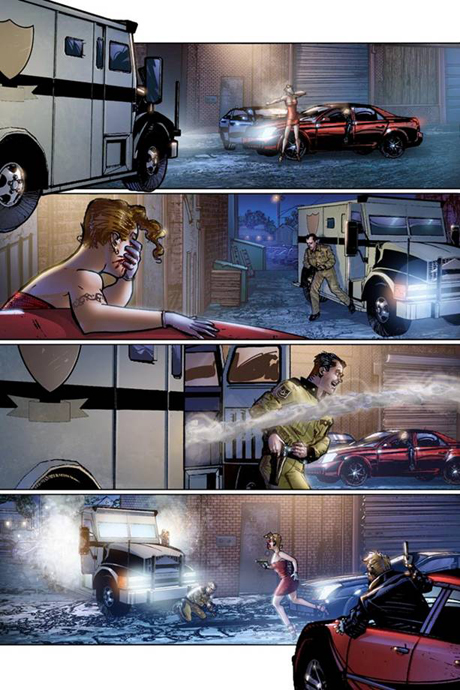
Sanders’ artwork captures the script very well. The detail and locations are there when needed, yet he’s not afraid to minimize his approach for the character scenes. There’s a nice sense of design to bring out the uniqueness of the world, and I’d also say the man draws an excellent fight, meeting every beat.

At the core though, Our Love is Real tells a classic yet compelling tale of a cop who has to rethink what he previously believed right. The theme is true to the noir state of mind. Humphries and Sanders do a great job telling this story. It’s a one-shot and it reads quick, but the team drops  a number of subtle marks to give readers spots to go deeper. On top of that though is a comic full of extremes. Animal/human relations. Sex with rocks. Protests. Over the top voice overs.  It’s as ridiculous as the subject it’s exploring. Or better yet, the subject it’s fighting against. By the end of the book, Humphries and Sanders make it clear that no specific type of love is the real, right, correct way to go, and the point is wonderfully summed up by the loving pair on the last page. A transgender and a deceased man’s crystallized ashes.

The Dudes
Alex Schubert

In my attempt to read comics outside of my usual focus, I stumbled upon Alex Schubert’s work after clicking a few links, and being as care free as I am I bought a few of his comics, not knowing what to expect.

Luckily, a pleasant surprise.

With his mini comic The Dudes, Alex Schubert shows us the darker, sadder side of the typically funny and well-loved “Dude” archetype. The story is very simple, or you could even say  nonexistent. Schubert places us in a neighborhood where we observe an assortment of typical hipster, stoner kids and their miserable existences. Yet, to these Dudes, their existence is pretty important. Or at least, they make it out to be as they find used condoms and discuss threesomes they’ll never have.

Now, Schubert spells none of this out directly. Most of it you infer from the artwork, situations and comical tone, but he does a nice job of conveying the idea that way. The comic exemplifies minimalism in a very interesting fashion, applying it both in terms of the artwork as well as the “plot.” Most of the book is just a collection of drawn out moments, and the moments are so pointless to begin with that there’s no point at all to draw them out. Except, that is the point. Drawing out these moments shows us how insignificant they are, and Schubert’s deliberate lengthening of them channels that very real life importance we like to place on everything. His artwork keeps backgrounds to an absolute minimum and his layouts are as plain as can be, but it’s these touches that bring home the idea. Even the character’s dialogue is well done. Any line within the comic could easily be switched around with another as not one line is specifically designed for a particular character. This shows how truly little these Dudes have to say.

The Dudes is a nice peak into the typical American way of life. It’s a comment on what little we really do with our time on this planet and how we lie to ourselves to make us believe the opposite. The book makes you laugh while also causing you to reflect on your own choices. Not bad for 12 pages.

Blast Furnace
Ryan Browne

This could be consider a combination of the first two in terms of execution and tone. More importantly though, it’s a fun fucking read.

Blast Furnace makes its usual rounds as a weekly web comic, but I managed to pick up a print collection – which is really a mini comic – at this year’s New York Comic Con. According to Browne’s website, Blast Furnace will run for an entire year with a new page each and every week, and the entire thing is completely improvised. None of Blast Furnace is planned out or necessary thought through in terms of a plot, but damn, I must say, it’s good.

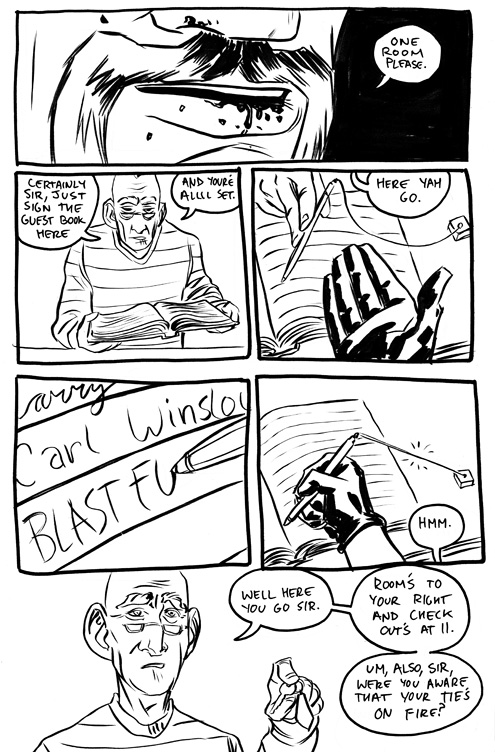
Browne’s entire base point seems to be an exploitation of badassery. The lead character wears a flaming tie and a handlebar mustache, and he goes around performing ridiculous feats of action. The first time we meet him his hands are dripping blood. The rest of the comic follows suit as Browne presents quirky situations and highlights them with accents of laughably exciting elements. Combined with the extreme though is a lighthearted sensibility of minimalism. His artwork strays completely away from any sense of rendering and instead looks like it came right off the sketch page. That’s not an insult. More comics should pack this vibe.

The look of the book and the line work used reminds the reader very well that Blast Furnace is nothing to take too seriously, just like the events in the story. Because it’s produced on a weekly basis Browne has room to go on the occasional tangent. Reading these pages in a row, you can clearly see how little this book follows a strict outline. The story goes where ever it goes. I like it, though. It feels very direct and there’s a certain flow on the pages.

1 Comment

Filed under The TW Review, Uncategorized

5 issues in …

Well, technically 6, but so far all I’ve read are 5. That is, of Dark Horse Presents – the newly revived version.

I’ve discussed the title before on this blog, but when I did I mostly stuck to the crazy Neal Adams bit. This time, I want to look at the project more as a whole. And, yeah, I’ll probably break down one specific short as well because there’s one that certainly deserves the attention. But more importantly, don’t expect anything long here. I’m feeling this to be a short post.

Why? Well, it’s simple. DHP hasn’t really offered much as of yet.

I’m honestly disappointed to type that. I rooted for this return right from the get-go announcement. You can take it back to my previous post and understand why. I like anthologies. And this seemed to be the mega-ultimate of anthologies. A blend of classic talent meeting and mingling with a fresh supply of new faces, and comics being comics in all sense of the idea. But it wasn’t even just that. The “Dark Horse Presents” brand possesses a certain charm. The original incarnation lasted 157 issues, spanning almost two decades. Within it, a few modern classics found their feet, and eventual industry giants published their early works. The title was a constant of its time, and I’d say the last, successful comic book of its kind. But even then, the flagship managed to morph and make an impact through the mid and late-2000s via MySpace Dark Horse Presents. It didn’t last as long, but Dark Horse certainly took bold steps in terms of web comics and the digital direction we seem to be so hopelessly moving in. The web series also spotlighted some Umbrella Academy shorts. That’s good stuff.

So, yeah, point is, DHP has a legacy and a status as a brand. I thought I would see that carry over to this third revision.

I think it has somewhat, but I also see this book still in the process of finding its feet and becoming what its going to become. DHP’s main problem is its singular reliance on veteran talent, which seems to no longer surprise or impress. I like a lot of these guys, and I respect them. Many of them are forever associated with the field. When I read Richard Corben’s bit though, I’m not reading anything memorable. And not memorable in terms of long lasting impact, but memorable in regards to keeping it in my mind for longer than ten minutes. Same goes for Chadwick and Adams, whose work may be beyond me, but I do not understand what they are after. Most of it seems to blend in with the general anthology feel – these stories are “eh” and throwaways. And it was really those three names, at least for the first few issues, that the series was banked on.

The sure-fire foundation crumbled, obviously.

The “new” talent has yet to blow me away either. Most of the attempts I read feel like anything else. Decent high concepts told in orthodox fashion.

One vet has impressed me, though. Chaykin. “Marked Man” is a wonderful example of serial fiction with its pulpy roots covered in airbrush neon. This comic does a great job of representing the crime/spy genre in this collection, or anthology, or multi-genres. It’s like the perfect spokesperson. A keen voice over, dis-likable, scummy, yet kind of sympathetic lead, a grimy environment, seedy doings, and even an obsessed cop on the trail. The components are there as well as the aesthetic of Chaykin that follows all of his work. If I’d read more of it, I’d probably possess a term to describe it. “Marked Man” also moves. Chaykin realizes this story lives and breathes in short chunks, so he sets to work and every page takes the reader somewhere knew. None of it feels rushed, though. The sign of a master.

Some good does exist beyond Chaykin, believe it or not. A strip titled “Resident Alien,” which kicked off in issue 4, packs a voice worth investigating. It plays to a high concept, which you could consider a short cut, but Alien really seems to rely on moments of humanity. The plot involves a crash landed extraterrestrial who’s extremely anti-social. Forced to live upon Earth, he hides out in the country in a cabin by the lake, pretending to be a wayward doctor. We catch up with him when he’s forced into a nearby town following the murder of a doctor. In absence of a medical professional, our Alien protagonist is asked to stay and live among the people. The sensations of awkwardness are well written as well as well portrayed, and the piece has a solid overall vibe which only conjures up images of some good auto-bio comic. I’m curious of this one’s development.

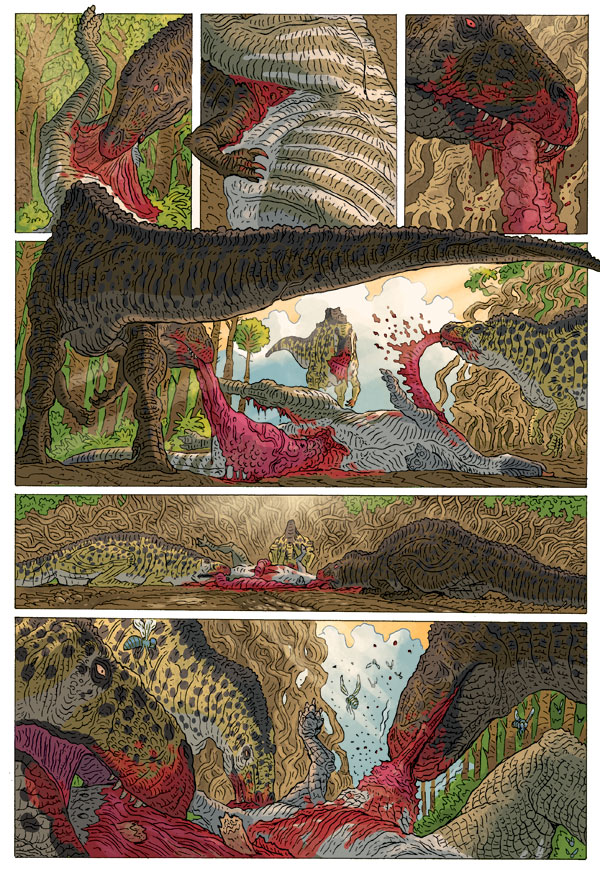
But the return of “Age of Reptiles” takes the cake. Ricardo Delgado illustrates something like 5 pages of a beautifully crafted, yet short, dinosaur narrative in which the body of one dinosaur feeds many others and completes the whole “dust-to-dust” cycle. Sounds simple, and it is, but the manner in which Delgado draws it turns the entire beat into a very poetic thought. His artwork and storytelling showcases not just the beauty of death but also the influence one can have after passing on. You can also meditate on the thought of how death can bring us together, and it of course, too, lends itself to the myth of the phoenix. You know, rising from the ashes and all that. The entire piece stands out from both a stylistic standpoint as well as a sub textual peg. “Age of Reptiles” has, by far, packed the most punch in this new DHP.

So, some good exists. I can’t deny it, but even though my post my suggest different, the bad far outweighs the good in this comic book package. I’m still optimistic, though. At 8 bucks a pop, maybe I shouldn’t be, but something tells me DHP will improve in the coming year. Look at the solicits for upcoming issues. Hellboy, Brian Wood stuff, Fabio Moon has something in issue 6, and if the few positives I mentioned continue, it’s possible Dark Horse Presents could straighten out. I think Mike Richardson and co. are still figuring this beast out. It’s DHP, but I get the vibe, like with Myspace Dark Horse Presents, the publisher is trying to find this version’s niche or job. Or, more plainly, adjusting the title for the current times.

Dark Horse Presents does seem to be some sort of representation of comics, though. By that I mean, it’s not an anthology excluding itself to one specific genre or style. Between dinosaurs, marked men, Neal Adams’ wacked out shit and the post-apocalyptic bullshit they’re determined to run, I’d say Dark Horse is all about offering up a nice helping of variety. The consistency in quality just needs to improve. Cut and paste that.

Leave a comment

Filed under Uncategorized

Spandexless Review: Spaceman #1

I wrote this review for Spandexless.com, a website dedicated to comics outside of the super hero genre. If anything, I really enjoyed Spaceman #1, and I had fun writing this review. So, if interested, you can read it. The original review is posted here.

We all know Brian Azzarello and Eduardo Risso work well together. Uttering the duo’s name automatically triggers thoughts of quality, and we all know the pair rests near the top of creative teams of the last decade. Sometimes, though, I believe we forget how truly great these guys are together. We acknowledge their high esteem in the medium, but after a while we get into the habit of just accepting without truly seeing. We lack the sort of realization you can only experience when you’re sat down in front of one of their comics – the sensation that as you turn the page, you know you’re reading something special because your mind is being blown.

Azzarello and Risso do comics how they should be done. These men, along with colorist Patricia Mulvihill, construct worlds and atmospheres and then tell you all about them in sophisticated fashion. The approach is reserved and cool. The necessary hints are subtly placed, and the reader’s own effort tells the tale. Azzarello/Risso books are, simply said, confident, independent and sexy.

And Spaceman #1 holds the crown as the single best comic book of October. Easily.

With Spaceman, we’re told the story of a genetically engineered man who’s life-long purpose was to go to Mars. In reality, his goal was never reached, and when we meet him he’s simply a junkie trapped in a world of decay.

That’s all you really need to know on your way in.  The beauty of the comic rests with how well Azzarello and Risso work as collaborators. A lot of comics these days seem to be one sided. Either the writer conducts the train or the artist. It’s rarely a case where the creative team truly acts as a team. You can see the team play when you read Spaceman, though. Azzarello gives Risso just the right amount of time to convey the narrative via the artwork, and Risso knows when to let Azzarello’s dialogue communicate a piece of information. Mulvihill, as the colorist, adds her own bit as well … highlighting Risso’s line work with hot sears of emotion or simple grayness and smudge. Her contribution fills out the tone of the work.

The comic book just feels like a group effort, and without all of the creative players Spaceman would not be the same book. The team meshes so well that none of the elements feel overbearing. The book just feels like a comic book should.

When you consider this team though, it’s odd to imagine them on a hard science fiction comic like this. Azzarello and Risso are known for the crime genre. Whether you take into account 100 Bullets or Batman:Knight of Vengeance, these guys spell out crime comics. But here they are doing science fiction, and they’re doing it so well.

There’s certainly still a street element to the book with the homicide detectives and drug deals, so this could possibly explain the team’s success on a sci fi book. I’d like to think it’s just simple skill, though. For one, Risso does a bang up job depicting a rundown city. The scapes are big. The rocks…you can feel them crumbling. Shadows cast themselves in all sorts of ways. And, man, the water feels like it may wash away everything at any moment. He does a great job of separating post-apocalyptic from currently apocalyptic. The world hasn’t ended yet, but Risso shows you that the moment is on its way. For two, Azzarello packs the script with numerous cues to build layers into the piece. The script obviously focuses on the main character, but small touches, like the setting, the technology and even the dialects in which people speak, suggest the first few hints of the piece’s core theme: lost potential. Azzarello crafts this script wonderfully and succeeds in the department of setting up this tale while also snatching the audience’s attention.

Where science fiction is concerned, the best of it always seems to really speak to the condition of our world. Spaceman looks to be nothing different. Azzarello and Risso have taken us to world where hope seems forgotten and the future we were promised is unlikely. Like all us, we start out hoping to one day be astronauts. Well, in this book, none of us made it.

Leave a comment

Filed under Uncategorized

“Everybody’s been too damn polite about this nonsense”

Saturday’s usually a quite day on the internet. Nothing really happens. Most people use the day as an opportunity to step outside and experience the real world.

But when Frank Miller decides to drop a king sized bastard of a blog post, well, people tend to log back on.

I’m sure by now most of you have read Miller’s latest example of public expression. It’s a little blog post he titled “Anarchy.” In it, Miller criticizes the now inescapable Occupy movement as well as suggests that our real enemy exists in the form of a turban and prays to another god. Haven’t read it? Do so. It’s interesting.

Now, before I really set out on this attempt of clearing my head, I need you to understand that Frank Miller is and always will be one of the absolute greats in this medium we call comic books. No matter what he states on the internet, no matter the man’s political beliefs, Miller’s pure ability as a visual storyteller earns him a pile of respect. I guess you could say it’s similar to Dave Sim. His views of women and whatever else may be completely insane, but removed from that Sim’s skill as a draftsman as well as completing such a ambitious project gives his credibility as a comics artist.

It’s complicated. Most suggest the artist and the artwork are one and the same, and they are, but it doesn’t always mean that you can drag in outside comments to tear down the actual works. It’s two different contexts.

So, I love Frank Miller’s comics, and I most likely always will. Because you know what? They’re great. Absolutely great. This world would be an even sadder place without a Dark Knight Strikes Again in it.

That said, because I can discuss Miller’s works as Miller’s works …you know, as their own thing, away from the other stuff, I can discuss Frank Miller as Frank Miller. Meaning, without discussing his works, I can talk about his beliefs and how he chooses to express them online. So that’s what this post is. This is a criticism of Miller’s blog post and the point he makes in it. None of this has anything to do with Miller’s comics. And I must say, Miller’s gone a little far.

I’m completely cool with an artist holding an opinion. Even when it’s an opinion I could not disagree with more. Opinions make us who we are, and this is a world of variety. In some funny way, even when differing opinions may annoy us, the human species, most, I feel varied opinions are an absolute necessary otherwise we’d all be chugging Diet Coke and watching re-runs of Charles in Charge, acting as if that were the pinnacle of society. So, if Frank Miller wants to be all conservative and tell the young kids to get jobs, fine, he can do just that. I wouldn’t agree with the belief, but if it’s how he feels, whatever, I can ignore the opinion and still read DKSA happily.

His latest statement goes beyond opinion though and into territory of hate and unnecessary name calling. As Miller puts it, the Occupiers are “nothing but a pack of louts, thieves, and rapists, an unruly mob, fed by Woodstock-era nostalgia and putrid false righteousness” who will undoubtedly “harm America.” That’s a bit much.

The Occupy movement may have made a mess of Miller’s beloved New York City, and it may also lack a solid focus, but to go out and generalize an entire group of people as “rapists” and “thieves” extends beyond the regular old understanding of being upset and disagreeing. And to claim that the movement will “harm America” … I don’t know, that only comes off like a plea from a successful man who enjoys the system currently in place because he’s at the top of it.

I kind of get where Miller’s coming from with his dislike of the Occupy Movement. He’s a cartoonist who’s worked hard for many year to achieve what he possesses today. He worked for the respect, the reputation and the money. And difficult work as well, locked away in isolation hunched over a drawing board. So, yeah, kids marching in the street, somehow acting like they’re entitled would set you off. You’d want to be the old man bellowing “get off my fucking lawn” in order to voice some concern over the latest generation’s willingness to work.

The problem is though that the Occupy Movement isn’t that simple.

I’m sure there are plenty of people protesting who fit the description of “young and entitled,” and I’m sure there are at least a dozen who are simply lazy and want handouts. But what about all the people who have actually tried to get jobs – like the college graduates – or the individuals who had jobs,  were laid off, tried all other means possible and now only have this? I’m sure there are also examples of that. So, what, they’re all rapists, now? Thieves?

No. Occupy is just a group of people who want change. Yeah, the focus may not be entirely tight, but I don’t necessarily feel that matters. What matters is the idea within this movement. The idea that people have tried and tried, but because the system is so damn complicated and broken, have no other option and now must take to the streets in order to voice a desire for help. That’s all this is at this point. It’s the social consciousness manifested into a physical form, and it’s showing everyone that these large problems can no longer be ignored.

I can only disagree with Miller when he states that the movement will “harm America.” No. What’s in place now, this broken system … that will harm America. Not the people’s desire for change and improvement.

And there’s also the call to arms Miller puts forth. According to him, we should all enlist with the military immediately to fight the real enemy … Al-Qaeda.

Now while these guys aren’t entirely nice and kind, Miller voices his concern for Al-Qaeda in a way which suggests fear. Fear of extremists rising up and shattering everything we know. He then moves on to insult what is probably most of his fan base – the nerds – by using the age old “you live in you mom’s basement” technique.

Really, a class act.

Certainly, Al-Qaeda is something to be concerned about as they are in favor of scary, bad things – to put it plainly. And I do feel that this extreme group should be dealt with in some fashion – whether diplomatically or actively – in order to protect innocent people. But Miller kind of casts these guys as cartoon villains, or as the “black” to his “white.” There is no grey.

And that’s the problem. We live in a fucking grey world. To be so “these are the bad guys, we’re the good guys” comes off as immature, really. It comes off as extreme. Isn’t that what Miller’s against? Extremism? I thought so, but this blog post really has me questioning. If Miller’s against extreme measures, well, I would say he’s being a bit hypocritical here because this “call to action” is completely extreme. I mean, the guy wants all of us to go to war and kill terrorists. That’s like as extreme as it gets.

That’s better than peacefully protesting the government? Really, Frank Miller?

While Miller may fear a sense of extreme anarchy, it seems he’s entirely for an extreme sense of order. You know, keep the powerful on top and eliminate the crazed religious guys. Put us all in the military where we can wear the uniforms and jump out of bed at 5 am. I kind of can’t believe Frank Miller – the same Frank Miller I have always loved – wrote this blog post. But I guess I should.

When I first read Miller’s statement, I automatically went into a mode of justification. I needed to find a way to justify his actions here because Miller, to me, has always been a man worth respecting. And I still feel he is simply based off of his work. But the fact is, Miller, even though a hero, isn’t exactly what I felt he was cracked up to be. At first response, I sent out this tweet:

So Frank Miller said some highly conservative shit. Big deal. I don’t agree whatsoever, but it’s not like he kicked me in the balls.

After a few moments of thought though, Miller’s statement went past simple “conservative shit.” This tweet was my sad attempt to save Frank Miller in my own eyes. I was fighting off the truth about someone I look up to. Reading “Anarchy” kind of falls in a similar place as meeting your hero. That terrible thought in which your hero does not live up to expectations. Yeah, I guess he kind of did kick me in the balls.

So I can’t really justify or apologize for Miller’s outside concerns anymore. He is a legend, and I love his comics – but I have to face facts – Miller’s political beliefs are not my own, and the way he choose to voice them leans a bit close to the extreme, and I’d say, unhealthy. The man can be a great cartoonist, and I can enjoy his work. This doesn’t mean I cannot call him out on his absolute bullshit, though. And that goes for any artist, really. Whether comics, music or film. I can dig the work, but just because I dig the work or am a fan doesn’t mean I have to stick up for everything they do or say.

Because “Anarchy” is absolute bullshit. Just the typings of a fearful, “good vs. evil” man. Miller does claim everyone is “too damn polite about this nonsense,” but I’d say his rough and rude approach did little to help either.

2 Comments

Filed under Uncategorized

Why do I like comics?

I wrote an article for my college newspaper The Daily Athenaeum on why I like comics and find them worth the time. I’m not sure if I managed to express everything, but I like my attempt. It’s written with an outsider audience in mind,  but, if you wish, you can read it.

Comic books. Those pulpy collections of scrap. A trashy source of entertainment only fit for those on the fringe of the social circle. A laughable commodity. A dead end. A zone preoccupied by childish fantasies. Who cares about comic books?

Me. I do.

As Scott McCloud notes in his seminal work “Understanding Comics,” communication through pictures holds deep roots in man’s history. Cave paintings depicted the life and culture of our ancient ancestors. These were the first examples of man’s ability to create and pursue artistic ventures. Maybe these remnants are now considered paintings, pertaining more to a medium of acrylics, but look at what those early visuals accomplished. They told stories. They illustrated an idea.

And in such a direct fashion. Like comics.

Comics derive their power from how accessible they are. Anyone with a pencil and a sheet of paper can cartoon. In fact, I’d say most of us already have.

Middle school, stuck in a useless math class, you doodled. Maybe your doodles didn’t shape up into panels and sequentially act upon one another, but the idea of pencil to paper is the same.

What you thought of in your mind only took minutes to translate to physical copy. Whatever your idea was, it came out on paper without going through a middle man of some sort.

Other media does not offer such a luxury. Hollywood makes it nearly impossible for a director or screenwriter to tell the exact story they desire. Television shows act similarly because of network constraints.

Hell, even news reporters are confided to two minute packages, and even me, the little sophomore of a writer in the old college newspaper, I go through a middleman. You may not even read this statement.

Comics, in their ideal form, bypass this. Anyone with an idea and a lick of talent can draw and self-publish a comic book, and because of that comics can offer a wide variety of perspectives, genres and voices.

The artists behind them also possess much more control over the final product and ensure their vision comes through.

What matters more, though, is the form of communication. We all know, on some base level, how comic strips work. There’s a picture, and there’s a caption or word balloon laid overtop of it. It seems simple, and most would say the combination requires little to no complexity because of how little attention it takes to read a comic.

Fact is, you’re wrong.

The marriage of images and words involves a lot more than you’d initially expect. Both elements have to coexist. It’s like a peanut butter and jelly sandwich. Both can work well on their own decorating bread, but when you combine them, they have to be even. If one overpowers the other, the formula fails, and you end up with an unsatisfying experience. You need to find joy in both elements in an even, collaborative state.

Many artists fail to find this balance, but when the execution works, man, it’s like nothing else.

Because, even though ideas through visuals may seem first grade, the form strikes a chord. We’re all influenced and emotionally struck by images. Visuals are visceral and up front. Novels packed with thousands of words may seem scholarly, and they are, but text, prose – it takes much more effort to inspire reaction.

Comic panels may seem infantile because they can be so direct, but, fact is, the ease of ability to convey a point makes comics a complex beast. Skill of an artist is responsible for such an ease of understanding on the reader’s end.

If anything, comic books are a breeding ground for new ideas. The accessibility I mentioned earlier allows creative individuals to go wild, and it seems with some comics – at least the very good ones – ideas manifest on each and every page.

Comic books aren’t slow. At least, they shouldn’t be. They work in small chunks of 20 pages and release on a monthly basis. An artist has little time while telling a story through comics. Not only because of the system and format but because of how the medium works.

Panels cannot act repetitive. It’s like film in that sense. You become bored after staring at the same image for so long. Comics have to keep you on your toes; therefore, each page and each panel go somewhere new.

And through this comes, what should be, an ever exciting landscape of narrative.

But, even as I write this in order to somehow legitimize comics, remember: They are comic books. Never are they cool. Most of them involve tights and capes or zombies and space ships.

The medium itself, the inner working of the art form. Yeah, that’s sophisticated. But the content? Sure, large, universal ideas can be communicated and often are, but usually these themes shine through grown men punching each other while wearing funny outfits.

I mean, they are “funny” books after all.

Leave a comment

Filed under Uncategorized

alec watches movies – Warren Ellis: Captured Ghosts

While it wasn’t the finished film, I caught a sneak peek screening of Warren Ellis: Captured Ghosts in New York City amidst all the convention hubbub, and I thought for the sake of it I’d write a “review.” Or, considering it’s not the finished product, a few words because I guess I can’t really review a film before its final cut. Stuff works that way sometimes.

But from what I understand, the cut I saw comes close to the eventual final version. I believe a few Grant Morrison bits need to be edited in. So, hell with it, this is a review review.

And now that I know what this is, why don’t I talk about the film? That’d be nice, right?

Warren Ellis: Captured Ghosts is a nice extension of Respect Film’s previous work Grant Morrison: Talking with Gods. Like Gods, the film focuses on a staple comics writer and boils down their work into a nice, even statement of what it represents and who, essentially, they are.  The film is cohesive, stylish, and exciting in its approach, and I am yet again impressed at how well the production team takes a comic book writer, with so much background, and presents them in a way a novice of the subject could understand.

However, Captured Ghosts is not just another Gods. The film conveys a very different personality by incorporating the spirit of its subject, Warren Ellis. Surprisingly, Ghosts packs a nice amount of humor via its interviews as well as scripted elements. The film can also gross you out through either witness accounts provided by interviewed guests or its array of dramatizations. Ellis himself supplies much of the humor. He recounts quite a few early experiences that both shock and inspire fits of clap-aided laughter. His personality comes across so strong in some bits the film itself takes on a very abrasive attitude, and I don’t type this to slant the piece. Ellis as “internet Jesus” suggests an air of cool roughness which is beyond everyone, and the documentary plays into that creating a tone fit for a guy on the cutting edge yet still smokes 5 packs a day.

Production wise, the film improves upon Gods. Things looks crisp, clear and professional. The editing holds tight and moves at a swift pace. Hell, even the film’s soundtrack is high standard as sounds range from eerie ambiances to bursting electronics. The film also applies an interesting technique by creating a neat, little atmosphere of its own via the Ellis clips. The crew places Ellis against a solid, black background, and Ellis just fills this empty, dark room with his speech and cigarette smoke. It’s a cool trick to imply, that while watching the Ellis clips, you’re actually in his head scape.

If anything, you will walk away from this documentary possessing a clear appreciation for Warren Ellis and his work. Director Patrick Meaney and crew communicate the big ideas associated with the subject, and hey, it’s entertaining. Multiple, well-known comic book personalities and creators appear throughout to share their Ellis-related thoughts and memories. There’s even a brief segment about Matt Fraction and Kelly Sue DeConnick’s marriage which is both cute and comical.

Plus, as someone who’s read very little Ellis, I walked away extremely interested. For the outsider, this could be the potential hook to make your un-comic book friends,well, read comics.

Transmet, here I come!

2 Comments

Filed under Uncategorized

Absent Colors

Edit: This post may not be up to the snuff of my recent writing on this blog as it is an inventory post. I wrote this back in July and never posted it. The piece was originally intended for PopMatters, but they suck and blew me off. So, here it is. Better writing will continue next week as I bunker down and create.

Still, it’s not terrible. An interesting point is made, and I feel it’s worth the time. Please only excuse some of its construction.

Hell, though, you may think it’s right on par with everything I do. If so, fuck you.

In comics, color tends to be the major indicator of tone. It can’t help but be. Above pure style or detail or simplicity, it’s the piece of comic art that makes the first impression. Why? The human eye is naturally attracted to color, or more specifically light. Our eyes respond to light. That’s their job; they take in light, process it, send messages to our brains, and our brains sketch out the world we see. Light holds no specific color, though. It’s just light. What builds our perception of color are the wavelengths possessed by the light our eyes process. When our brains decode the wavelengths though, it is believed that we make judgments of our world based on our perceptions of color. Want a healthy snack? The bright green of celery may be a good indicator.  Safe place to live? The neighborhood with the bright, red rose buds and the white picket fences probably appears secure.

If this belief be true, which I feel it is, then we are constantly reading tones in our everyday lives. It makes sense that a violent splash of red gives a comic book a sense of danger. For reason why we respond to specific colors in specific ways, I’m not sure, but there is this great essay from writer Matt Seneca on the subject (seriously, read it).

So what’s the case for black and white comic books? They certainly exist, and they certainly contain stories with emotion and idea. How do they communicate their tone? Maybe simple subject matter has something to do with it – see The Walking Dead – but I have a feeling that in the absence of color art line art carries a little more weight.

For a random example, take Eastman and Laird’s Teenage Mutant Ninja Turtles #1. A comic book that uses a lot of cross-hatching and small lines to create a feeling of grit and urbanness while populated by lines making animal shapes to build a sense of parody.

Even with color, line can still dictate tone. Sam Kieth uses many angular lines to convey the edge his work his after while Frank Quitely’s line gives off a vibe of fun energy with its round, almost wafting quality.

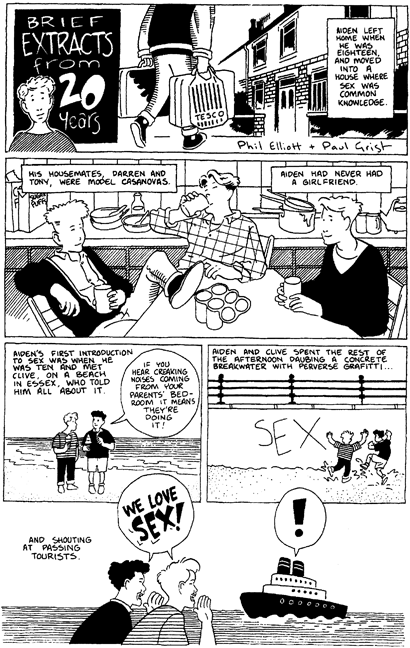
This next example may not be as “glamorous” as the few previous, but I’ve recently read a collection of short strips from Jack Staff artist Paul Grist that is to blame for the thought I’m typing here. While Grist collaborated with writer Phil Elliott in the early years of their careers, the men produced a handful of comic strips for magazines such as Taboo and Escape. Recently, these early strips were collected into a mini comic collection by Slave Labor Graphics which is titled Absent Friends. I, believe or not, obtained my copy via Erik Larsen’s garage or at least an associate of his who obtained this Larsen-garage treasure and then sent it to me. Yeah, sorry, I had to name drop. Anyway, these tales explore the usual ideas with stories of friendship, career, and sex, but they do so without coming off as just another “auto-bio, young man’s view of the world” comic. Even though they do cross the usual thoughts of indie comics, these strips do so very well by simple fact of their craft. Elliott writes a story that never spells it all out. His scripts are tight and fast paced. You never really get it all on the first read through, but you still get enough to entice you back for more. The second reading is when narrative details pop; a quality I’ve never really seen in short, vignette comics. There is actually something quite short story, or even Hemingway about them.

I’m here to talk about Grist’s work, though. As you recall, this post did start out with thoughts of visuals and tone, and I feel the work in Absent Friends really is a nice example of tone through line work. Grist is well-known for his charismatic, dynamic style because of his comic Jack Staff, but Absent Friends carries more of a rigidness. It’s not bad rigidness, like Alex Ross or recent Scott Kolins would present, just rigidness in the sense that this is a young artist, as of yet, without a particular style, and in the context of Grist’s current work it’s comparatively stiff next to Jack Staff.  Grist understands mechanics and can tell a story, but he just lacks a flamboyant style that comic readers are accustomed to.

The rigidness is one of the techniques that convey tone, though. As described, these are stories about relationships, lost friends, and struggling artists, so the stiff, more serious aesthetic of his line actually works well to communicate the point that most of these stories are not to be laughed at but rather thought about. The line art is very blunt in it’s nature. This work well for these comic strips because writer Phil Elliott, while not spelling everything out, is sort of blunt in his storytelling, or at least the nature of his narrative is very visceral. It’s not visceral in a violent sense, but the stories do present their events in a very forward fashion. The approach could be described as  “Look, this happens. Now, it’s over. Move on. Think about it when you’re done reading.” The sort of up front, no flare about it artwork Grist creates reflects this tone very well and furthers its transmission.

Grist also gives attention to his backgrounds for the cause of tone. Absent Friends isn’t one-hundred percent serious. There are a few, I guess you’d call them, “gag strips” or humorous takes on relationships throughout the collection. They’re intermingled, and the collection transitions through an array of emotions. Grist helps separate these stories by taking advantage of or destroying open space. Stories that exist to be taken a bit seriously usually contain panels with cluttered backgrounds. Grist uses devices such as rain, snow, simple cross-hatches, or a wide array of dispersed objects to tighten up the panel. That tight, almost claustrophobic feel contains the reader into a certain emotional mindset. The humor strips are the opposite. Grist leaves a lot of white space in the backgrounds, lettering and sound effects appear enthusiastic, and even character’s heads are a little more round and cartoonish. The humor stories, because of the environment Grist puts them in, look very dynamic.

This is an early work from Elliott and Grist, but in some ways it feels like years and years of experience were on hand when they made the stories within Absent Friends. These comics are well crafted, and while printed in black and white, Grist makes use of the line art to sell the heart of these stories. More importantly, Absent Friends made me consider the role of line art. I tend to think it’s job is simply style and obviously building shapes, but there is more to it, especially when you read a comic book that takes advantage of it. Color will always be the dominate messenger of tone, certainly, but I think next time I read a comic I’ll study the line and see if it too is sending a message.

1 Comment

Filed under Uncategorized

Butcher Baker, the Statement Maker

Joe Casey wants us to wake up. He’s screaming in our ears. “Hey, fuckheads! Put it together!” For some, a rude awakening. For me, a welcome cry.

I never enjoy being the “all comics suck, especially the cape ones” guy, yet, at times, I slip into that mindset (especially if I’ve read Fear Itself). I join the crew of the hyper-critical, and we chant via our internet connections of how much we hate everything. Actually, I lied. Sometimes that mindset feels splendid. There’s a certain air of “above it all” that comes with the hate. You feel ahead of the curve. At least, I do. At some point though, you realize the amount of negativity you spout and things turn dark. You look at yourself in the reflection of your computer screen and beg the question: am I negative for a justified reason or am I hating to hate?

The “all super hero comics suck” label seems too easy to apply. It goes beyond the reasonable complaint of limited creativity to levels of nothing is possible in the genre. Sure, the genre has its problems. Creators get fucked, progress isn’t always made, and comics resemble product rather than art. The corporate lock down and fan culture provide plenty of reason for people to disown the angle. It even encourages it.  Small press suffers the same issues, though.  TokyoPop completely fucked Brandon Graham, the black and white boom felt more like early Image Comics than progress, and the number of publishers pushing panels of licensed properties goes uncounted. Small publishers suck just as bad. The flaws of comics go beyond the capes. It’s comics as a whole.

Still, for some, there’s nothing beyond Fantagraphics and PictureBox. The output of Oni Press doesn’t apply to them. My argument doesn’t apply to them. Whatever. For those who state an open existence though – the people in it for the art and seeing the world in open terms – it seems pretty fucking stupid to limit your reading. Sure, hero comics contain a lot of bad, and sure, few contain the passion and personal touch of art, but if  any of those things were the case, super hero comics seem like the most likely place. Motherfuckers fly in these books. I’d say a lot’s possible. And – super hero comics hold a certain place in the medium. To ignore them or brush them off only signals a being living in a bubble. In some senses, cape comics are the medium, at least in terms of identity. Study that. Learn from that. Invite the cape and cowl in and let it join the house party you call context.

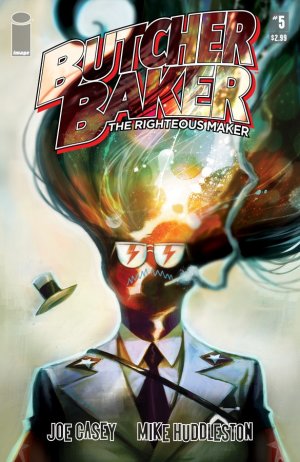
Joe Casey proves the potential and awesome of super heroes with each issue of Butcher Baker, the Righteous Maker. He sends a statement to the art house goon, the mind-mushed hero reader, and the comics professional. The super hero isn’t a bitch; the super hero has balls. Such detail is built into Casey’s lead and book namesake, Butcher Baker, as well as the up front, hyper-active aesthetic of the comic. But I wouldn’t even limit the cry to super hero comics. As typed above, small press or guys like IDW, Oni, and Dark Horse can suck just as bad. Hell, even Image who publishes the work of the industry right now publishes some shit (*cough*Invincible*cough*). As we’ve learned, it’s not about limiting one’s self to a specific area of comics or literature. The mission pertains to an all-encompassing mind, and Casey is a smart fucker. This dude speaks a little something to everyone.

But, hey, comics books are about pretty pictures and cool looking shit. Let’s talk about the bitchin’ work of Mike Huddleston.
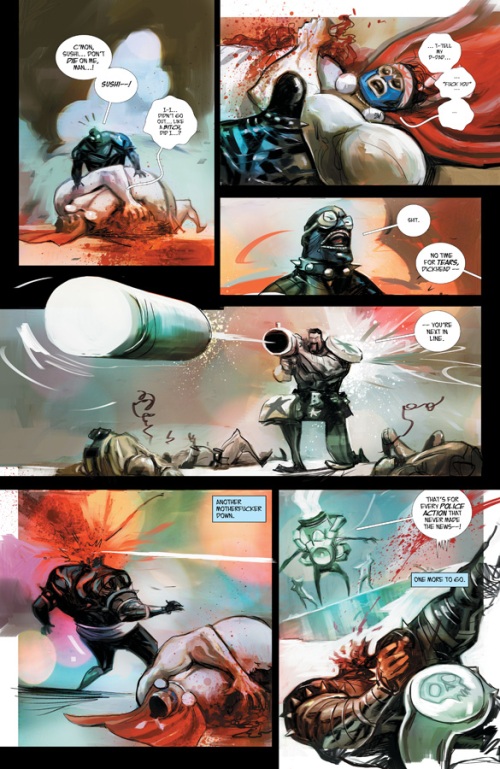
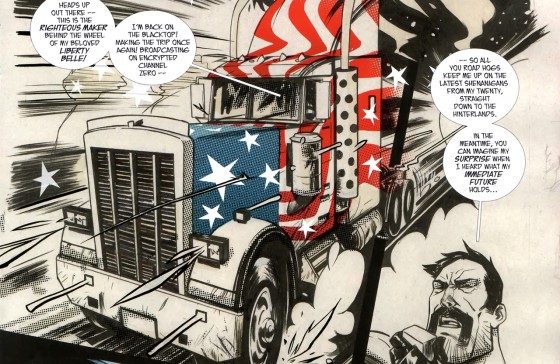
So much happens in this comic because of Huddleston. Casey inspires the work and sprinkles in the bits of manifesto and meta, but Huddleston sings the fucking song. His art spotlights many approaches, techniques, and tones to create an air of sophistication and complexity. Baker is not a comic to sit and stare at a consistent color choice or line. Huddleston flashes between neon and grainy black and white. Speed lines touched by a manga flare decorate fight scenes. Cross hatches and angles bend lines to an edge. My descriptions of art only go so far, but you get the idea. Mike Huddleston fills Butcher Baker with a mixture of approaches. The question to ask: why?

When reading comics (or any type of literature), always ask why things are done the way they are. That’s basic 9th grade shit, but it works. Techniques and narrative choices spawn from more than just accident. Everything contains a purpose. In the case of Huddleston’s art, I’m sure there are numerous – NUMEROUS – reasons. The dude no doubt possesses more brain cells than I, so I’m certain his artistic choices run deep. Too much happens in Baker in terms of visual expression for there not to be detailed reasons. I believe I can offer one, measly, bullshit reason, though. Huddleston’s art is on the constant move. Every scene works under different circumstances, and while I’m certain each scene looks the way it does for a specific purpose, I’m more interested in the general idea of change or the simple notion of complexity.

Casey shines a spotlight, aiming the bright, phosphorescent bulb on the super hero and the genre’s ability to preform. From that, we’re seeing the genre’s multifunction. Casey’s telling a high octane, “last job” thriller, but he’s also documenting a very personal journey. Much of this book is Casey’s career in comics deployed through the Butcher Baker analog. At the same time, the book offers character study.  The old war hero forced back to the life of combat. How’s that work? Butcher Baker, mentioned in this blog post’s title, also presents statement, a manifesto from Casey communicated through the genre and comic book as media.  The comic book as media … yeah. The spotlight, the statement, the study … it’s on the super hero, but again, no limits, Casey shows us the multifunction of comic books. Comic books in general, as form, rather than keeping to one section. A lot of change and movement exists in that goal. It only makes sense Huddleston’s art be so shifting. At least, in a collaborative sense. The artwork echos the writing. Provides emphasis. Huddleston’s complexity in style and technique is the visual hand to the face to push the idea through the eyeballs. Casey says comic books can do it all, and Huddleston backs him up.

Most comics keep to the single, visual vision. Reasons vary. Mostly, it rests on creative restriction because of risk of readers freaking the fuck out. Readers lose shit when comics lack realism, resemble manga, or go black and white. Huddleston brings all of that, though. He tells the notion of drawing “house style” to fuck itself. “House style” doesn’t know. It wants a set visual when comics could present so much more. The “so much more” never sees the light of day, though. The need to satisfy “house style” mentality boils strong, so artists force out status quo images. The art of Butcher Baker represents a sexy middle finger, and it yells at everyone, “hey, get a fucking load of this!”  A load of what, you ask? Metaphorical testicles communicated by the artwork’s aesthetic. Simply said, Huddleston’s work is pumped full of testosterone, and it follows Casey’s lead in that comics know no bounds.

The statement of Butcher Baker matters, and a main feature of that equals Casey’s personal touch. Baker feels like a very cathartic work of fiction.  We have some knowledge of the bullshit Casey’s dealt with in recent years. DC rewrote a few Superman/Batman scripts, and this obviously affected him. Maybe other things have happened as well. But the DC incident is the public one we, or I, know, and, you what, it’s enough to inspire the self-therapy Casey’s exploring. Baker contains a specific timeline, and it can be traced to match the experience of a comics writer. Issue #4 depicts a younger Butcher Baker – in his prime, the super hero of legend – combating against a villain in the middle of a desert. As the fight romps on, dialogue appears:

Butcher: “This place … kinda’ like the Wild West, eh Gator?”

“You think you can hide out, but it’s still Cowboys an’ Indians …”

“… while the goddamn world ends all around us.”

The Wild West. Cowboys an’ Indians. A good way to describe comic books, right? A medium with such potential and so much room for a pioneer to work with, but really it’s chained down by industry standards to play out the same old fights, over and over. Butcher speaks of the world ending as well. I take that as, “you can try to hide out in comics, doing something important, but while you play what’s really a dumb game, real shit is happening in the world.”

Gator is put down by page 2. Butcher than hands his mask over to an army officer and walks away from the scene.

Butcher: “Chasing super-villains halfway across the globe had me feeling like I was trapped in a Roadrunner Cartoon …”

I feel the line speaks for itself.

Issue #1 would be where we first meet up with Butcher in the present, years after the flashback. He’s living in his grotto, banging multiple chicks, and drinking. The dude’s all over the fruits of retirement. Then come Jay Leno and Dick Chaney, whom could easily be interpreted as Marvel and DC as well as other things. But for the sake of the point I’m on, let’s stick with Marvel and DC. These guys bring Butcher out of retirement to fulfill a mission. The mission, blowing up a high security prison in order to kill a bunch of super villains, goes wrong and Butcher is left with a mess to clean up. The mess being a number of old foes such as a behemoth named “Angerhead” who spouts lines like, “My hatred will fuck you up!” Even though higher powers sent Butcher on this mission, he’s on his own to clean the mess. Hell, the high powers look to cover their asses and send in military force to fuck Butcher. There’s even missiles sprayed painted with the phrase “fuck you” fired at the Righteous Maker.

This reads like an account of a comics writer picking up mainstream work and then realizing the mess it can be. Some creators claim to do very well under corporate structure. Guys like Brian Bendis has flourished and still produce solid work while being the company name. The other half of the story exists, though. Casey would most likely be the poster child. Lines like, “Those assholes promised I had their ‘full support’ on this mission – is this what they meant? The first sign of trouble…they turn their guns on me, too!?” totally fit Casey.

“But it never fails. The white men in their black suits…they want what they want. And I’m expendable. Fuck me.”

It’s like the reaction of a writer going in, trying something exciting under a corporate umbrella, and then discovering the company men are pissed and will fuck you hard to fix what you’ve done. This element of the story actually provides an interesting contradiction. As typed, most of this book sets a goal to present the awesome and capability of super-heroes as genre. It’s almost like a pep rally in comic book form. So why show the darker side? I believe it’s to discuss the issue of super-hero comics entirely. As we all know, creator rights have once again become the big, controversial issue in our daily Twitter feeds. And you know what? Good of those people concerned. It’s an issue that demands dealing. But as we all come to question the moral behavior of our heroes’ homes (the publishers), we reach a point of contradiction. We all favor creator rights, and I bet quite a few would give an arm to get Kirby is rightful due, but when you boil down the argument, how many can actually boycott Marvel? A sense of evil and moral question disgusts us, but we also love the story potential of capes. We reach a point of enternal struggle. What do we do here?

Baker’s at the same point. The dude wants to enjoy the life but constantly suffers from its seedy side. He is us, and he is Casey, locked in a world of indecision and contradiction, trying to make any fucking sense of it he can.

And then Butcher makes a break for it after a bloody battle in Times Square. He disappears like a criminal after a successful heist, beaching himself in a resort spa. Not the place for Butcher. The dude can’t escape the thoughts of heroing and who he is. Butcher contemplates what’s next for him.

The writer cannot just leave the field even after a hard fucking. The writer has to produce. It’s who the writer is. Resort beaches and bullshit small talk are not him. But what else is there other than the game he’s already played? Same goes for the reader. Once you see the potential of comics, how can you leave forever?

Butcher Baker sees a lot of time as an analog character, and honestly you could probably spend a few hundred words or more discussing analog characters in this comic. The entire cast of villains thus far seem to each speak a specific personality, and there is as well Arnie B. Willard. This determined, beer-gut of a law man comes as a bit more difficult to pin down. I’d say he represents another side of Casey, though. Just because of his ying/yang connection to Butcher. Issue #5 really gives me that vibe. When the transgender force of universe provides Willard with a higher sense, his thoughts and Butcher’s intertwine. Both characters take a trip to each other’s head, and it’s from this we learn Willard wants to be Butcher. He’s the law man who loves dishing out justice and hates his fat fuck of a wife, and Butcher appears appealing by way of his many female friends and beefy, Liberty Belle truck. It’s all in this head trip process as Casey writes in an Alan Moore image/caption juxtaposition.

The important fact would be Willard’s action of chasing Butcher. He’s chasing him to lay down the law, but his transgender friend offers a little more insight. She (or he) claims Willard must seek the ultimate truth, and from the pages in the comic it seems the ultimate truth lies with Butcher Baker. So, if Willard does represent some side of Casey, what is it that Casey finds in Butcher Baker, which I would say is another piece of him?

Willard could even fit the contradiction theme. A lawman hunting a vigilante, yet he secretly desires to be just like him.

The answer is where this series is going.

Now how the fuck do I wrap this up? I suck at conclusions. (you may even think I suck at writing. period.)

It’s like this: comics can do a lot. We live in an era of Hollywood R&D and formula. Comic books sit in the shopping carts of suits and then meet check out upon option. Nobodies’ taking it seriously until it hits the silver screen. Nobody. Except for Joe Casey and Mike Huddleston, two dudes on a mission to prove the comic book’s versatility and creative potential. Butcher Baker, the Righteous Maker contains a mix of levels and “abouts.” It’s a comic book that’s proud to be a comic book, and it’s doing things only comic books can do. In a collaborative manner, I might add. The book even teaches a lesson for the already comic book faithful. More is possible, and super heroes, the go-to blemish of the medium, can transform and do new things while offering personal expression. For some, the manifesto may not be even be enough, but remember, this series is 5 issues old, and Joe Casey seems totally open to change. I’m sure Butcher Baker will develop with the time as well as develop with its author’s voice. This would be the last comic book I’d expect to go stale.

It’s the best motherfucking book out there.

4 Comments

Filed under Uncategorized

Neal Adams super-science. Dark Horse Presents. “And nobody listened.”

Dark Horse Presents once again. Does anyone care? I ask that out of sincerity rather than snark or rhetoric. Does anyone really care? Or, maybe “care” is the wrong word to place in that question. Maybe “like” fits better? Does anyone like this newly relaunched, anthology comic?

I only ask because most reaction seems either non existent or “meh.” Granted, I don’t read every blog or bit of comics criticism, but from the usual circles I follow I see little to no comment, and if comment appears it’s of the “meh” type. The most detailed comment my ears have stumbled upon sounded something like, “it’s a showcase of a bunch of once great creators doing mediocre stuff.” Not the most flattering critique.

Not that any of this upsets me or even remotely keeps me up at night (trust me, I ❤ sleep) because I follow the crowd in this case and really only offer the “meh” comment. It’s a “meh” kind of comic book. Frank Miller brightened the picture and gave DHP #1 some sort of flare and Chaykin’s Marked Man looks great, but the story so far does nothing for me. Corben, same case. I’m clueless as to what the fuck Paul Chadwick does in Concrete. The “new” talent feels like filler except for Carla Speed McNeil and Patrick Alexander. And Neal Adams…yeah.

I’m all for the concept of Dark Horse Presents, or really just the concept of anthology in general. I like short stories, and I like the idea of artists, new and old, telling random stories they see fit. Of the few anthologies I’ve read though, the case never works. I’ve read a few, though. Mainstream ones at that. Maybe you cool kids know where to find the good shit and can set me straight. I don’t know.

Point being, Dark Horse Presents could bring real energy to the medium via new talent and old school class acts, but the comic falls flat by way of its wonk content and finds itself largely overlooked. Again, overlooked from where I’m standing. DHP stood significant once. The anthology ushered in a new publisher and presented notable works like Miller’s Sin City and Byrne’s Next Men. 157 issues were published over the span of 14 years, and, through hindsight, DHP seemed to pump variety into the industry. Like a little blip where surely something interesting could be found. Now, it wafts about like the comic’s current line up of talent. There’s more of a connection between the artists and the comic than just sharing the same page. Both seem out of their era, yet oddly present hope for a desired quality or artistic push.

Neal Adams, as much as I respect this man, symbolizes such an idea more than anyone else.

Adams integrated advertising illustration with four color pulp and transformed the expectation of super hero visuals. At least, that’s what I’ve been told. I’ve had zero experience in the field of Neal Adams up until this year. His work affects me more through the pieces of criticism I read or medium lookbacks I hear on podcasts than actual comic books. Fucked up, maybe, but let’s face it, I’m 19. Neal Adams – the prime, industry breaking Neal Adams – came way before my time, and I only have so much money for comics.  Cut me some fucking slack. Still, I understand his place in comics lore. I understand, from a second hand account, what Neal Adams did. It’s not necessarily why I respect him, though.

My respect derives from Adams’ recent work, actually, as well as the man’s scientific reputation. We’re all aware of Neal Adams’ personal beliefs – the expanding Earth theory -, and we’re all aware that Batman: Odyssey is bat-shit crazy. Most now mourn Adams because of these choices in expression, but I don’t know, I see something fascinating and even respectable here. Here’s a man, a man who draws better than most, using comics completely for personal expression, as art is intended, rather than sloshing about in useless plots like most industry veterans seem to do these days (DC Retroactive, anyone?). This guy does what he wants and plays by no rule other than his own. This guy took Batman, in the current era of DC editoral comics, and made it completely his own. Neal Adams remains an artist – an honest to God artist and auteur producing content when most vets fade away.

Maybe I shouldn’t praise someone, especially a storyteller of all people, for having a voice – that shit should come standard – but, and maybe this speaks of our time, voice  has become more and more limited. Not every comic book or film for that matter presents an identity. Most forms of narrative are more common to follow the formula rather than an artist’s vision. The world finds fuel in product, and our commercial arts suffer. Voice, whenever present, deserves the recognition. At least a few points.

Especially when said voice shouts to the world, “planet Earth is expanding!” Takes balls to host an opinion most deem insane.

And this is where we arrive. Dark Horse Presents, volume 2, #2. The second installment of Neal Adams’ Blood. This 8-pager sums up the new era Neal Adams.

Here’s a base description:

-There’s a guy named Blood.
-He comes from an ancient source of alien power.
-This power known as the “animae,” which is basically a symbiote, attaches to selected humans and provides them with universal knowledge.
-Throughout time, the animae links itself to numerous people.
-Linked people have visions of a great oncoming threat and said people warn the human race
-Human reaction to warning is summed up by one caption – “And nobody listened.”

Then, at some point in this extended flashback, a Jesus stand-in instructs the Knights Templar on the notion of change. The comic then ends.

No grand points to take away from this. Another crazy Neal Adams comic with little narrative value. Except…guy with knowledge tries to warn the world and “nobody” listens…where have I heard this before?  Oh. Someone got self-aware. Blood chapter 2 is the Neal Adams reaction comic. Rather than ignore his reputation and the criticism he receives, Adams turns it around and fires back at us. The tone of this comic exemplifies a feeling of “I know something grand and world changing, but you and your ignorance prohibit anything outside the accepted norm.” If you could pin it down to a theme, Blood chapter 2 syncs well with “humanity finds comfort in conformity.” I feel the pseudo-Jesus speech says much.

Choose not to kill me? It would hardly matter. It’s a small thing not to kill me. At best, you will be stepping outside your machine, your premade place, for merely an instant of time. Everything you do after that decision will carry you back into the machine. You will be consigned to an obscurity of sameness. Men will know nothing of you.

To become an un-same, to make a change, an impact on history, you must find a path, a way of being that does not follow your preordained way. Only change brings new. How could you possibly learn to step out of your machine?

Does Adams, by way of his beliefs, feels he’s making an impact on history, or is that simply an exaggeration for sake of story? I mean, why use the Jesus image? It could be entirely for story purposes. A sense of symbolism. Or, maybe it says a bit more about this artist. There’s also the idea of men, men who conform, existing within what Adams calls “the machine,” and Adams, by way of the possible Jesus analog, suggests he’s outside or even above “the machine.”

It’s a loaded 8-pager, but as a narrative it fails. Adams tends to make the story’s message overbearing or “preachy” while allowing the actual plot, the fictional element, to drop into the background like it’s unimportant and almost in the way. The story really isn’t even the focus. The comic just reads like someone shouting at you. It’s an interesting way to execute a story, but it doesn’t work.

I still enjoy it, though. I’m a guy for which style overbears execution, and Blood chapter 2 is the poster child of such attitude. Even so, it’s only one section of the 80 page Dark Horse Presents, and I’m most likely alone in the enjoyment. As Adams puts it, nobody is listening. Listening to Blood or Dark Horse Presents. While both subjects could light a fire under the industry’s ass, execution is poor and holds back any attempt at game changing or award worthy quality. Once upon a time, Adams and DHP could do such a thing. Today, both Adams and DHP are revamped versions of themselves, laced with bits that sound tasty in passing, but when actually read pack no punch.

DHP’s only 2 issues in. Things could change. Maybe Brian Wood and The Massive can stir things up. Here’s hoping.

1 Comment

Filed under Uncategorized

Peter Bagge on the age old Single Issue vs. OGN debate

“I myself vastly prefer comic books. I like working in that format. There’s something real cozy about it. You can digest a comic in one sitting. It’s easy for an artist to conceptualize it in one piece. I like the more casual feel of the comic book. It’s unpretentious.”

“A graphic novel takes on an air of self-importance. And I hate going through the embarrassment of asking your famous friends to contribute blurbs and pull quotes. All this log-rolling and high-falutin’ self-congratulation. A comic book is like vaudeville as opposed to the graphic novel’s Broadway. If I had my druthers it’s the only thing I would do.”

– Shrinking Alternatives, The Comics Journal #263, Oct/Nov 2004

A quote filled with simple statements rather than the poetry we all enjoy reading, but solid simple statements that only encourage my head into a nod of agreement.  Not that I detest the graphic novel format. It’s a fine format, and many artists have accomplished wonderful feats through it. But as Bagge states, the good old, floppy comic book is unpretentious nor self-important. Such a quality reminds me of what comics are all about – artwork that is what it is. Comics books are proud to be comic books.

Of course, Bagge has worked in the graphic novel format since. Vertigo released Other Lives last year. Bagge obviously holds no grudge against the format, but neither has he turned his back on the single issue. Hate Annual #9 dropped in April of this year. 32 pages of comic book.

Leave a comment

Filed under Uncategorized