Print Still Cool

Yeah, print. I know, a stretch calling it cool, right? It’s bulky, inconvenient and doesn’t scream “FUTURE”. The printed “book” aspect of comics is something that everyone seems ready to just put in the back seat and forget. We want to move on, look toward better and brighter things and find a way to save a dying industry (note that I typed “industry” and not “medium”: the medium will always be, but the industry is a machine breaking down). Not saying that people are chanting, “Die, print! DIE!” I do not think anyone wants it wiped away and buried, but I do think people tend to look down on print at times. The promise and shine of digital seems to mesmerize the populace, so print just becomes this red-headed step child who is no longer as exciting and gets a bit overlooked.

Why though? Print has so much to offer still. On textile alone, it provides a physical weight. A great example is reading The New York Times in print versus digital.

The New York Times

We all read news online. The internet is now the vessel for the knowledge we consume. I easily spend twenty to thirty minutes a day between classes clicking links on Twitter, zipping my way across the internet cosmos reading blogs and news sites. I do it in hopes of learning something and making myself aware of events outside of my visual range. At first, it can be exciting. All of this info instantly. It’s just waiting for you. At some point though the feeling of it all slows down and suddenly all of what you read can blend together. The New York Times can start to look a lot like any other web page you read. Why? Because they are all web pages. They all have the text section, the ads on the top banner and sidebar, and the buttons to “Like” and “Tweet.” Sure, most print newspapers also carry a similar format of want ads, editorials and front pages, but print still manages to make itself special.

Web sites, at least to me, tend to just blend together after a while, and I think it is because web sites lack that physical weight print ever so seems to provide. Back to the New York Times reference, I do not enjoy reading it daily online because at this point reading from a screen feels so faceless while print kind of makes itself an event. When I pick up the Times in print, it does not feel like clicking another link. There is an action to it, an identity. You are reading THE New York Times. The paper’s coverage may be agreeable or disagreeable to you, but it is still a world famous paper that carries a huge reputation. And you feel that weight when you read a print copy of the paper. I like reading it that way. I read it to read The New York Times rather than just to consume information. The textile nature of the newspaper makes the experience enjoyable; it makes the Times feel like more of a work of art rather than a product presented by pixels. The words written by the journalists are all collected in this wonderful array of pulpy pages which are folded in a manner that resembles a possible type of architecture or origami. There is more to it than information and all of that comes through just when you pick it up. The weight. And all newspapers have their own physical weight, just as they do layout, writing styles and ink preferences. They are art works in a sense.

Comic books are similar. When I read comics on the screen, no matter the content, they all kind of read the same. I find myself having a hard time actually gathering a feel for a comic when I read it on the screen because I do not have a physical connection with the work. It’s just a progression of panels on a screen. There is no ID for it because it’s just another file or application or whatever. When  I read a print comic though, I’m closer to the work. I do not feel the distance. The work is in my hands and actually feels like it matters. That is the key feeling of print: importance. Ideas that are presented in a textile format ultimately hold a stronger sense of realism. And not realism as in “Batman is real”, but realism as in the art, the writing, the point of the story being real. Print makes it all physically exist.

Plus, with a print comic, a reader can gather an extra aesthetic value. An artist can make print work to their advantage just by being selective of the paper quality they use, or by printing in different sizes. I would not want to read Orc Stain or King City digitally. I would loose the cardstock covers and pulpy paper of Orc Stain. The Golden Age format of King City would be lost. Those books, even though with great content, would just be more panels on the screen.

Page from King City #5 by Brandon Graham

The print aspect is ultimately a part of the comic book. Where do you think the “book” comes from? The print angle and the staples are a part of the identity of comic books. It may seem like just a package, but the package can say quite a lot. It defines the look of the medium. When you think of CDs or Vinyl, does your mind not think of music? No matter the abundance of MP3 usage today, music will always be correlated to the visual look of a Vinyl Record or a Jewel Case just as comic books are synonymous with the tall pamphlet and the goofy ads. Print is not just the packaging or delivery system; print is a part of the comic book, a part of the art form.   

With print being this cool and offering the possibilites of such gut punches of impact, why not keep it alive? Rather than following the likes of all other media, why not keep comics in print, keep them unique, keep them with an identity as the rest of the world goes to pixels. At some point, people grow tired of the computer monitor. Wouldn’t it be great if there were a media option that didn’t require a computer or internet connection? I feel so. I kind of hate the computer at the end of the day anyway. It’s work anymore, not leisure.
2 Comments

Filed under Uncategorized

No Moore Hate

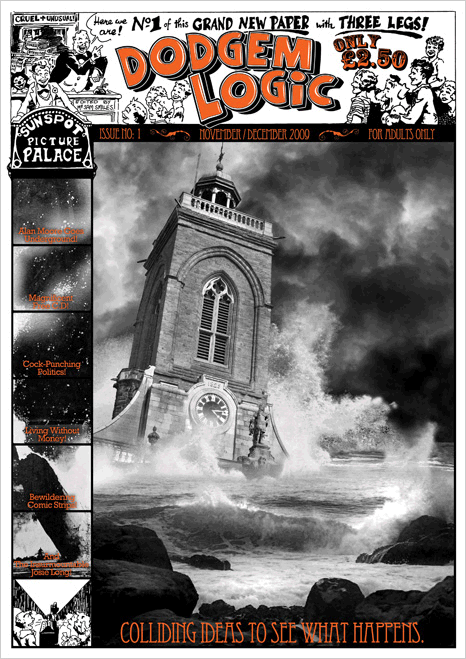
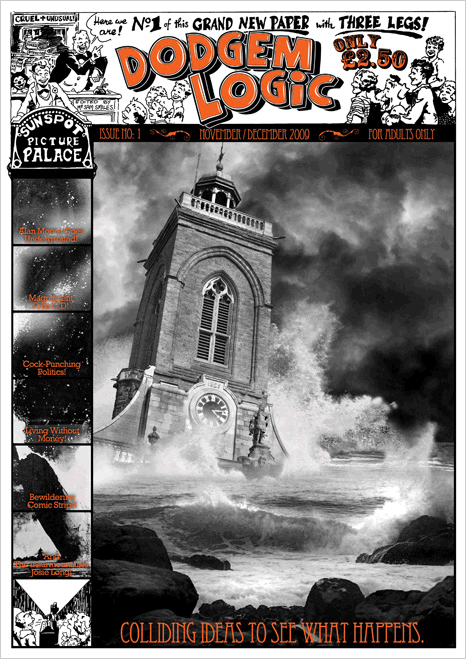
This is a post about Dodgem Logic #1. I would not consider this a critical piece, though. Why? It reads to me as more random thoughts mixed in with some personal sentiment. But, hey, if you want to take it as a critical piece, feel free. I won’t stop you.

So, I started to write this post as a “nice try, but Dodgem Logic, you failed” kind of blog post, but after you read this, it’s obvious that didn’t happen.

 I had my reasons noted, and I was typing, typing away. I felt I had my point, yet when it comes to writing about some certain thing, you tend to gain a perspective you did not have before. This happened to me. In the meat of my original take, my view on Dodgem Logic shifted. I went from seeing it as the interesting failure to now a pure, little passion project.

For sake of context, and to not totally waste the other post I wrote, here were my original thoughts on the magazine:

“For a magazine that is supposed to channel the likes of the underground’s finest, Dodgem Logic feels oddly mainstream. The writing it presents, though objectively fine all around, does not totally encompass the underground aesthetic. The magazine seems to get it half right with Moore’s piece and the music scene essay by Tim Lately. They both play to their strengths, and they both offer a focus specific to the magazine. The Twitter observations and “how-to” articles seem to bring all of that down, though. They read more like installments in a hipster’s version of Wired than they do an Alan Moore project.”

Right after the word “project,” I stopped and asked myself a question: what is underground? This question was not meant to be some universal, truth-seeking question for all of humanity. It was just a question for myself. In my eyes, what is underground?

I grew up a very sheltered, very conventional  young man. Mom and Dad, they raised me on football, dog walking, lawn mowers, classic rock and hard work. I didn’t attend a concert let alone take part in any “underground” activities. So, the question made me realize that I do not know what underground is, or at least traditional underground. I do not have the context; I have not been the audience of any underground mags, or art, or ideas. How can I claim Dodgem Logic as not being underground enough? I cannot.

The question then made me wonder what could be considered underground. To me, anyway.

Anything not recognized by the mainstream, I would suppose. Comics were the first thing in my mind. All comics. They do not sell high. It is tough to find a fellow reader, let alone one who reads the same books. They are somewhat looked down upon. Comic books fit the underground calling card, but…Is Batman really “underground”?  I love Batman, but the character is owned by Warner Brothers and featured in high grossing films. That doesn’t seem very “underground.”  I mean, comic books are certainly not synonymous with the mainstream of CNN, Kim Kardashian, and Bright Eyes, but comic books still have their own mainstream. Even though the books may sell less than one hundred thousand copies, most comic books still work under pretty mainstream conditions. The first two in my mind are editorial mandates and corporate interests.

Independent comics, though. Those still work, right? I think it depends. Most of what Image releases is technically indy, but only a few really carry that independent aesthetic.  That aesthetic is a sense of personal touch reflected in the work. James Stokoe’s Orc Stain and Brandom Graham’s King City capture that really well. Books like Chew or Walking Dead, while both good and enjoyable, seem to just tell a story, though, while the other two mentioned seem to tell a story plus more. Like Matt Fraction’s Casanova, Orc Stain and King City reflect their creators and share the ideas of their lives. This aesthetic quality plus the “do it yourself” mentality seemed pretty underground to me. Plus, books like Orc Stain, King City or any other number of PictureBox books are not very recognized in the comic book mainstream.

With the question answered, my idea of “underground” came to be:

1.)    Self produced, published, distributed, etc.

2.)    A reflection of personal beliefs, vibes, ideas, etc. of the person (persons) behind the work.

3.)    Most important, honest.

I came back to Dodgem Logic with this new found definition, and when I applied it, Dodgem Logic suddenly became an underground magazine.  There are columns that talk about Twitter or whether or not doctors are good for your health, but they are wrapped in an honest package. The idea of Dodgem Logic, as quoted from Mr. Moore, is, “old-school underground illegibility tooled up for a new century” (Issue 1, Pg. 7).  The magazine does that. There are articles about music you’ve never heard of and artwork featuring actions you would rather not describe, but there are also thoughts on feminism and the internet. The magazine makes it all work, though, because each bit is provided by someone relatively unknown, and it is honest stuff.

Dodgem Logic feels like a jam piece between Alan Moore and his friends. The notion that these guys are having fun producing this is quite evident while reading. The jokes and the topic spotlights both provide me with this feeling. The magazine is something they just want to do; they want Dodgem Logic to exist. In a weird way, Dodgem Logic felt like this war cry. It is a magazine that obviously states that underground is back, and it is back in a different way. It seems that Alan Moore wants this to represent something. For one, it is the underground aesthetic. I think by the very fact of this magazine existing it is clear Moore wants more content like this alive and available. It is also clear Dodgem Logic speaks for Alan Moore’s point of origin, Northampton, which I assume is somewhere in the UK.

It is no secret Moore likes to speak up for Northampton. Most interviews with the man bring at least a brief mention of the area. He has made it clear that it is a place troubled with poverty and misfortune, but I always get a sense that Moore is proud to represent Northampton. Why else mention it as much as he does? He wants to draw awareness, but he also wants to give the region cred. Dodgem Logic continues this idea. The magazine features the work of creative folk from the area, but it also just talks about Northampton. The music essay certainly does this, but the magazine also features a pullout section completely dedicated to Northampton. Most of the pullout is specifically for the Northampton audience, but even if you do not care about the local events, the section still brings about a sense that this magazine has a purpose.

As a reader abroad, you gain an idea of what Northampton is about. You are told and shown the conflict through various forms. You understand the problems Alan Moore and others understand. It comes off as a bit eye-opening, but then the local music reviews provide a balance, showing that Northampton also has things to be proud off. It has its own scene and its own culture. Coming from Alan Moore and a mix of other Northampton talent, Dodgem Logic just screams to me, “Hey, world. Here’s Northampton. He we are. Pretty or not, here we are!” I think that is awesome.

The whole “Northampton representative” thing goes to another level too when you consider its charitable mission. The profits of Dodgem Logic go right back to the community, creating this “you feed us, we’ll feed you” idea. Northampton seems to be the fuel for Dodgem Logic, and as Northampton is fed out to the world through print, the world returns the act by feeding, literally, Northampton. I find that to be a very cool symmetry, and it adds another layer to the work overall.  More importantly, though, it brings home the idea that Dodgem Logic has an actual purpose(s) as a work.

For one, the words written in it are honest, and the magazine conveys a collection of ideas that hold personal attachment to the men and women behind them.  Dodgem Logic is not just another magazine where people write in it because it is their job. Instead, it is a publication done for the sake of want. The people writing and designing Dodgem Logic want to. Second, the magazine stands to represent a place. A place close to Alan Moore and many others. A place stuck at the bottom. Dodgem Logic gives that place a voice and puts it out into the world. Third, Dodgem Logic gives back to what inspires it. The magazine actually affects the world in real ways. It does charitable work, and it brings about awareness. Shouldn’t more art do that?

I feel so. Last but not least, I cannot put Dodgem Logic down because, well, it is Alan Moore. I know that is probably a lame excuse, but Moore’s catalog of work has done so much for comics. Whether every work is a masterpiece or not (I couldn’t tell you, really. I have only read a few), Moore’s work has inspired and influenced so many. He has been labeled the greatest comics writer. The greatest. I have heard complaints that Dodgem Logic is a lame use of Moore’s time and talents. “Why doesn’t he focus more on comics?” is the usual remark. I cannot agree, though.  Like Frank Miller, Alan Moore has earned the right to just do what he wishes. The guy has proven time and again that he can do great work. More importanly, he is an artist and every artist has a right to do what they wish. If Alan Moore wants to do Dodgem Logic, a small magazine centered on Northampton and life style ideas, he is allowed to.  I know I will pay attention because whether it is objectively perfect or agreeable, it is an Alan Moore work. That alone makes it interesting and worth my time.

I just need some spare cash to buy another issue.

Leave a comment

Filed under Uncategorized