Category Archives: Uncategorized

Vile #1 by Tyler Landry


I’ve put off typing these notes for about a month. But what follows was captured as it happened, after the eye hit the page. I’m not trying to make this into a gimmick, I swear, but I am interested in keeping this informal.

Vile #1 by Tyler Landry features a science fiction story called “The Coward’s Hole”. It’s about an astronaut war pilot who crash lands on a strange plant during a space battle against some enemy guns. After he escapes the wreckage, he starts to have visions of other war pilots who’ve died on this planet, guys he knew, all of them skeletons, trying to convince our hero to accept the fate that no one is coming to save him. The story ends with this realization and pulls back to a grand level of cosmic horror.

Some background:

I like Tyler Landry’s other book called Old Caves. More thoughts on that below.

I bought this (and issue #2) at Copacetic Comics in Pittsburgh at the suggestion of the owner, Bill Boichel. I did this on a trip with my friend Jordan. We just stood up there in that small attic room for about two hours and looked over everything, sometimes twice. Jordan spent all his money.

So …

Notes // 2/22/2025 

  • I like Tyler Landry’s use of black in this comic. The way the art is printed, the use of black ink feels very definite. The entire printed page is on black paper with a toothy, grainy feel. Really gives the impression of being lost in space.

  • Feel like this story, called “The Coward’s Hole”, is an example of what Frank Santoro called “fusion comics,” or popular genre stories drawn by cartoonists with broader influences, artistic touch points and sensibilities. Interesting concept but super nerdy and a bit pretentious but also, I think, serving the point of exploring commercial art as a real source of influence or care.

  • The story feels like a play on EC Comics-era sci-fi/horror. Existential, the bomb hanging over your head (not necessarily seen). Lovecraft? I never read any Lovecraft, don’t know if I care to right now, but from reading or hearing others talk about him, this seems like a similar thematic focus?

  • Space pilot goes missing in combat, crash lands, meets the ghosts of his former military unit and realizes he is dead, or dying, too. The ship has come down. Twilight Zone reveal, twist end, dramatic horrifying fade away.

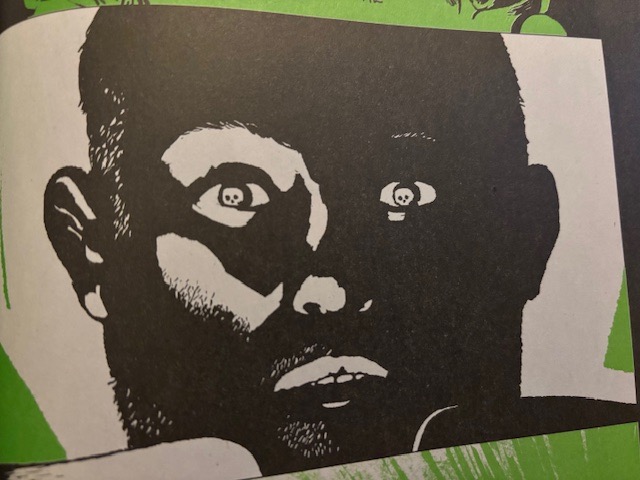
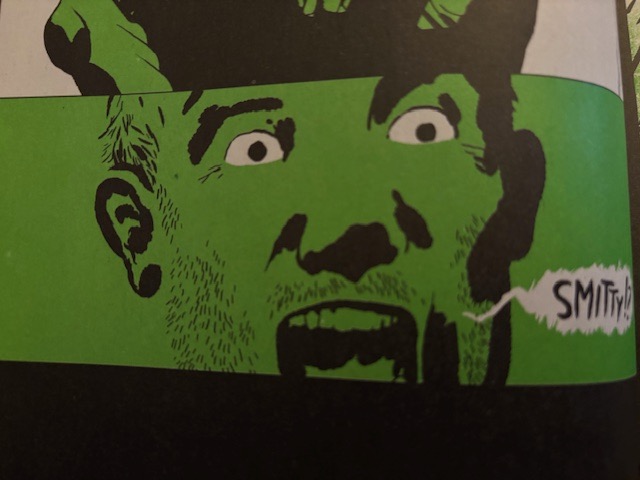
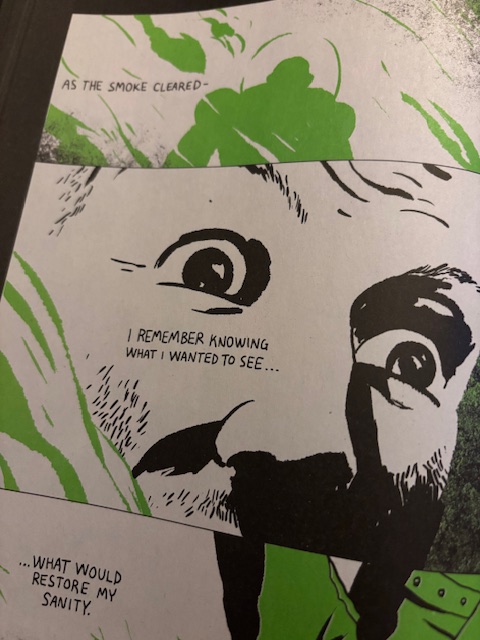
  • Tyler Landry is great at drawing faces, especially someone looking shocked.

  • Favorite lines: “Someone surely saw me in all that chaos?!”; “Are you worth the cost of a rescue mission?”; “I’m fucking indispensable!”; “I remember knowing what I wanted to see …”

  • It’s dramatic in a playful way. Its genre. Go with it, and this comic has a confident sense of atmosphere, silence, certain pace, an uneasy balance.

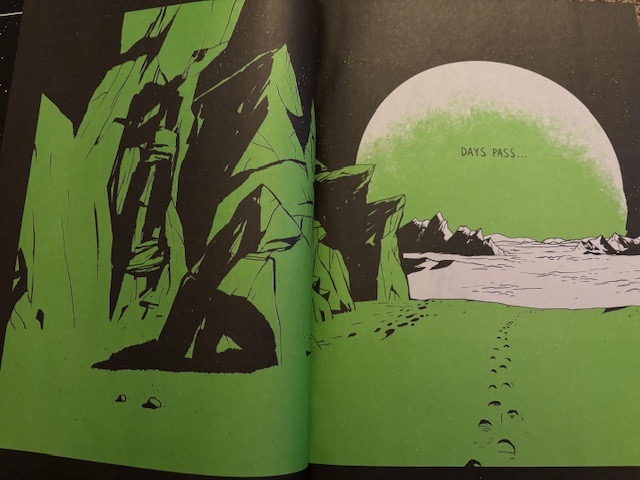
  • A lot of focus on faces, close-ups, contrasted with wide landscapes, two-page spreads. The individual planted in vast outer space.

  • I love the panel (below) showing the main character’s feet smashing through glass. The shapes Tyler Landry draws look like loose mass, have personality.

  • Vile #1 was published by Study Group Comics. They published similar work where genre was met with a high-quality of craft, less of a direct commercial interest motivating its production. They weren’t really breaking the mold, so to speak, blowing my mind with what they presented, but there was some good work there, for sure.

  • Not as good as Old Caves.

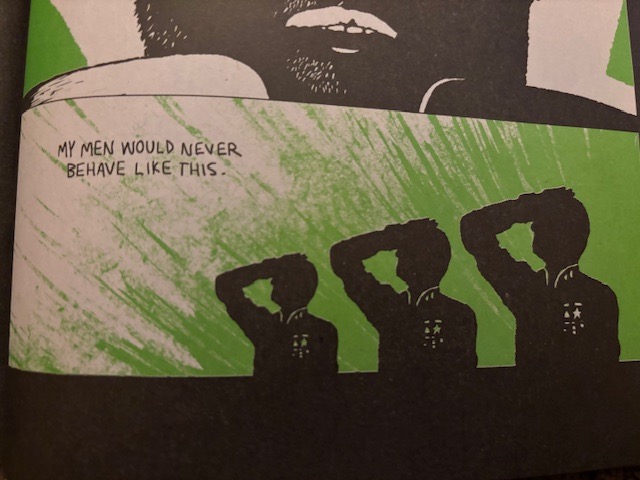
  • Though, there is a similar thematic thread between the two comics. Old Caves is more pointed in its focus, but Vile #1 suggests the main character, a commanding war hero certain of his value and of what he believes, comes to question everything he knows. This idea that we hold onto our assumptions as fact even though everything can go sideways. See the panel (below) where he says “my men” would never go against his word, and they do, and at large, so does the God he served.

  • People come into contact with the collapse of their identities and security, but when you finish reading it, you’re like, “That was nifty.” 

Leave a comment

Filed under Uncategorized

“A Monty” by Zak Sally

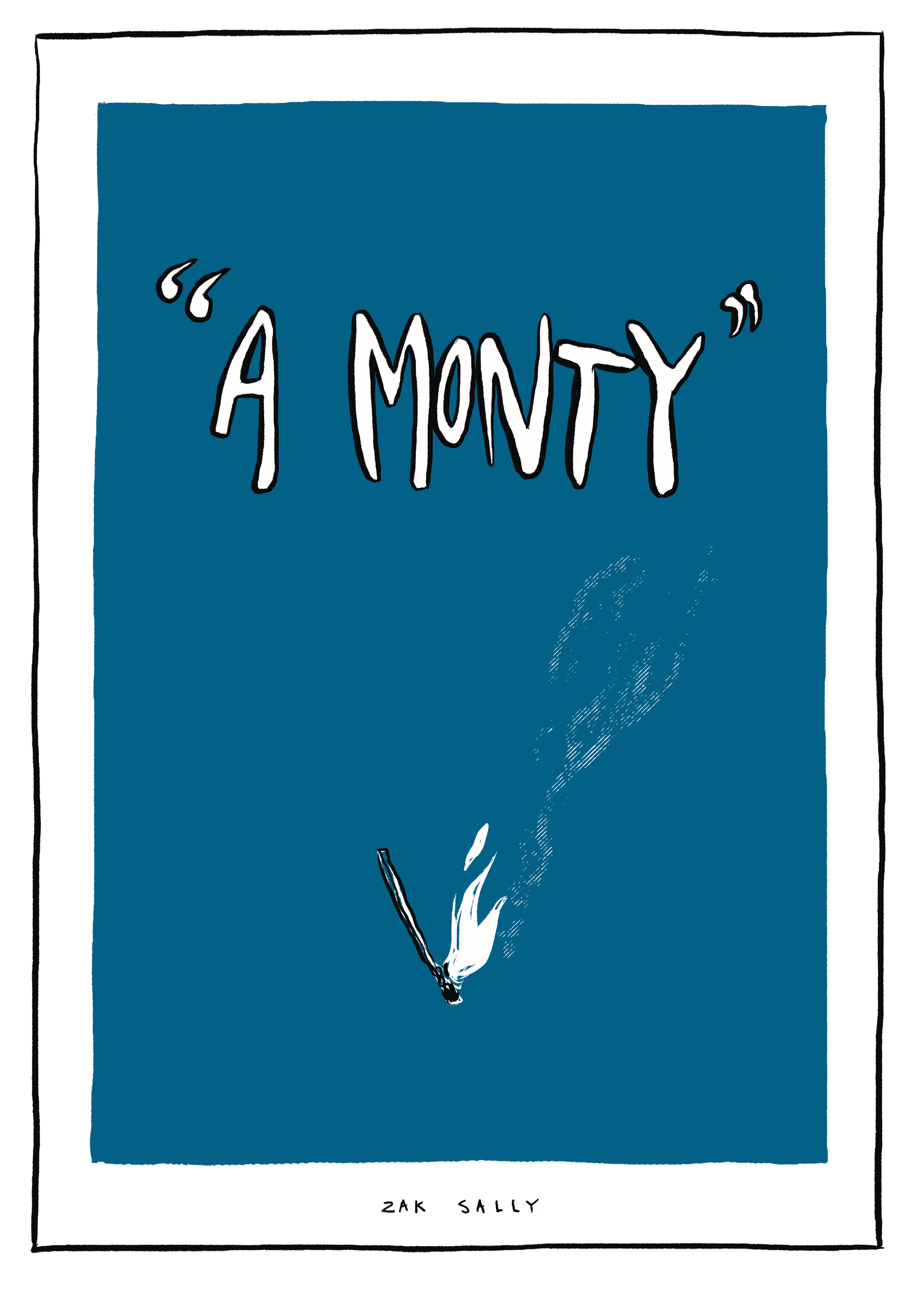
I woke up and read this one in bed. A 20-page, self-published comic book by Zak Sally called “A Monty”.

This comic gets pretty heavy, and maybe that’s not the best way to start your day, but I liked it a lot. I felt more connected after reading it, connected to an artist I’ve followed for a while, and connected to the feeling of knowing you’re not the only one upset by everyday cruelty.  

Zak Sally describes the thought behind “A Monty” in this blog post:

“I knew putting “The R word” in there with regularity was going to be a tough pill to swallow, and some valued friends brought it up. I certainly didn’t throw that word around without consideration and thought. It’s wasn’t fun or funny for me. And I absolutely did not intend to be insensitive on purpose.

So: without any qualifications, I think calling someone a “retard” is a shitty, cruel thing to do. Then and now. In fact, I think that’s what my whole strip is about.

It’s about a child (in this case, me) learning that for themselves.”

Instead of writing a full-on review, I think it’ll be more interesting to share my first impression notes written down in a notebook right after reading the comic. Not that they’re anything crazy spectacular, but I like the casualness of it. It’s also hard to over analyze when you’re reacting to an experience that just happened, and I feel like less formality lets the comic be what it is, versus good or bad. 

Anyway, here are my notes from reading it:

Notes // 2/20/2025 

  • Intersection of memory and current shakiness 
  • Last line, “Like children who don’t know better. Until they do.” 
  • Education and understanding of Monty, Zak Sally’s neighbor, versus going with word on the street, the gossip of the other kids, following the uninformed. Feels like an exercise of the punk attitude/approach to life, in that things aren’t taken at face value, and a decision is made to go another route. Zak Sally’s connection to punk music and its culture also makes me think of this.
  • Monty telling Zak Sally, “Leave me alone” and the match burning motif/sequence hits its peak and lights a trail of something, gasoline?
  • Exploring these memories from the present day Zak Sally’s POV supports the idea that we’re all continually uncovering ourselves. When young Zak Sally asks his Mom whether Monty, living with a disability, knows he’s disabled, she responds, “I don’t think so, no.” Just like Monty, who actually knows where they stand? Are you always okay?  

  • Older Zak Sally looking in the mirror throughout the comic, intercut between parts of the main story
  • Match burning motif/sequence connects to the line, “Or why we made the world our dumpster and then set it on fire.”
  • Shift from main memory of childhood to the narrator in the current day
  • Visually consistent with Zak Sally’s other work, two-color and use of blue
  • Backgrounds from the past, the Duluth, MN, neighborhood, are shown more faintly while the line art for the characters is bold and remembered well
  • Because of the introductory blog post, where I first learned about this new comic, I went into reading this knowing well enough what territory it would cover, and while this doesn’t match the what-the, I love this, where is it going qualities of Sammy the Mouse, “A Monty” was a good pause on how some people are treated and misunderstood. I will admit, it did, at first, feel like the expectations set by the story gave this comic a seriousness, but the actual energy of it, when I read the whole thing, the tone of Zak Sally’s writing feels genuine. The story and its telling have plenty of variation and nuance to make it feel lived. And I do feel its a further exploration of what he’s learned from and since being a “punk,” for lack of a better word.
  • I really thought it was compelling the narration/voice over was written in Zak Sally’s very direct, first person voice from the present day. I like his voice a lot. Consistent with his prose autobiography, Folrath, where he talks about forging bus passes and being miserable in Seattle.

Leave a comment

Filed under Uncategorized

Free associations: Black Cloak #1-6, etc.

I finished cleaning the garage, showered. Now, I’m drinking tea. Here’s the latest … Black Cloak #1-6 by Kelly Thompson and Meredith McClaren … I wanted to enjoy this one more than I did. The covers are all so sleek. The interior art by Meredith McClaren is vibrant, lush, and distinct. It looks like bright fruit sugar water caught and held inside round lines and shapes. It really catches your eye. But the story just isn’t there, for me. At least not in this series’ first arc. The decision to center this opening chapter around a murder mystery does well to bring the reader into this fantastical, sci-fi world up from the ground level, in its streets and hidden meeting spots. But the flow and the plot points of this detective story feel played out and predictable. Or I don’t know … It just reads as a means to an end, a way to get the story going. Another mix-up of genres. It doesn’t feel particularly inspired or energized. That said, the choice does lead to an interesting outcome with where this first arc ends up. The detectives solve their case, but the city crumbles because of the answer. This shake-up introduces a power struggle between various parties for the future of this fictional society. And this conflict is only made possible because multiple people made poor decisions and kept them secret. The series seems set up to explore the rationalizations the powerful employ to make their choices. That thematic concept does kind of save it for me. So, I might have to give it another arc. We’ll see … The Lonesome Shepherd by James Collier is worth checking out. The cartooning in this comic book is very lucid, very wandering. Light line work, a limited use of color, and plenty of blank, open space. I took the story as an allegory for pursuing the life you want, even if it appears as failure and leads to loneliness? Which totally feels like something a cartoonist would say … But I don’t know. I’m not entirely sure what James Collier intends to be the exact point of his comic, but the ending felt open to interpretation. You’re left to wonder whether this lonesome shepherd, our main character, is leading the life he craves or is actually only pretending to be. The comic does a good job, too, to subtly ridicule certain annoying personality traits of the self-righteous, those out there being a “wanderer,” getting to the truth. But it very quickly finds the cracks in these people for you to reach through and empathize with. If James Collier ever makes another comic, I’ll take a look! … Nightwing #105 by Tom Taylor and Bruno Redondo ain’t a bad time. Am I being overly positive? I don’t think so. This special first-person POV issue, where you, the reader, experience the story as the titular hero, Nightwing, feels fresh, even if this narrative trick has been pulled somewhere else before. If so, I haven’t seen it, but I haven’t read everything. In this instance, I feel like it lends to Tom Taylor’s ongoing attempts to explore the personal lives of these mainstay superhero characters. The use of first-person POV helps in this regard, at least to visualize a superhero plot from their vantage point. It literally puts us in their shoes … It’s refreshing. It hits familiar beats without sounding tired.

Leave a comment

Filed under Uncategorized

Free associations: Angloid, Keeping Two, etc.

Well, well, well. The latest comic books I’ve read … Angloid by Alex Graham. It’s $12. I really think you should go buy it. I read this one on a lazy Saturday, and it just reminded me that there are so many talented artists out there, and while I risk sounding corny, it feels good to step outside the norm and spend time with their work. Alex Graham, if you think about it, had to take a lot of steps and live a lot of life for this book to come together and make its way to little ol’ me, and here we are. Reading Angloid, I appreciated the presentation of the main character, someone who is characterized by their poor choices and actions, but who isn’t made out to be a monster. If anything, they’re very familiar, and for that, this story fits within a genre focused on slacker creative types getting fucked up and coming of age. Not a knock at it, at all. I love that type of thing. And for starters, Alex Graham shows a more unique approach to this story with interludes that feature tales of alien ghosts who watch over humanity, rooting for our success. Our guardian angels, they look on as we flounder. Angloid blends slice-of-life with a sense of cosmic place. … Keeping Two by Jordan Crane offers a relationship story fixated on loss, built by someone that applies the merits of the medium they work in. With differently formatted comic book panels, Jordan Crane shows various points of time and possible futures simultaneously, sequencing different events right up against each other. You experience the story more so as to how someone would perceive it in their mind, directly, as they went about their day and daydreamed, every so often hit with a memory. Time being far from linear. Keeping Two’s two-tone color aesthetic and Crane’s drawings keep the story energetic and approachable, though. The subject matter and the themes at play are heavy, but the comic book doesn’t suffer a loss of personality or softness or bounce. The drawings show exaggerated features, a whimsical sense of physics, and a distinctive, minimal use of lines that give the book its vibe. If anything, the final points the story pulls together can feel a bit cliche in their universal nature, but it doesn’t seem to make them any less true. And beyond that, it feels like Jordan Crane’s storytelling choices really enable the reader to take another look. … Old Dog #1-6 by Declan Shalvey hasn’t left me with much to say, but it’s not bad. I’ll check out the next arc when it’s released. This is a spy thriller about an old man agent and his younger daughter agent. They don’t get a long but they must team up to uncover secrets and kill bad people. It’s whatever as a premise, but I like that Declan Shalvey writes, draws, and colors this, it’s his book, exclusively, which isn’t very common for more mainstream comics. The quality of his drawings aren’t, either. The fights scenes are well articulated, and I really like his square-jawline artwork. He’s also not afraid to break a page down into a maximum amount of panels, which can really help with controlling pace and focusing the reader’s attention. Or he can use a splash page for good effect, to really make a moment. Declan Shalvey uses more creative page layouts and cuts between scenes to give a familiar genre story some heightened style. The colors are crisp and consistent throughout, too, but they offer a few bright hues that really catch the eye and give this comic a visual edge. Which is really the only reason to check it out. Anyway …

Leave a comment

Filed under Uncategorized

Free associations: I consume

Big box came yesterday. Straight from Fantagraphics, the great publisher of the Pacific Northwest. Lotta’ good looking books in there, including Ultrasound by Conor Stechschulte, The Complete Eightball by Daniel Clowes, and Metax by Antoine Cosse. This morning, another package. This one from Uncivilized Books, the Minneapolis gem, with their latest, including The Sickness by Jenna Cha and Lonnie Nadler, Maple Terrace by Noah Van Sciver, and West by John Grund. Why am I listing all of this out for you? I think it’s just for the sake of noting. But also, I’m excited. I have a BIG pile of books at my bedside. And it doesn’t account for the stack of monthly superhero comics and zines that I have purchased. I’m a sucker. There’s too much to check out. For this reason, art kind of feels like a commodity, like any other. It feels like I’m consuming instead of engaging with it. Maybe that’s on me … Yet, art is different from a commodity because it is entirely its own universe. It has principles that guide and direct it, and there’s room within for people to take and reinterpret what they see in highly personalized ways. It’s open and free and welcome. Or it can be, at least. In this way, art feels a bit like an economy where humanity is allowed, where emotion and perspective are valuable and given space. But, creative expression still has its ties to that cold hard dollar. It’s forced to. Everything is (in these conditions). And some art seems to persist just to spite these circumstances. The books I’ve already mentioned … Their publishers are, to me, projects with ambitious goals of expanding the thought potential and intellectual scope of comic books. They are businesses, yes. And they are out to make all the money. But the primary concerns motivating these enterprises seems more altruistic, meaningful. They’re about participating in an art form that’s much larger than any one entity or person and giving something back to it. The other side of the coin … BANG! SHIT! WHOO! BOOM! The superheroes. I love them. But they are a bottomless pit, engineered to suck up all your money and keep you caught inside a tight narrative groove. The same repetitive plots. You get it … A complicated subject, for sure. As you can tell by my years blogging, I’ve thought way too much about it. But ultimately, superhero comic books are products meant to support brands and turn profits for mega corporations. They are the responsibilities of departments within global media organizations, and they are positioned and marketed to make that cash. They can almost seem to be the antithesis of art, but this isn’t actually so. Are there rules that say art is inherently aligned with one ideology over another? One political system over another? Not that I know of. It’s a tool developed by humans, and humans can use it in a variety of ways. So, superheroes are art, just another kind … But anyway, the point is … I have a lot to read. A lot of comic books to read. That’s really all I’m trying to say. Did you see that pile? Do you think I have a problem? I don’t know. Yeah, it’s probably just rampant consumption feeding the devil, but I see it as enthusiasm, curiosity. A way to be entertained and connected. A portal into a shared imagination, a convoluted, continued human work-in-progress.

Leave a comment

Filed under Uncategorized

Free associations: Old Caves, Crisis Zone, etc.

Reading again. Here’s where I stand so far on what I’ve seen … Old Caves by Tyler Landry really fucking rules. Like, that book just rules. I don’t know how to explain it … It’s just a simple story done by someone with talent. His drawings and the heavy use of black make you feel the immensity and isolation of dead winter in the remote mountains, out there with the wolves. The pacing and presentation of the story allows for some pointed subtly, but the narrative also leans into big, dramatic moments. I don’t know, the ending really just hit me. The guy just walks off into the cave, and the perspective Landry shows it from is amazing. That, and I really appreciated the book’s focus on obsession and conspiracy and Bigfoot. While it seems to criticize a certain type of person, it does so with compassion, showing the obsessed’s side of the story. Anyway … go buy that book. It’s beautifully designed, too! … Crisis Zone by Simon Hanselmann also blew me away because it just keeps escalating, upping the ante, and it commits to the depravity of the pandemic clear until the end. I’ve never wanted to read Covid fiction, but this book breaks the rule. As a fan of the Megg & Mogg series, it further expands the scope of who these characters can be and how they can continue to change. As a standalone book and a comment on the global lockdown collectively experienced in 2020, Crisis Zone, to me, completely gets at and calls out the hypocrisy of that time and its lasting affects felt today. It does so with sharp humor and clear direction. No one operating with less talent than Hanselmann could have pulled this off. I’m very appreciative that this book exists because it made me laugh, and it helped me reassess some of what that time was like. I feel like every new Megg & Mogg comic pushes the possibilities of the series, and for that fact, I think Hanselmann is one of the best. … The Avengers #1-3 by Jed MacKay and C.F. Villa was way better than I would have initially thought to give it credit for. I’d previously read about 12 issues of MacKay’s Moon Knight series, and I found it to be uneventful, kind of boring. Which says a lot because Moon Knight is one of my favorite superhero characters. But the start of this new Avengers run is pretty fun. A lot of big moments, big characters. The cliffhanger and scene between Kang and Captain Marvel is attention getting. Captain Marvel as the team leader feels like a fresh approach. There seems to be a bigger story brewing in the background. I don’t know … I really liked what I read, and I’m hoping for a new memorable run on the series.

Leave a comment

Filed under Uncategorized

Really good water

One common thing about near-all Americans is that we’re all upset about something. Like, there’s something about this country and its culture, where it makes its citizens unhappy, and they wish to change or grieve. We each really dislike and want to improve some part of our world, some law that needs to be fixed or ecosystem that needs saving. We all want some fairness brought back to the American Dream. Or, maybe, we just want to recognize some truth of it, to maybe make sense of it for our own sake. Each of us screams about something that is holding us back, breaking down the system, or that’s underneath it all hidden in the shadows. In response to that, we really just want to say that this thing is wrong … it makes our lives here worse. We want to express ourselves. Even the people who believe in the craziest things … If you look past their visions and their flaws, you’ll see that we’re all just screaming about something from our digital rooftops, saying it’s that thing that’s wrong that we care about! We’re all rattled right now, and life in America hasn’t gotten easier. But what is the actual response to outcry? Nothing, really. If anything, arguments and roadblocks, pointless disagreement, and money. Maybe, someday, you’ll see or achieve some small victory, but what if it’s too little, too late? How does history regard that accomplishment? I wish those that were supposed to listen, the people that were put in charge to act, weren’t too busy to bother. Because Americans live with a sense of never being heard. And we’re all so frustrated by this experience. Because even though we all scream — from all these platforms and open stages, blown up on TV in the latest news cycle — nothing changes or is properly grieved. We just move right along, onto the next tragedy. We don’t take a lot of time to actually fix what’s wrong. We all just want a chance at something good, to do something good. But we make it so easy to fail.

I don’t want to sound all doom and gloom. I know that I can be, at times. But I’m not, really. I have some hope, and I honestly still think that America has a lot of promising potential. For instance, what could we be or do if we were all just more understanding with each other, and not as driven by our pain? What if we were nicer to one another and forwent most of our conflicts? I know, I know … I sound corny. This sounds like the promise of a hippie cult, but seriously, what if we were? Isn’t much of human struggle based on our difficulties with one another? For whatever reason, people don’t get along. And that’s fine. That’s our nature. But we’re also smart enough to work through most differences, and we can collaborate in basic ways that improve the quality of life for all. We don’t have to be best friends! I don’t even have to like you. But what about core decency and promise? Why can’t our country have that as a spiritual guide, propelling it forward? Couldn’t we just make it nice here for all? 

I do think it’s possible. We’re probably just going to need some time to do it. It’ll take generations to create a country of bounty and security, where you have a right to live the way you want, so long as you give yourself the chance to do so. You have to make that happen, ultimately. But America could greatly improve its support system and actually enable personal growth and success. It could revisit its priorities. It could do this with the long-term in mind. America could look out and plan for a better future, and through sustained effort, make true improvements to itself and to the world at large. Every human being, all across Earth, has some small ability to change our world. We all can make better choices and realize what matters. We can change our own perceptions and attitudes to feel more connected, and we can get over our own bullshit. We could make true, sustained, actual progress and see a better world as a reality. And if not on a global scale, it’s amazing what you can do for yourself. You can change your own world much, much easier than you can the real one. You can replay your movie-life and light certain scenes differently. You can recast a key character in the middle of the playback. But by changing your own world, is the real world then changed? 

For example, think about David Foster Wallace’s “this is water” graduation day speech that he gave to a college as the special guest star. I’ve never read any of his books, just never rushed to really do it, but I like that talk, a lot. Because he’s right. We determine what we’re experiencing, and we give ourselves a lot of grief. People are hard on other people and themselves, and we can clearly see how corrosive that is. I know David Foster Wallace didn’t invent or discover this conceptualization of life, the thought that “this is water,” but his communication of it isn’t wrong. So, why don’t we just change it? Why not make it say, “this is really good water.”? I can’t answer that question. Anyone that says they can is a fool or a conman. But, gratitude and appreciation, and a mind open to the possibilities, are required, and we struggle with those character qualities at the moment. Collectively, we feel ripped off. We’re not entirely wrong. The rich and the powerful have defrauded us. Have made it harder to establish something that lasts and is ours, is personal. This hurts and angers us in deep and literally brutal ways, emotional and physical. We work pretty hard in this country, yet most of that effort isn’t made for your own cause and direction, and a lot of it just makes certain people rich. Generations and generations have fought through this system. This fraud defines our lives and culture in real ways, and I believe the outcomes — the poverty, drug addictions, crime, lack of education, greed, ego, gluttony, hatred, ignorance, power-hungry, celebrity — stem from our struggle to keep going, to secure what we need to survive and enjoy our time on this Earth. But more than that, we struggle because we’re in unhealthy competition with one another. Our egos have run rampant. We keep searching for meaning or significance, but in that quest, we somehow bury each other. There can’t be a winner without a loser. 

So, to ask again: If we change our own world, do we change the shared one, as a result?  

I honestly think it’s possible. But it will be very, very difficult and take some time. I mean, what do I know? Nothing. I know nothing at all, as I’m a person. But I just believe that progress takes time, and you have to learn lessons from failures along the way. Because progress is a long game. And I’m glad we’re playing it. I just think we need more of a playful spirit, as we engage. Life doesn’t have to be bad or a chore. You can choose to see it through a different filter. Isn’t that how we see hope at all? We place the future through a filter of our own making and see the lives we’d like to lead. We hope, somewhere in us, that we can be that person someday. Just the best versions of ourselves. We hope to see that experience of growth through fully before it’s gone in death. 

I think we really need to be critical of wealthy, powerful people, very critical when necessary, without forgetting that they’re people. We cannot villanize them, not entirely, because to do so will only drive them further into greed. They will break apart from the rest of us, and they could really go sour. It should be expected that if and when criticism is rendered to someone, the one in the spotlight gets a chance to respond. We should give them a place to be open and work through something. Casting someone out doesn’t seem to help. It enables division and conflict. We just need a better way to work through our conflicts. And there is. It’s called being humble. It’s about being honest, understanding that we’re all flawed, and helping others get back up after they’ve fallen. We don’t do this enough. We’re still cavemen, to some extent. But cavemen evolve. We’ve had fire-on-a-stick and the smartphone for a while, now. Both of these developments have brought good and bad. But they’ve brought us forward, as well.   

I know preaching mindfulness and self-reflection, cognitive-behavioral therapy, and David Foster Wallace is not the solution to real problems. Real problems must be dealt with in the real world. But, unfortunately, the actors who could correct these challenges fail to. Instead, they use real struggle to write talking points for media appearances. And they ask us to vote for them. And we do. We give them real power and wealth. What a politician gets from their election compared to what their constituents get, the odds are completely different. Near every politician gets rich and believes their own bullshit, more and more. They get elected and they lose touch with us. So, I know mindfulness and changing your outlook on life seem like consolation prizes, like a way to just manage expectations and accept your lack of control, an excuse to let what happen, happen … But maybe if we all changed our thoughts we could see the error in our approach. We could see how much power we actually have. We’re the first living things (that we know of) with consciousness. Think about that, if that is true! But, maybe more likely, we’re actually far from the first. It is a big universe out there, after all. We don’t know where it goes and what it contains. But with all that said, I feel our story has just begun. I feel like mine has, at least. I mean, I turn 30 years old in less than a month, and though that’s wild to think, that I’ve been here 30 years, I still feel so new to all this, and I want to keep going. I think we all feel that in us, somewhere. This urge to keep going. So, let’s keep going. I hope we keep going. I hope we can look out at the world and America someday and be proud of the way we’ve shaped them to enable true growth of the lives that want to live. And I hope it’s tons of fun. Just simply beautiful. I can see it now.

Leave a comment

Filed under Uncategorized

Penny and The Wolf Man

Some dogs have a crush on the Wolf Man. 

This one dog I know, Penny — she definitely does. If you ask her, she’ll tell you the Wolf Man is something to see. 

Ever since she was a pup, Penny’s had his poster hung inside her kennel crate. 

She’d finish out the day napping, then spend the night looking at that classic black and white marquee image of the Wolf Man howling at the cloud-covered moon, and she’d sigh, thinking: 

He’s so dreamy.  

Like a hairy James Dean. Howling at everything and nothing, all at once. 

The other dogs never understood her preference. 

Their taste was more for AirBud or the show-dog cast of Best in Show. 

To them, these dogs exemplified excellence and ability. 

Their fur held well, like nice and shiny, like good boys — pedigree picturesque. 

To them, the Wolf Man wasn’t even a dog. He was a monster. A sad story.

But Penny saw something else. She saw another kind of life. 


That’s why when Penny grew up, she moved to Los Angeles. 

She became tired of the confines of her crate. She wanted action. And she found that she fit this new lifestyle just fine. 

Some nights, you found Penny at West Hollywood drag shows, draped in color streamers and neon glitter, barking Britney Spears lyrics in choir with her fellow lovers-of-life. Other times, she was poolside somewhere in the hills, quiet, diligently listening as someone offered to collaborate on something — like a TV pilot or an improv performance — right as she’d float to the next conversation with another someone, where the same thing was said again, yet, this time, the proposal was maybe more legitimate or possible or prestigious. 

This went on for about a year. 

Before Penny ran out of money. And she had to bartend. 

Now out of the social circuit, her dreams faded. Morale crumbled and caught a black eye.

The rail liquor looked more like fun to her than something to sell. She’d take anything to get away from the stale same-old, same-old of the working man. 

That is until the Wolf Man walked in one night. 

And let out a howl. 

Then laid eyes on her. 

And right then, Penny was back out of the crate.

Except for this time, she was carrying a souvenir. Some potent feelings from the past. That black and white buzz of something classic, just as it’s seen on TV. 

The Wolf Man was here and now, and he was a dream seen long ago. 

He walked up to the bar, let out a gruff, and said: “What’s down there in the well, you got?”

And before Penny could say, the Wolf Man reached in and brought back that brown Kentucky Sweet. Laid out a 20 for the bill. And he smiled his white, white fangs, still perfect after all the years. 


That’s when it got fun again. 

The Wolf Man loved her, and she loved the Wolf Man. The parties got better, too. 

No one could party better than the Wolf Man. 

Everybody wanted to celebrate with him. It didn’t matter that he never made another movie. 

The guy was an icon. And Penny was a reminder. 

The old boy still had it. 

He could walk into a room and rip his signature hooooooooooowwwwwwwlllll. 

And every single time, admiration would be waiting. 

From celebrities and civilians, alike. 

Because they only had to hear it once. 

Just the one time, real quick, and move on with their ambitions and doldrums. 

But not Penny. 

She heard it every time. 

Every single time, the same hat trick. The same schtick.  

Night in, night out.

And like anything, what was once exciting grew stale and tired and threatened to fall apart.

Because the Wolf Man was a narcissist. All he wanted was the spotlight. 

And he made sure to take it. 


The writing was on the wall. 

Except, Penny did see something. She saw an opportunity of another kind. 

She could howl, too. She could play the game.

And so she did. 

She started to howl with the Wolf Man. 

Upon entrance to any party they attended.

They gave the people what they wanted. 

And they became something to see. 


In a year, they were no longer a couple, but a tabloid meme. 

Penny was the Wolf Man’s creative director, and her own talent (with her own agent).

They’d been on Jimmy Fallon! Ripping big, beautiful howls. Telling Jimmy it’s great to be here. Making Jimmy laugh. 

The Wolf Man couldn’t have been happier. 

What a way to rebound one’s career. Back in action, at the top. 

But Penny … Penny saw this as just the start of something more big, more beautiful. 

She could build a howling empire. 

And never go back to the crate. 

So, she took her skills to TikTok, and learned to game algorithms. She figured out that 11-second howls performed better than 8-second ones. And A-B testing revealed a preference for deeper tones than harrowing ones. The depth of a howl implied confidence, you see. And the TikTok audience wanted self-esteem. 

The Wolf Man didn’t understand any of this. 

He just did what he did. He brought it up from his gut, through his lungs, and out into the world.

While Penny thought data could guide her self-expression. 

She could point and shoot it exactly to the heights it could go. Content became her king. 

More and more to feed the beast.   

While the Wolf Man took a backseat. Down at the end of the bar, howling on the social circuit, for all the new faces in town. 


Now, I don’t have to tell you how this story ends. 

It’s pretty obvious.

Penny became a billionaire. 

But more than that, she became a celebrity. 

And more than that, she achieved a dream. 

Sounds pretty nice, right?

It is. 

Today, Penny is happy and fulfilled. The world at large is hers to explore.

She never went back to the crate.

But what about the rest of us? 

Howling now saturates the culture. We hear it all the time! 

From a phenomenon to an identifier, to a war cry. 

It’s ours to live with.

Because of Penny. 

Staring at her crush caught on a poster. 

We’re a lot like the Wolf Man.

Howling at everything and nothing, all at once. 


You can listen to this story on the Appalachian Sound and Color podcast. Hosted by Logan Schmitt and Will Wallace, this podcast covers art and artists throughout Appalachia. You can hear the show on Spotify.

Leave a comment

Filed under Uncategorized

(Why Think About) Comic Books?

They’ve just always been there. Comic books. Ever since I was a kid I’ve found them very interesting. Because of the superheroes their pages showed me. And because they just stuck out. These crazy little drawings inside crazy little boxes — that you read

Nothing else was comic books. 

And in fact, they still get my mind going. 

I can read the worst one and still find something to say about it. Like, about how dumb the plot is. Because of how poorly it was written, and the artist that drew it … they couldn’t save it. Like, that’s a shame. Because it could have been something. And that sticks with you. 


But, you know, comic books are a business. And that’s where it goes wrong. 

But, isn’t that interesting, too? With all its stories about real people who created, wrote, and drew to make a middle-class living, on insane deadlines. Competing with each other. 

Making stuff up!

These creative-types evolved from a point of origin. A guy who did it first — A central, defining artist, who laid the ground rules and instigated copycats. And then they summoned new, working artists. People who grew up reading as fans. And then they took over the business, slowly. But first, they had to learn the ropes via the standards of their time. 

Or steal from the best, their tricks and stylistic flourishes. 

All for a paycheck. 

And to keep the comic book machine printing and the good money coming. 

Because, you know, comic books are a business. 

But it’s run by people, and some of them are great.


Some of them are really bad, too. But that’s not what I want to say right now. 

I want to show you something, instead. An example of what I like: 

Just take 10 seconds and look at that image. Whether you think it’s ugly, or goofy, or not worth your time. Just realize that’s a real drawing in the world, and someone spent a lot of time on it. 

They’ve spent a lot of time throughout their lives trying to draw that image that way

It required their sustained progress, month-to-month, year-to-year. There are people that do this and succeed. There are some people in comic books that want to do something with comic books. And you can see who they are. And I love that.

A man named Bill Sienkiewicz drew the image shown above. Its subject is Moon Knight, a Marvel Comics superhero. A Batman-like character with a religious turn and a thing for brutality. He’s a man with multiple personalities, a disorder, playing a hero. To somehow change his past. 

The image shown above is a two-page spread. 

It’s two separate pages that amount to a whole, grandiose image. A two-page spread is often employed as a storytelling tool to emphasize dramatic moments in the plot. 

This Moon Knight example, shown in Moon Knight #26 from 1982, serves as a final snare drum snap. It concludes the piece of music soundtracking the introduction of this comic book story, where Bill Sienkiewicz is the storyteller. 

I mean, he has help — and a co-author. It’s the writer Doug Moench, who created Moon Knight, thought him up, who actually wrote this specific comic book. And there are the art assistants who helped the main artist, who helped Bill Sienkiewicz, such as the colorist, Christie Scheele. 

Plus, there’s the person who letters the text. Joe Rosen. 

You can see their names in the little box at the bottom right-hand corner of the image shown. All of those people contribute something. 

But it’s Bill Sienkiewicz who ultimately tells the story. 

How? Look at it again:

The text captions, written by Doug Moench, are rhythmic. They connect the character, Moon Knight, to the liveliness of the world around him. “Cats in windows … Money itching to change hands.” The character is a part of this scene. Another element of the city. And Bill Sienkiewicz draws this sweeping, graceful presence connected to a cape, high above a night-time mess. “Always, always blood to be spilled” down below in those streets. And Moon Knight looks light as a feather.  

That visual characterization tells you who this guy is. He’s a lunatic at ease in the debris. Comfortable with extremes. Bill Sienkiewicz presents him with style and composition. From a perspective anchored at a point that extends beyond the character. It encompasses what the image is really about. The image is really about those two buildings set in the background … and their yellow-lit windows. The people inside, having dinner, watching TV, that look out and see what we see. They look at this image, too, of a costumed man gliding through the sky, and recognize something. They see the world is fucking crazy. 

Bill Sienkiewicz decided to act to show this part of the story in this way. This is his brain at work. It’s his conceptualization and guiding hand that portrays it. He is communicating to a reader. And the communication of this idea, visually — that the world is kind of wild, and beautiful, and what the fuck — when that image is complemented by thoughtfully written prose … It is an example of someone saying something through an art form often doubted. In a genre that’s super nerdy and corporate and Disney-fied. But doing it, nonetheless. 


I think about comic books because there is potential in them, and that potential can be realized.

There’s proof. 

Here’s another example (not superheroes): 

This is a complete story. 

It’s called The Lifted Brow, and it’s by Lala Albert. It was self-published online in 2019. 

Notice how it’s designed to be read as you scroll on your phone. 

Then, notice how it’s the only image shown per “page.” There are no panels. There are no small boxes, just like you would see in a classic example of the comic book. But, when you scroll and realize these images are sequenced to show something happening, to show that eyebrow going back, the mechanics behind the story really take over, subconsciously. 

Your brain is taking static images and connecting them in a sequence. It’s a much slower version of what your brain kind of does all the time. Comic books can just show us that process. 

And like Bill Sienkiewicz, Lala Albert made these choices. 

An artist is directing your experience of the story. They are employing storytelling tools to show and communicate the story in a specific way that also contributes to its meaning. 

Why does Lala Albert want to show us this moment this way

I believe the meaning of the story varies between its readers. 

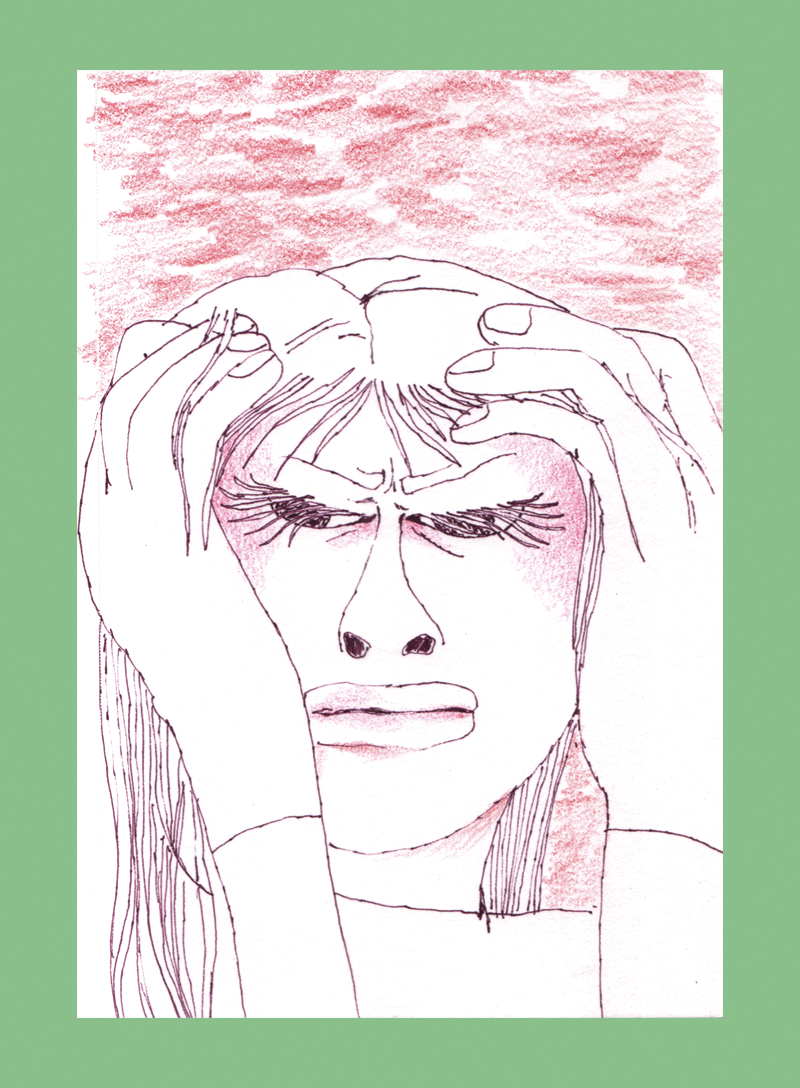
I can see a feminist concept in the story. Someone may connect to that — or understand it better — than someone who connects to or better understands the broader stress the character seems to be experiencing. Or maybe this entire comic is a reference to a similar piece of art, a way of talking on it? Maybe the story isn’t about anything other than showing the mechanisms of a story?

But just like Bill Sienkiewicz, Lala Albert drew this, and we can recognize something in it.

We can recognize that someone is saying something to us, and we can listen.

2 Comments

Filed under Uncategorized

Personal

All of this has been said before, bro. You know it.
I know you know it. But, 
I want to say it again:

I want to say it again because I’m sick of you, man.

I want my turn. 

But, what is there to really add? 

Except, a lot!

Except, I’m not exactly sure!

So, I still drive drunk, some nights. And that gives me power. 

That little league power.

But, Power! — from a broken law and a useless risk
Just to feel a bit wild and out there and no-turning-back. 

I’m looking out at the power plant smokestacks, tonight, 
while they send their legacy to the moon, 
and you know what, bro, 
it’s real pretty out here.

In this valley between the hills and Ohio, the graveyard to the world, the backbone of money spent and ignorant Jamboree. Down here in this valley of smokestacks. 

And I think about all those so many lips wrapped around me, 
doing favors, 
asking for their own. 

Promising me, it ain’t all bad.

And that’s where I am now

A place that ain’t all bad.

In the debris the moon rejects.


I hardly think about anything anymore except, “what to do.” 

I never know what to do. 

The therapist says, “do something.”

And I don’t! 

Except! 

I went to Florida. 

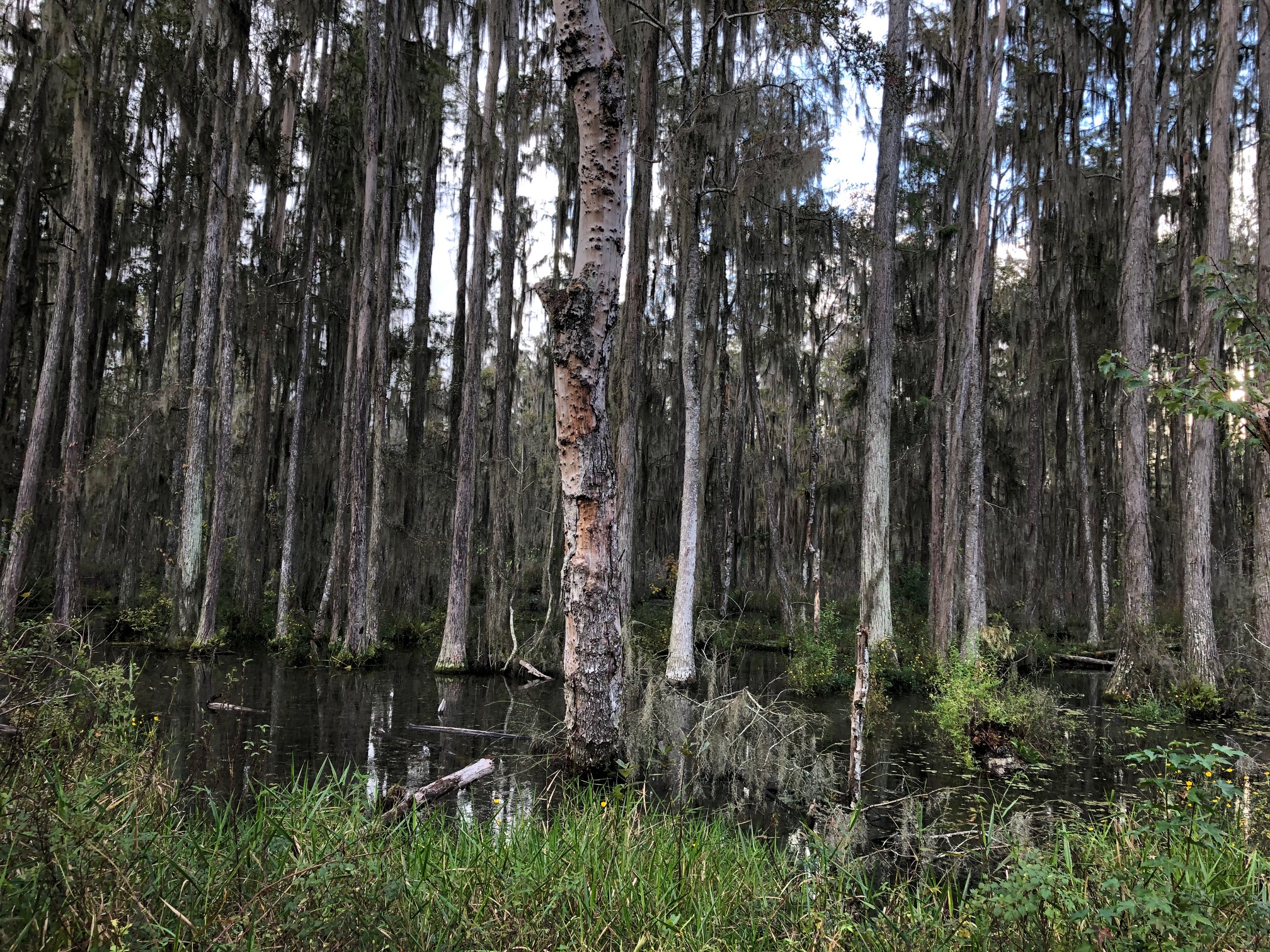
I went to Florida and fucked my girlfriend in the swamp, 
and a hidden security camera saw us. It did! 
And the owner of that camera still has the show, and 
I live in a reality, now, where our porn exists, and 
I cannot help but laugh. 
Because that’s my own, special mistake. 
And who puts a camera in a swamp?

But, when I sit here and type, it’s always disappointing.

I feel delusional. 

I read stories by people who really do things. 

Bro, you said my stories could be good
if I didn’t leave Florida.

I mean, Fucking Florida?

And I’m kinda fucked up over that, still. 

I mean, it’s kinda fucked up that you even said that. 

But, honestly, I’m glad you did. 

I’m glad the reality shows. I’m glad I see the holes. I’m glad I recognize the pain. 

So, I can now write good stories. And get old.  


I’ve listened to a lot of bands like Creed, or A Perfect Circle, or Puddle of Mudd because they remind me of who I am. Guns N’ Roses, too. 

Back then, I would walk to high school just to listen to music. 

Just to excuse myself away from all things. Then, focus on nothing but walking to school and losing it. 

I’d see what I’d want to see: I’d see these giant guitar riffs soundtracking fight scenes or battle sequences, with a Tsunami tracking overhead, and all those great achievements I could collect, one day, held high at a banquet in my honor. Haha. 

And it was exciting! This was my music. 

This was not my dad’s music — This was mine to explore and pirate and appreciate until the time came to grow into someone else. When I realized this music is adolescent. 

It is written to recognize certain emotions felt at a specific time in your life. At least, if you are of a particular demeanor: An angry young man, maybe a little ticked off with your dad. 

And that’s fine!

That happens to more than would care to admit it. 

But, how many can admit it and get past it? 

Not enough, man. I’m trying!  

My way of trying is by appreciating a band like Slipknot or System of a Down for what they are, and maybe a little of what they aren’t. It’s commercial art dressed as something more.

And, you know what, when you’re 15, 16 years old in a small, limited place, 
back in time, Rust Belt stranded, 
it is something more.  

Bands like that did show me a thing or two. 

And I think it’s OK to take what you can, or need to, from that. 

And if you do it right, if you follow then break the rules, 
that someone-else you can become …
They’ll hold onto bits and pieces of the past. For good luck. 

And I wish that was OK with people. 

I wish it was OK with people for there to be people in West Virginia. 

West Fucking Virginia. 

Loyal, actually kind, actually curious,
talents found in and out of streams, and 
dollar stores, and Mountain Dew Monster cans, and Dolly Sods, 
covered in all those bent pine trees. 

But, it ain’t seen as too good. It ain’t given much of a chance. 

They look at us like we’re the blight of this land. 

And that hurts. 

It hurts to know that in some ways, we deserve it. 

And we don’t. 


And yet. 

On the drive home from Florida, crossing this state line, I cried and cried. 

I really did! I missed it here! 

I knew I was home 
the moment my car’s frontend climbed into a tilt, to the curve of that big hill, 
and I ascended into heaven.

Leave a comment

Filed under Uncategorized